This checklist is for DIY woodworkers setting up or improving dust collection in a home workshop. It covers the main equipment choices and the supporting parts that help a system work with your tools.

Get business pricing on tools and workshop supplies
- Business-only prices and quantity discounts
- Tax-exempt purchasing
- Multiple users, one account, clear invoices
The sections follow the dust collection path: a workshop collector, a cyclone separator, a vacuum hose, compatible fittings and filter bags, then room air filtration. Some sections include a named pick; others offer selection advice.
Use each section to check tool compatibility, connection sizes, and how you work before choosing. Treat the product names as starting points, and confirm the specifications and included parts for your setup.
Workshop Dust Collector
A workshop dust collector is the central collection point for machines that produce wood chips and dust. Before choosing one, list the tools you expect to connect and consider where the collector will sit, how the ducting will reach each machine, and whether you can access the filter and collection bag for maintenance. A collector that does not match your tool connections or workshop layout can be awkward to use every day.
The listed pick is the JET DC-1100VX-CK Vortex Cone Dust Collector, 1-1/2 HP, 2-Micron Canist. Check the full product specifications for the exact model configuration, outlet dimensions, included collection components, and filter details; the provided name is abbreviated, so it does not establish every included feature. Common buying mistakes include assuming a port will fit without an adapter, overlooking hose routing, and choosing a location that makes emptying or filter access difficult. Measure tool ports and planned runs first, and verify that the collector’s connections and installation requirements suit them.
What to look for:
- Confirm the collector’s inlet and outlet dimensions against your tools and ducting.
- Check the full model name and included components before ordering.
- Measure the available footprint and allow access for filter and bag maintenance.
- Plan hose or duct routing from each machine to the collector.
- Review the manufacturer’s installation and electrical requirements.
JET DC-1100VX-CK Vortex Cone Dust Collector, 1-1/2 HP, 2-Micron Canister
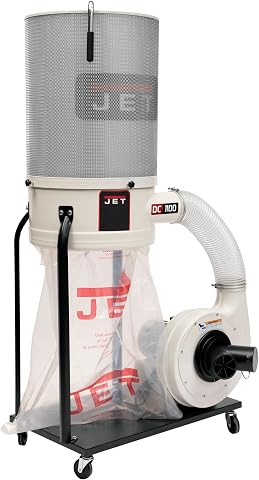
This indoor dust collector uses a Vortex Cone to separate wood chips before they reach the canister, helping maintain airflow and pack the collection bag efficiently. Its pleated 2-micron filter is cleaned by turning a handle, and it connects to woodworking machines through one 6-inch inlet or two 4-inch inlets.
Pros:
- Vortex Cone separates chips to help keep the filter clear and improve bag packing.
- Canister filter is cleaned with a handle without removing it.
- Connects to machines with one 6-inch inlet or two 4-inch inlets.
- Four swivel casters make it easier to move around a workshop.
Cons:
- Limited to indoor collection of wood dust and chips; not suitable for metal or liquids.
- Remote control is sold separately.
- Requires a 20A circuit when wired for 115V.
Best for: Woodworkers connecting compatible machines to a central collection point.
Not ideal for: Setups where the available space or connections do not fit the collector.
Bottom line: Confirm the exact configuration, connection sizes, and placement needs before building your system around this collector.
Cyclone Dust Separator
A cyclone separator sits between a dust-producing tool and a collection system, so its connection compatibility matters as much as where it will be placed. Check how the separator connects to the tool and collector, what container or accessories are part of the configuration, and whether the assembly fits your workspace. Think through emptying access as well: a separator that is difficult to reach can turn routine cleanup into a chore.
The named pick is the Festool CT CYCLONE Dust Separator CT-VA-20. Confirm the exact model’s compatible vacuum or extractor connections, required components, and any limitations in the manufacturer’s documentation before combining it with other equipment. A common mistake is assuming that a separator will work with any shop vacuum or hose because the connectors appear similar. Measure the connection points and verify adapters where needed. Also check the height and footprint of the assembled setup, including the space needed to remove and empty its container. Match the separator to the tools and extraction equipment you actually use rather than relying on the product category alone.
What to look for:
- Verify compatible extractor and tool connections in the product documentation.
- Check which containers, hoses, and adapters are included or required.
- Measure assembled height and footprint, including room to empty it.
- Confirm that the separator fits your intended vacuum or extraction setup.
- Plan access for routine inspection and emptying.
Festool CT CYCLONE Dust Separator CT-VA-20
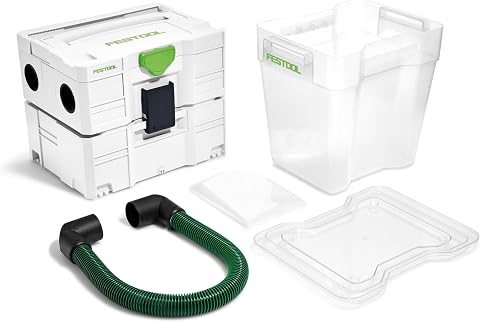
The Festool CT CYCLONE Dust Separator reduces filter bag replacements by removing larger dust and debris efficiently. Its compact, flat cyclone design allows easy storage and portability, compatible with Festool Systainer systems.
Pros:
- Reduces filter bag replacements, saving time and money
- Compact and portable design for easy transport
- Compatible with multiple Festool dust extractors
Cons:
- Requires a HEPA-certified dust extractor for OSHA compliance
- Designed primarily for use with Festool systems
- May be less effective with very fine dust without proper filtration
Best for: Owners whose extraction equipment is confirmed compatible with the CT-VA-20.
Not ideal for: Workshops that need universal connections without checking adapters.
Bottom line: Verify the full connection path and included components before pairing this separator with your equipment.
Shop Vacuum Hose
A vacuum hose links a tool to its collection source, and its fit at both ends determines whether it can serve the intended job. Check the tool port, vacuum connection, hose length, and routing around your bench or work area. A hose that is too short can restrict tool placement, while a connection mismatch may require an adapter. Consider whether you need a hose for a specific vacuum or a more flexible connection for several tools.
The supplied pick is Shop-Vac Cordless Wet Dry Vacuum Mop with 15000Pa Suction and Self-Cle. This product name describes a vacuum mop rather than identifying a standalone shop-vac hose, and it is abbreviated. Do not assume it includes a hose or that it connects to woodworking tools. Review the complete product listing and manufacturer information to confirm the included accessories, port dimensions, intended use, and compatibility before treating it as a dust-collection hose solution. For a hose purchase, look for a listing that clearly states hose length, end fittings, and compatible equipment. Measure your tool ports and vacuum inlet, then match those measurements to the documented connections or specified adapters.
What to look for:
- Confirm whether the listed product includes a hose at all.
- Check the complete model name and included accessories.
- Match both hose ends to the tool port and vacuum inlet.
- Compare stated hose length with the distance and routing in your workspace.
- Verify woodworking tool compatibility and adapter requirements.
Shop-Vac Cordless Wet Dry Vacuum Mop with 15000Pa Suction and Self-Cleaning

This cordless wet-dry vacuum mop combines powerful 15000Pa suction with mopping capabilities to clean dry debris and liquid spills in a single pass. It features a lightweight 7.5 lb design with 160° lay-flat flexibility, smart voice prompts, and an automatic self-cleaning function for the roller brush.
Pros:
- Combines vacuuming and mopping in one pass with separate clean and dirty water tanks
- Lightweight 7.5 lb design with 160° lay-flat capability for cleaning under furniture
- Self-cleaning function reduces manual maintenance of the roller brush
- Smart voice prompts and LED display provide real-time status and maintenance reminders
Cons:
- Requires use of non-foaming cleaning agents to protect internal components
- Noise level of 75 dB may be disruptive in quiet environments
- Limited to indoor use only
Best for: Shoppers who can verify the product includes a compatible hose solution.
Not ideal for: Anyone needing a confirmed standalone woodworking vacuum hose from the name alone.
Bottom line: The supplied name identifies a vacuum mop, so confirm its contents and tool compatibility before selecting it for dust collection.
Dust Collection Fittings
Fittings connect tools, hoses, branches, and the collector, making them essential to a well-matched system. Start by measuring each tool port and hose end instead of relying on a nominal size or appearance. Note which connections need a reducer, adapter, Y-fitting, elbow, or straight coupler, then sketch how the parts will route through the shop. This simple inventory helps prevent buying fittings that do not mate with your equipment.
A frequent mistake is mixing connection standards or assuming a fitting is universal. Check the actual dimensions and the shape of each connection, and confirm that any proposed adapter is specified for the components you own. Account for bends and branch locations when measuring, since a fitting that technically connects may still create an awkward route or interfere with machine access. Keep the layout straightforward and confirm every transition from tool to collection source before ordering. No product is specified for this section, so use the measurements and manufacturer compatibility information for your own tools and ducting to build a fitting list.
What to look for:
- Measure tool ports, hose ends, and collector connections directly.
- Identify each reducer, adapter, elbow, coupler, or branch needed.
- Confirm connection standards and documented compatibility.
- Map the route and check clearances around machines and walkways.
- Order fittings based on a complete connection inventory.
Replacement Filter Bags
Replacement bags and filters need to match the specific collector model and its configuration. Before shopping, find the exact product model and identify whether the part you need is a collection bag, a filter bag, or another component. These terms can refer to different parts of a system, so verify the part description and fit rather than choosing by broad category. Keep the model information available when comparing options.
A common mistake is treating bags as interchangeable because they appear to have similar dimensions. Check the manufacturer’s part information for the correct model, attachment method, and any stated filtration specifications. Also confirm whether your collector uses a disposable bag, a reusable bag, a canister, or a combination; the product name alone may not answer that. Inspect the collector’s documentation and existing part markings before ordering, and compare the replacement’s dimensions and connection details where provided. No specific replacement product is named here, so use your collector’s documentation to identify the right item and confirm it fits your exact setup.
What to look for:
- Record the collector’s exact model and configuration.
- Distinguish a collection bag from a filter or canister component.
- Confirm the replacement part number and fit with manufacturer information.
- Check attachment method and stated filtration details.
- Compare the part with markings and dimensions on the existing component.
Air Filtration Unit
An air filtration unit addresses airborne dust in the workshop, complementing collection at the tool. Consider room coverage and placement before selecting a unit: note the room layout, where dust-producing work happens, and where the unit can be installed or positioned without obstructing your workflow. Check the manufacturer’s stated specifications and mounting requirements against your space rather than assuming a unit will suit every shop.
The listed pick is the JET IAFS-2400 Industrial Air Filtration System, 2097 CFM, 3/4 HP. Confirm the full product specifications, installation options, operating requirements, and filter details for the exact model. A common mistake is treating an air filtration unit as a substitute for connecting tools to a dust collector; consider how it fits alongside collection at the source. Check clearance, access for filter maintenance, and whether the unit can be placed where its airflow suits your workshop layout. Use the manufacturer’s coverage guidance, if provided, to assess the room rather than relying on the model name alone.
What to look for:
- Compare manufacturer coverage guidance with your workshop layout.
- Confirm mounting or placement options and required clearances.
- Review filter details and maintenance access for the exact model.
- Check electrical and installation requirements.
- Plan the unit as part of a broader dust collection setup.
JET IAFS-2400 Industrial Air Filtration System, 2097 CFM, 3/4 HP

This workshop air filtration system uses a washable MERV 8 outer filter and a MERV 12 inner filter to capture dust, smoke, oil mist, and other particles. It has a remote control with three airflow speeds and a 1–9 hour timer, plus an optional slot for a charcoal filter to help reduce odors.
Pros:
- Washable outer filter paired with a MERV 12 inner filter
- Remote control includes a timer with automatic shutoff
- Three airflow speed modes
- Optional charcoal filter slot can help reduce odors
Cons:
- Optional charcoal filter is not included
- Weighs 120 pounds
Best for: Woodworkers looking to add a dedicated air filtration unit to a workshop.
Not ideal for: Shops without a suitable placement or installation option.
Bottom line: Check the manufacturer’s coverage, filter, and installation details to see whether this unit fits your workshop.
Work through the checklist one connection at a time, using manufacturer specifications to resolve fit and installation questions. A measured, compatible setup is easier to assemble and maintain; start with the parts your workflow needs most, then expand as your workshop changes.
Black Friday Picks

KitchenAid Classic Series 4.5-Quart Tilt-Head Stand Mixer, Onyx Black
As an affiliate, we earn on qualifying purchases.