![There Will Come Soft Rains (1950) [Pdf]](https://worldfinecrafts.com/wp-content/uploads/2026/08/there-will-come-soft-rains-1950-pdf-featured-200x110.jpg)
When you overwork clay, you weaken its internal structure by disrupting particle alignment, making it more fragile and prone to breakage. Handling it too much also causes surface imperfections like fingerprints or tool marks, while excessive tension or moisture loss can lead to cracks during drying or firing. By pushing the clay beyond its limits, you compromise its durability and smoothness. Keep exploring to discover how proper techniques can help you achieve better results.

Get business pricing on tools and workshop supplies
- Business-only prices and quantity discounts
- Tax-exempt purchasing
- Multiple users, one account, clear invoices
Key Takeaways
- Overworking distorts internal particle alignment, weakening the clay’s structural integrity.
- Excessive handling causes surface marks and imperfections, compromising the final appearance.
- Continuous manipulation increases internal stress, leading to warping or cracking during drying or firing.
- Over-tension from tight grip can create stress points, resulting in surface flaws or breakage.
- Repeated work disrupts moisture balance, causing uneven drying and surface inconsistencies.
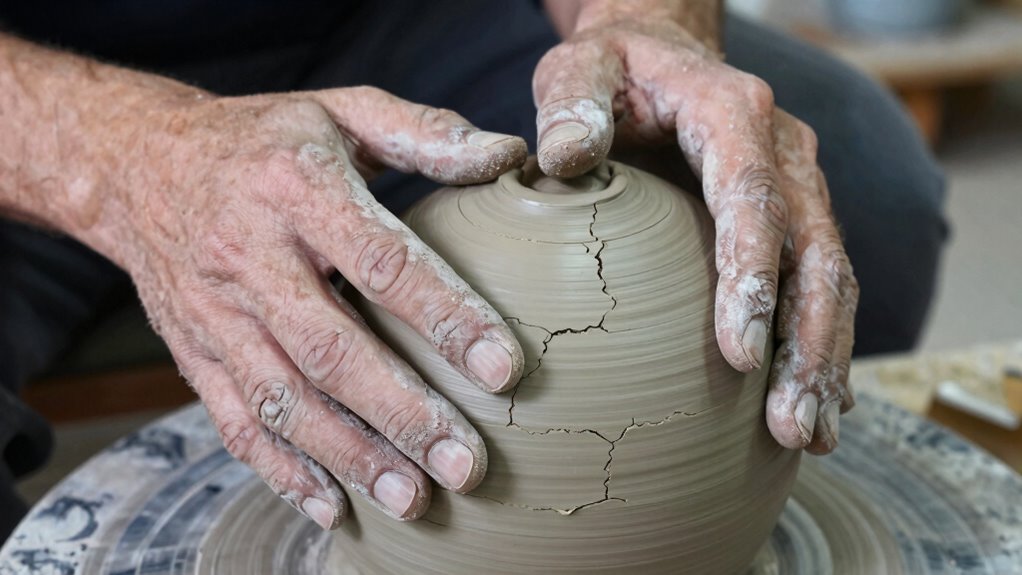
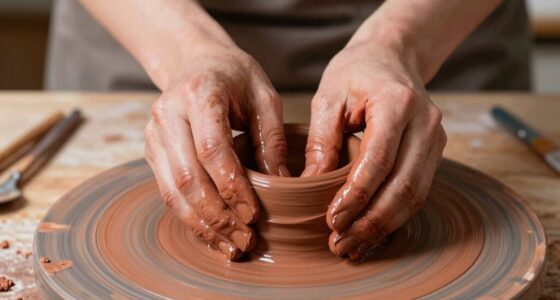
Overworking clay can markedly alter the final outcome of your project, often in ways you might not expect. When you repeatedly manipulate the clay, you risk affecting its texture, strength, and appearance. One key factor is hand tension. If you apply too much pressure or grip the clay too tightly, you can unintentionally distort your design or create uneven surfaces. Excessive hand tension can also make the clay more prone to cracking as it dries, especially if it’s been overworked during shaping or smoothing. To prevent this, you should aim for a relaxed, steady hold, allowing the clay to move smoothly beneath your fingers without forcing it. This helps maintain the integrity of your form and minimizes stress points that could lead to cracks or warping later.
Avoid overworking clay by maintaining a relaxed grip to prevent cracks and preserve your design’s integrity.
Moisture control is another critical aspect when overworking clay. Clay contains water, which acts as a binder and lubricant, enabling easier shaping. When you over-manipulate your piece, especially during long working sessions, the moisture can evaporate unevenly or excessively. This results in dry patches that weaken the structure, making it more susceptible to cracking or breaking. Conversely, overworking can also cause the clay to become too soft or sticky if you add water in an attempt to smooth or reshape it repeatedly. Such inconsistent moisture levels compromise the clay’s cohesion and can distort your final form. To avoid this, keep a spray bottle nearby to mist the surface gently if it begins to dry out, and be cautious about adding water gradually rather than all at once. Maintaining a steady moisture balance ensures your clay remains workable without becoming overly soft or dry.
When you keep overworking your clay, you also risk breaking down its internal structure. The more you manipulate it, the more you disturb the natural alignment of its particles. This can lead to a weaker, more fragile piece that’s prone to breakage during firing or handling. Additionally, overworking often results in a surface that looks glazed with fingerprints or tool marks, which can be difficult to smooth out later. Understanding the material properties and working within their limits can help you avoid these issues. To avoid these pitfalls, pace yourself during the sculpting process. Take breaks to assess your work and allow the clay to rest, giving the moisture a chance to distribute evenly and preventing you from applying excessive hand tension. This mindful approach helps preserve the clay’s natural strength and surface quality, leading to a more polished and durable final piece. Proper timing during working sessions also allows the clay to recover from over-manipulation, ensuring better results.
Being aware of how moisture levels fluctuate during working sessions can significantly impact the quality of your finished piece. In essence, understanding the importance of hand tension and moisture control during your work process helps you avoid the common pitfalls of overworking clay. Maintaining consistent moisture and working gently will improve your chances of creating a beautifully finished piece that stands the test of time.
As an affiliate, we earn on qualifying purchases.
Frequently Asked Questions
How Can I Tell if I’ve Overworked My Clay?
You can tell if you’ve overworked your clay when its texture becomes overly soft, sticky, or crumbly, making it difficult to shape. Using certain working techniques, like kneading or blending, can cause this. If your clay starts to lose its firmness or becomes too elastic, it’s a sign you’ve pushed it too far. Pay attention to these cues, and stop working before it reaches a point where it can’t hold its form.
Does Overworking Clay Affect Its Drying Time?
Yes, overworking clay can affect its drying time. When you overwork it, you reduce its elasticity, making it more prone to cracking. Additionally, excessive handling causes moisture loss, which speeds up drying unevenly. This uneven moisture distribution can lead to cracks or warping. To avoid this, work the clay just enough to achieve the desired consistency, preserving its elasticity and moisture balance for a smoother, more even drying process.
Can Overworking Clay Cause Cracking During Firing?
Yes, overworking clay can cause cracking during firing. When you overwork the clay, its texture becomes more inconsistent, creating weak spots that are prone to cracking. As you increase the firing temperature, these weak spots expand unevenly, leading to cracks. To avoid this, knead the clay gently and evenly, ensuring a smooth texture before firing. Proper handling helps maintain structural integrity and prevents cracking during the firing process.
Are There Specific Types of Clay More Prone to Overworking Issues?
Think of clay as a delicate dance partner—some are more graceful, others more stubborn. Certain clay types, like earthenware or low-fire clays, have specific properties that make them more prone to overworking issues, such as cracking or becoming too stiff. Their workability issues stem from how their unique composition reacts under pressure. So, knowing your clay’s properties helps you avoid overworking and keeps your sculpture in harmony.
How Can I Fix Overworked Clay Before Firing?
To fix overworked clay before firing, first knead it gently to restore some flexibility, improving its texture. If it’s too stiff or cracked, add a small amount of water and blend thoroughly. Be cautious of firing safety; overworked clay may have weakened spots, so inspect carefully. If necessary, re-wedge the clay to guarantee even consistency, helping prevent issues during firing and ensuring your final piece maintains its integrity.
As an affiliate, we earn on qualifying purchases.
Conclusion
Overworking clay is like stirring a pot too much—you risk breaking down its structure and losing the desired shape. If you push it too far, you’ll notice cracks, warping, or a fragile finish that doesn’t hold. To get the best results, work with patience and stop before it becomes too soft or brittle. Remember, gentle handling keeps your creation strong and beautiful, much like a delicate flower that needs just the right touch to thrive.
As an affiliate, we earn on qualifying purchases.
As an affiliate, we earn on qualifying purchases.
Halloween Picks
halloween
As an affiliate, we earn on qualifying purchases.