TL;DR

Get business pricing on tools and workshop supplies
- Business-only prices and quantity discounts
- Tax-exempt purchasing
- Multiple users, one account, clear invoices
The best hydraulic press for jewelry making depends on your dies, metal, workspace, and the force your specific setup can safely handle. A 3-ton jewelry press may suit small work, while 6-ton and 12-ton shop presses offer different capacity and footprint tradeoffs; verify their working openings, throat depth, platen size, accessories, and support before buying.
A bigger tonnage number can look reassuring on a product page, but it won’t tell you whether your favorite die fits between the platens. For jewelry work, the press is only one part of the setup: working opening, frame rigidity, tooling, and controlled pressure all shape what you can make safely and consistently.
If you’re replacing a large 20-ton shop press or buying your first machine, this guide helps you match a press to your actual projects. You’ll see how a compact 3-ton option compares with 6-ton and 12-ton shop presses, what the listed dimensions do and don’t tell you, and which questions to check with the seller before you commit.
There isn’t one universal winner. A small silver texture plate and a broad forming die ask different things of a press, much like a jeweler’s saw and a rolling mill serve different jobs. Choose for the work you do most often, then verify that every part of the setup can handle it.
Choose a press by matching its opening, throat depth, platens, and tooling to your largest planned jewelry setup.
Treat tonnage as the machine’s rating, not the safe capacity of every die, platen, or support in the setup.
The listed alternatives lack several decision-making specs; verify usable opening, throat depth, platen size, accessories, warranty, and current product detail…
A 5-ton heat press listing aimed at PU and textiles needs explicit confirmation before you treat it as suitable for jewelry metal forming.
Start with suitable scrap, align tooling carefully, apply pressure gradually, and follow the press and die makers’ safety instructions.
Start with the jewelry you want to make
The best hydraulic press for jewelry making is the model whose opening, frame, and compatible tooling suit your most common task. A press can emboss texture, form shallow shapes with a die, or help you make repeatable components, but the die and workpiece determine what the machine can accomplish.
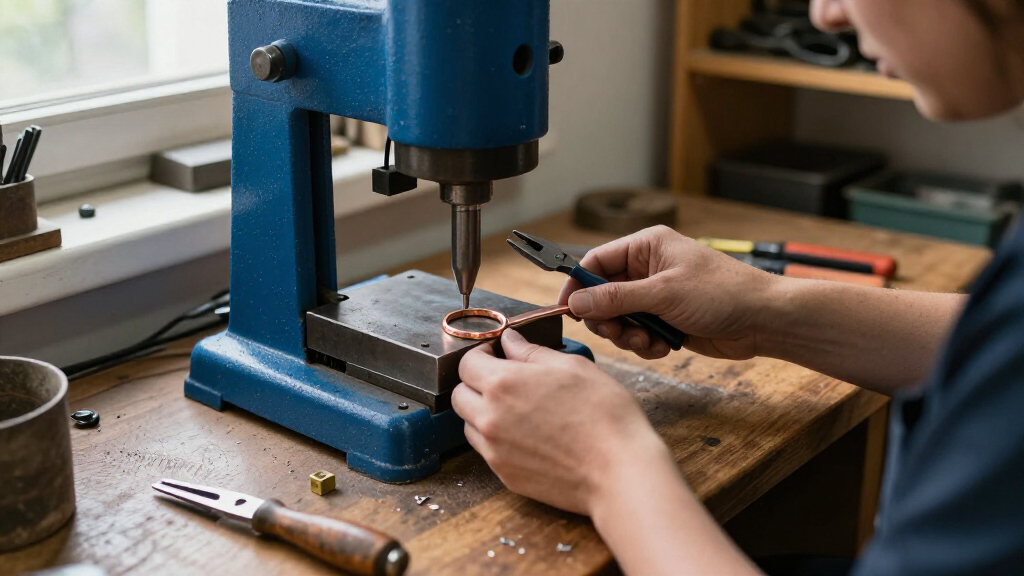
Imagine you want to press a fern pattern into a small copper pendant blank. You need a stable press, a texture plate designed for that process, and enough room to position the blank and any backing material. Extra tonnage won’t sharpen a soft pattern or correct a plate that sits crooked.
Now compare that job with forming a shallow bowl from a larger sheet. The sheet may need more room to sit flat, and the forming die may be much taller than the texture setup. A compact press can be convenient for the pendant yet too cramped for the bowl. Plan around the biggest die and workpiece you actually expect to use, not just the smallest project on your bench.
A hydraulic press also doesn’t do every forming job. A rolling mill reduces or textures metal between rollers; a press applies force through dies or an appropriate forming setup. If your work calls for repeated incremental shaping by hand, a press may be a poor fit. It works well when a planned setup can shape the material in a controlled way.
Before shopping, write down two or three real projects: metal type and thickness, approximate blank size, die dimensions, and desired result. That simple list turns vague claims like “heavy duty” into concrete questions about fit, load, and repeatability.
As an affiliate, we earn on qualifying purchases.
Compare four press options without guessing at the specs
When you compare the best hydraulic press for jewelry making, start with the stated capacity, then check the dimensions that tell you whether your tooling and work can fit. The available product information lists four alternatives, but it does not provide verified opening, throat depth, platen size, included accessories, warranty, or current availability for each one.
| Option | Listed capacity | Listed dimensions | What to verify |
|---|---|---|---|
| 3 Ton Hydraulic Press for Jewelry and Metalworking | 3 tons | 14 × 7 × 11 in | Opening, throat depth, platen size, included jewelry tooling, mounting |
| TUFFIOM 6-Ton Hydraulic Shop Press | 6 tons | 18.9 × 15.75 × 36.8 in | Working opening, throat depth, plate alignment, bench or stand requirements |
| 5 Ton Hydraulic Heat Press Machine | Not specified in the provided listing details | 11.81 × 5.31 × 19.29 in | Whether it is designed for jewelry dies and metal forming; stated capacity and plate limits |
| Performance Tool W41062 commercial shop press | 12 tons | Not specified | Footprint, opening, throat depth, platens, stability, and jewelry-tooling compatibility |
These are spec-match leads, not a verified ranking. The compact 3-ton listing names jewelry and metalworking, while the TUFFIOM and Performance Tool models are shop presses. That distinction gives you a useful starting point, but it does not establish that a particular die fits or that the press includes suitable forming accessories. A press marketed for jewelry may reduce the work of adapting your setup, but its label still cannot answer whether its opening accommodates your dies or whether its frame and accessories suit your process. A shop press may offer more capacity or a larger frame, while taking up more room and requiring you to confirm how jewelry tooling can be supported.
The capacity and exterior dimensions reveal different things. Tonnage indicates the machine’s rated force; it does not tell you how that force is delivered across a small die or whether the frame remains suitable for your setup. Overall dimensions help estimate storage and workspace needs, but a tall frame can still have a narrow throat or an opening too short for a die stack. Treat missing measurements as unanswered fit questions, not as evidence that the press will work. A larger rating is useful only when your process and all components can safely use it; otherwise, you may pay for capacity that adds no practical benefit while still needing the right opening, plates, and tooling.
The 5-ton listing describes a heat press for PU pressing and textiles. Its listed dimensions alone don’t show that it’s appropriate for jewelry metal forming. Heat-press plates and controls may be designed around heat and broad, relatively even contact rather than concentrated loads through a metal-forming die. Before treating it as an alternative, ask the maker whether its plates, pressure system, and intended use support your process. Product specifications can change, so confirm details with the manufacturer or retailer before publication or purchase.
In practice, compare models in this order: confirm intended use and tooling compatibility, then check usable opening and throat depth, then consider capacity and footprint. This order helps avoid buying a powerful machine that cannot fit your work or a compact one whose tooling and support are unsuitable. It also makes the compromises explicit: a smaller unit may be easier to place and set up, while a larger shop press may offer room or headroom you need but demand more space and adaptation. If two models both fit the job, weigh those everyday costs against capacity you expect to use.
shop press 12 ton with large opening
As an affiliate, we earn on qualifying purchases.
As an affiliate, we earn on qualifying purchases.
Match tonnage to the whole setup, not the biggest number
Tonnage is a capacity rating, not a promise of better jewelry. The press, frame, platens, die, supports, and workpiece all have limits, and your working setup must stay within the limit of its least-rated part. Choose the lowest force that performs the task as directed by the tool and press makers.
For example, suppose a small die is rated for a lower load than the press can deliver. The press’s larger capacity doesn’t upgrade the die. Applying excessive pressure could damage the tooling, deform the workpiece, or create an unsafe failure. A dial or gauge can help you repeat a pressure setting, but it cannot make an unsuitable die safe.
A 3-ton press may be a sensible place to investigate for small, light forming work, provided its maker supports the intended task and the die fits. A 6-ton or 12-ton model may give you more capacity for suitable setups, but more force can also increase the consequences of poor alignment or improvised supports. Capacity must match the process, not your optimism about future projects.
Use the lowest force that works, and treat the lowest-rated component as the limit for the whole setup.
Keep a simple log when learning a new die: record the material, thickness, die, backing layers, and pressure setting where available. If the first pass leaves a faint impression in scrap, you can adjust carefully within the maker’s instructions instead of jumping straight to maximum force.
Metal type, thickness, die geometry, and preparation all affect the result. A thin sheet and a broad die can behave differently from a thicker blank and a narrow die. There is no dependable tonnage shortcut that replaces checking the tooling instructions.
pneumatic shop press for metal forming
As an affiliate, we earn on qualifying purchases.
As an affiliate, we earn on qualifying purchases.
Measure the opening, throat, and platens before ordering
A press fits your jewelry work only if its opening height, throat depth, and platen area accommodate the complete setup. Overall machine dimensions tell you how much floor or bench space it takes; they don’t tell you how large a die or sheet can fit inside.
Take a pendant die that measures four inches across. You still need room for its backing plate, any forming medium, and your fingers or tool to position the work safely before pressing. If the throat is shallow, a larger sheet may not reach the center of the press even when the platens look wide enough.
Before you buy, draw your planned setup as a side view. Include the upper and lower plates, die height, metal, and support layers. Compare that stack with the press opening at the working position, and ask how the opening changes if the press has an adjustable bed. Get the usable dimensions in writing when the listing only shows exterior measurements.
These measurements describe separate constraints. Opening height determines whether the full vertical stack fits and whether there is enough travel to load it; throat depth limits how far a wide sheet can reach beneath the pressing point; platen area determines how well the die can be supported. A setup can pass one check and fail another, so matching only the platen width may leave a die too tall or a sheet unable to reach the center. In practical terms, a short opening can rule out a tall die stack even when the footprint is compact, while a shallow throat can force you to use smaller blanks or change how you position them. A platen that is too small can leave part of a die unsupported, which makes alignment and even pressure harder to maintain.
Also ask whether the platens are flat, removable, or designed for a particular accessory. A die that sits partly off a platen may receive uneven support. That can spoil an impression or put stress on the die and frame. A neat, centered setup is much like placing a stamp squarely on paper: alignment makes the result more predictable.
For a small workbench, footprint and mounting matter too. A press that seems compact on a product page may still need room for its handle, safe hand access, and a stable bench. Measure the space with the handle in its operating position, not just the machine’s stored outline. Allowing room to load, operate, and release the press may reduce the space left for other bench tasks, so compare the full operating footprint with your actual workspace before choosing a larger frame.
jewelry forming press with tooling compatibility
As an affiliate, we earn on qualifying purchases.
As an affiliate, we earn on qualifying purchases.
Choose a press that fits your tooling and repeatable process
A press needs compatible tooling to form jewelry reliably. It doesn’t automatically arrive as a complete jewelry-forming system, and a plain platen is not a general-purpose substitute for a correctly designed die or forming medium.
Say you want to make a dozen matching copper leaf pendants for a market stall. A matched die set can help repeat the outline, while consistent blank size and positioning help keep each piece similar. If your tooling shifts between passes, or the die isn’t rated for the pressure, a more powerful press won’t rescue the result.
Make a tooling checklist before comparing models: die dimensions and attachment method, platen compatibility, forming media or release materials recommended by the tool maker, and any spacers or supports required. Confirm which items come with the press and which you must source separately. Accessory bundles vary, so don’t infer what’s included from a product photo.
Pressure readouts and controlled release can make repeated work easier to manage. A gauge lets you note a setting that worked for a particular material and die. Still, the gauge measures pressure in the system; it doesn’t confirm that the die is centered or that pressure spreads evenly across the work.
For a first project, use suitable scrap and a simple die. Follow the press and tooling instructions, apply pressure gradually, and inspect the result before increasing force. This works well for learning a process, except when the die maker specifies a different sequence or prohibits testing that way; their directions take priority.
Use a safe setup every time you press
Keep hands clear of the pressing area and follow the manufacturer’s instructions. Hydraulic presses store substantial force, so a small setup error can damage a die, workpiece, or machine. Wear appropriate eye protection and secure the press as directed before you start.
Picture a steel die sitting a little off-center on the lower platen. As you pump, the parts may shift under load. A gradual approach gives you a chance to notice a poor setup before applying more pressure; a sudden push to the limit can turn a minor alignment mistake into damaged tooling.
Before each session, inspect the frame, plates, die, and supports for visible damage. Check that every part sits squarely and is rated for the intended load. Don’t improvise unstable stacks of scrap metal or exceed the rating of any component. If the press needs a dedicated stand or a particular mounting method, follow that guidance.
Learn the release control before loading a workpiece. Know where your hands will go, how the press returns, and how to remove the die without reaching into a loaded setup. If a plate or die seems stuck, don’t put your fingers between the parts to free it under pressure.
A press rating applies to the machine; your safe working limit also depends on the die, platens, and supports.
For electrical work on a powered press, follow its instructions and have a qualified professional handle electrical installation or repair. Keep safety steps proportionate to the machine: don’t bypass guards or controls, and stop if a component looks damaged or the setup behaves unexpectedly.
Ask these questions before you replace a 20-ton shop press
If you’re replacing a 20-ton shop press with pneumatic and hand pump, first pin down what you used it for. The product details in this brief list a capacity of 20 tons and overall dimensions of 27.5 × 29.5 × 59.5 inches, but they don’t establish that the product is currently available or that a replacement shares its work area or accessories.
Perhaps you used the old machine for a small texture die and valued its broad frame. A 3-ton jewelry press could be worth comparing if it accommodates that die and process. If you also pressed larger parts, the smaller machine may not give you the opening, throat, or frame you need. Think of tonnage as one line on the checklist, not a complete description of the press.
Ask the seller or manufacturer for the current specifications: rated capacity, usable opening, throat depth, platen dimensions, footprint, mounting requirements, included plates and accessories, warranty, instructions, and replacement-part support. Ask whether the press is approved for the material-forming process you intend to use. If those answers aren’t available, you can’t make a confident spec match from the product name alone.
Use this short sequence to narrow the field:
- List your work. Note the largest blank, thickest material, and die you expect to use.
- Measure the setup. Include every plate, die, and support layer.
- Check ratings. Confirm the press and each tooling component can handle the intended load.
- Confirm support. Find instructions, service parts, and clear mounting guidance.
- Compare the space. Leave room for safe access, operation, and release.
This process may point to a smaller press than the one you’re replacing, or it may show that you need a larger, sturdier machine. The right answer follows from your actual jobs and tooling.
Make your first projects simple and repeatable
Start with a small, well-supported project so you can learn how your press and tooling behave together. A simple texture impression in suitable scrap is easier to evaluate than a complex, valuable piece with several forming stages.
For instance, cut two matching copper blanks from scrap and test the same texture plate on each, following the tool maker’s setup guidance. Keep the metal, backing, alignment, and pressure approach consistent. If one impression looks faint on one edge, inspect how the plate sits before increasing pressure; an uneven mark often points to setup or contact, not a need for a more powerful press.
Repeatability matters when you make a pair of earrings or a small batch of bezels. Record the metal thickness, die, orientation, and any pressure reading that the press provides. That note gives you a starting point next time, although material and tool variations can still change the result.
A press can help jewelry makers form sheet into repeatable shapes when the die and process are designed for that job. It won’t create a complex form just by adding force. The shape comes from the die geometry, material preparation, and forming sequence; the press supplies controlled load.
Once a simple task behaves consistently, expand one variable at a time. Try a different blank size or die only after you understand the current setup. This deliberate pace may feel slower, but it saves material and helps you spot the cause when a result changes.
Frequently Asked Questions
What tonnage do you need for jewelry making?
It depends on the material, thickness, die size, and forming process. Choose a press and tooling rated for the task, and use the lowest force that works according to the maker’s instructions.
Can a small bench press form silver or gold?
It may handle suitable small-scale work when the press, die, and setup support the material and task. Check the manufacturer’s specifications and begin with an appropriate test piece rather than a valuable finished blank.
Can you use a hydraulic press without a die?
Some processes use purpose-designed forming media or other setups, but direct platen contact isn’t a general-purpose jewelry-forming method. Use tooling intended for the job and follow its instructions.
What is the difference between a hydraulic press and a rolling mill?
A press applies force through a die or forming setup. A rolling mill passes metal between rollers to reduce thickness or add texture, so the tools suit different processes.
Does more tonnage mean better results?
No. Excess force can damage tooling or the workpiece. Die design, alignment, frame rigidity, and controlled pressure matter alongside the press rating.
What should you verify before buying a replacement for a 20-ton shop press?
Confirm the current rated capacity, usable opening, throat depth, platen size, footprint, mounting method, accessories, warranty, instructions, and replacement-part support. Then check that the press and every component in your setup suit your jewelry process.
Conclusion
Choose your press by measuring the work you want to make and the complete tooling stack it requires. Then match the press capacity to the ratings of the die, plates, and supports, and confirm the usable opening and service details with the manufacturer.
Remember: the best press is the one that fits your process cleanly. A centered die, a steady hand on the release, and a copper blank taking a crisp fern imprint will tell you more than a giant number on a product page.
Fall yard work Picks
leaf blowers
As an affiliate, we earn on qualifying purchases.