Wedging clay is the process of kneading and folding to remove air bubbles, evenly distribute moisture, and create a uniform, workable material. It improves consistency, making it easier to shape and reducing defects like cracks or explosions during firing. Proper wedging doesn’t change the clay’s color or texture but prepares it for throwing. If you’re curious about techniques and common mistakes, you’ll find more helpful tips below.
Listen free for 30 days with Audible
Thousands of audiobooks and originals — cancel anytime.
As an affiliate, we earn on qualifying purchases.
Key Takeaways
- Wedging removes air bubbles and ensures uniform moisture, preventing cracks and kiln explosions.
- It creates a dense, cohesive clay body for better durability and control during shaping.
- The process involves rhythmic folding, pressing, and stretching to evenly distribute moisture and eliminate trapped air.
- Proper wedging produces a smooth, consistent texture, enhancing surface quality and reducing defects.
- It does not change clay color or require speed; thorough technique is key to effective wedging.
As an affiliate, we earn on qualifying purchases.
The Primary Purpose of Wedging Clay
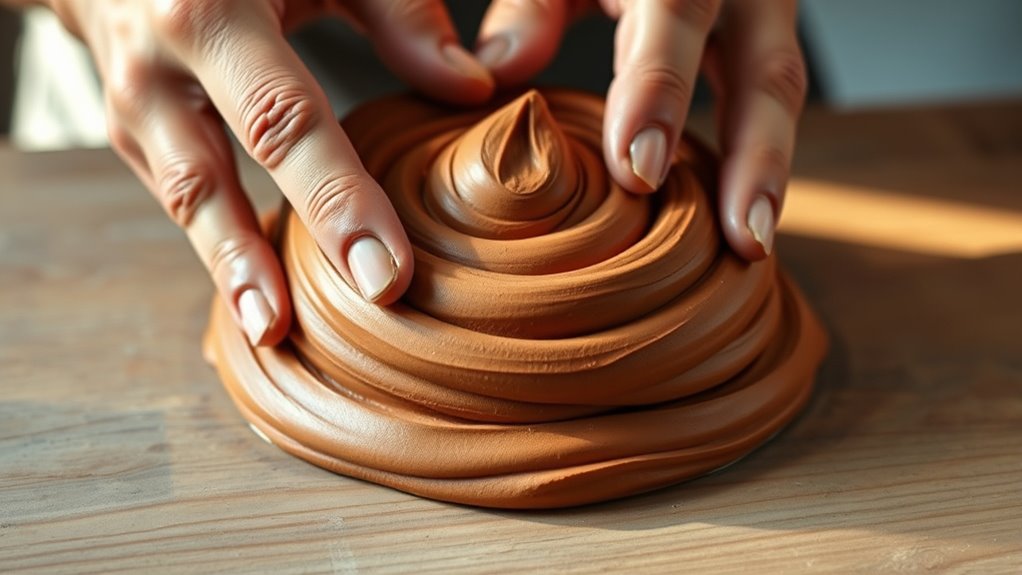
The primary purpose of wedging clay is to eliminate air bubbles and create a uniform, workable material. When you wedge, you’re ensuring proper clay hydration, which is necessary for consistent workability. By thoroughly mixing the clay, you promote even moisture distribution, preventing dry spots or overly moist areas that could cause issues during shaping. This process breaks up any trapped air that might cause cracking or explosions in the kiln. As you knead and fold the clay, you also improve its consistency, making it easier to mold and shape. Proper wedging ensures your clay has balanced moisture levels, providing a reliable and smooth surface for your project. Additionally, airless paint sprayers offer a quick and efficient way to apply paint, making projects faster and less labor-intensive. Proper clay preparation is essential for achieving a durable, well-formed ceramic piece. Regularly conditioning the clay can also help maintain its plasticity over time, ensuring better workability during your sculpting process. Understanding the moisture content of your clay is crucial, as it helps prevent common problems like cracking or warping during firing. Furthermore, consistent wedging enhances the overall strength of your ceramic pieces by ensuring even drying and firing.
As an affiliate, we earn on qualifying purchases.
How Wedging Improves Clay Consistency
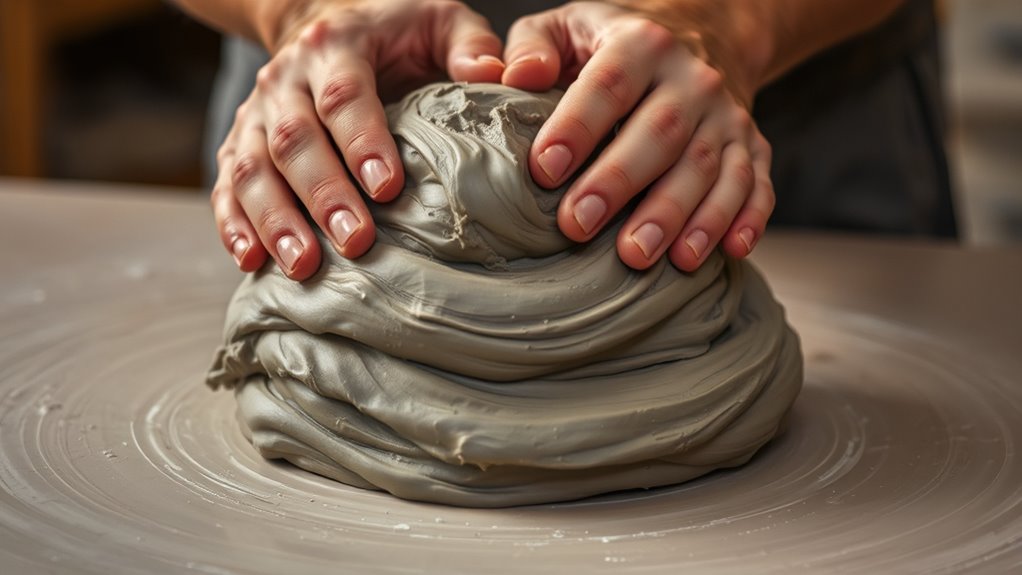
Wedging actively works to improve clay consistency by evenly distributing moisture and breaking up uneven pockets. This process ensures your clay has uniform clay moisture, reducing cracks and air bubbles during shaping. By using effective wedging techniques, you create a smooth, workable surface that responds predictably. Here’s a quick comparison:
| Aspect | Before Wedging | After Wedging | Benefits |
|---|---|---|---|
| Clay Moisture | Uneven, pockets of dryness or wetness | Evenly distributed | Reduces cracking and improves workability |
| Texture | Lumpy or inconsistent | Smooth and uniform | Easier to shape and fire |
| Air Bubbles | Trapped inside | Removed through kneading | Prevents explosions in firing |
| Consistency | Unpredictable | Reliable and consistent | Better control during forming |
Using the right wedging techniques transforms your clay into a reliable, uniform material, ready for your creative process. Proper clay preparation is essential for achieving optimal results in pottery and sculpture. Additionally, consistent wedging can help prevent air bubbles that may compromise the integrity of your finished piece. Effective wedging can also facilitate better moisture control, leading to fewer defects during firing. Incorporating proper wedging practices enhances overall clay health, contributing to more successful projects.
As an affiliate, we earn on qualifying purchases.
Common Myths About Wedging
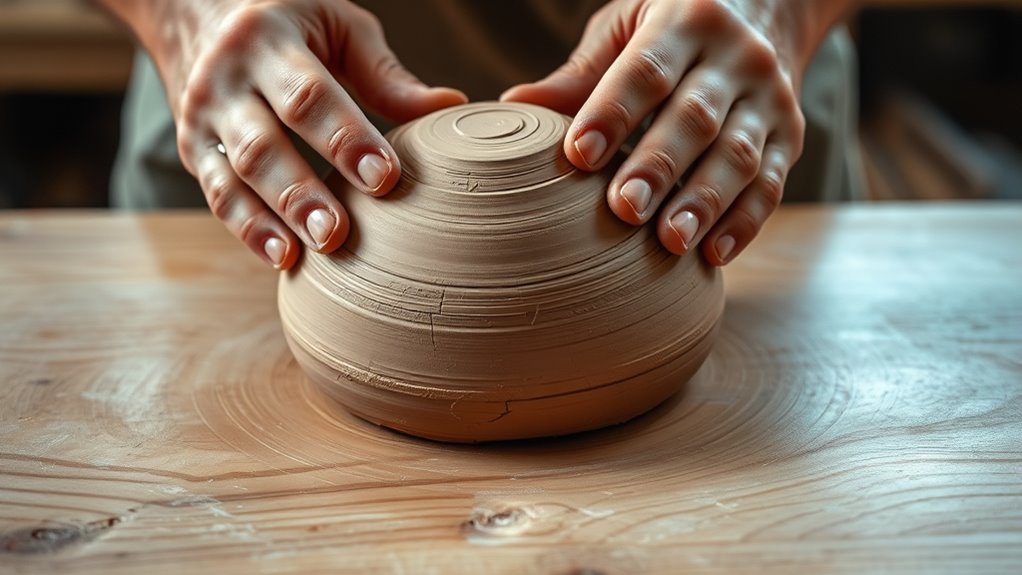
Many potters believe that wedging is a complicated or unnecessary step, but these ideas are often based on myths rather than facts. Some think that wedging affects clay color or that rushing through it can ruin the process. In reality, wedging doesn’t change the clay’s hue; it simply prepares it for shaping. Another myth is that speed matters less, but rushing can trap air and cause issues later. Proper wedging ensures even consistency and removes air bubbles, regardless of how quickly you work. It’s a common misconception that you need to spend a lot of time on it or that it’s only about aesthetics. In truth, the main goal is to make your clay uniform and workable, not to obsess over speed or color changes. Additionally, understanding the importance of appliance maintenance plans can help you appreciate the tools that enhance your viewing experience. Regularly maintaining your tools and equipment ensures consistent performance and prevents issues that could compromise your work. Proper maintenance of your clay tools, similar to tool upkeep, is essential for achieving the best results in pottery.
As an affiliate, we earn on qualifying purchases.
The Physical Process of Wedging
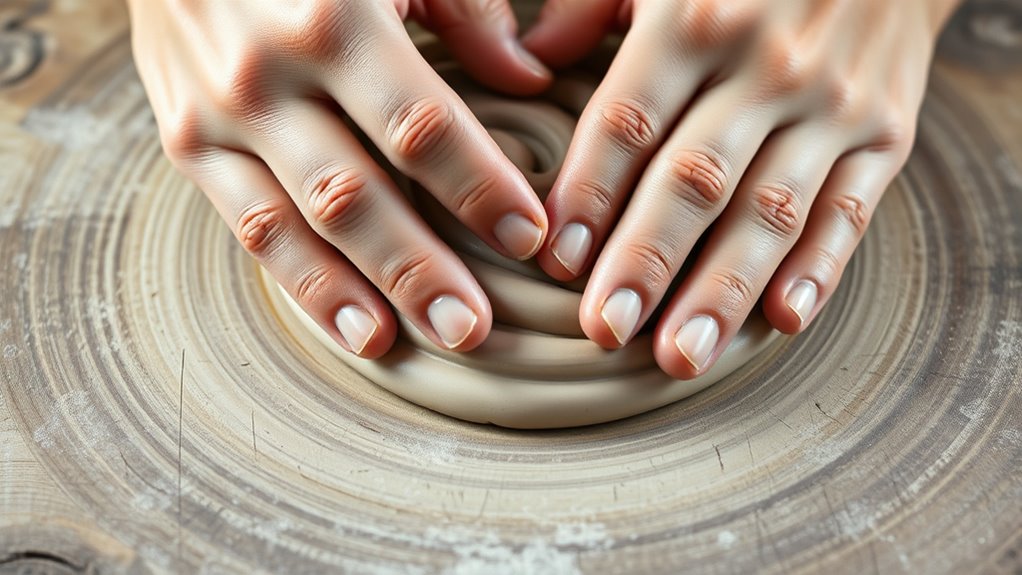
To effectively prepare clay, you need to understand the physical motions involved in wedging. This process involves applying consistent pressure and rhythmic movements to stretch and align the clay particles. As you wedge, you’ll focus on:
Mastering rhythmic pressure and folding motions to prepare clay for successful pottery.
- Clay stretching to eliminate air bubbles and create uniform consistency
- Moisture control to maintain the right level of dampness, preventing stickiness or cracking. Proper wedging also helps develop a better understanding of clay properties, which is essential for achieving desired textures and forms. Developing body jewelry measurements and materials knowledge can assist in selecting appropriate tools and techniques for different clay types.
- Using a rolling or spiral motion to fold and press the clay, ensuring even distribution of moisture and strength. Developing an awareness of clay behavior allows for more precise adjustments during the wedging process.
These motions help loosen the clay, improve plasticity, and prepare it for shaping. Proper wedging ensures your clay is free of air pockets and has the right consistency for workability. Mastering these physical motions results in a more successful pottery process, especially when clay conditioning techniques are used to enhance the workability and aroma during crafting.
Differences Between Wedging and Kneading
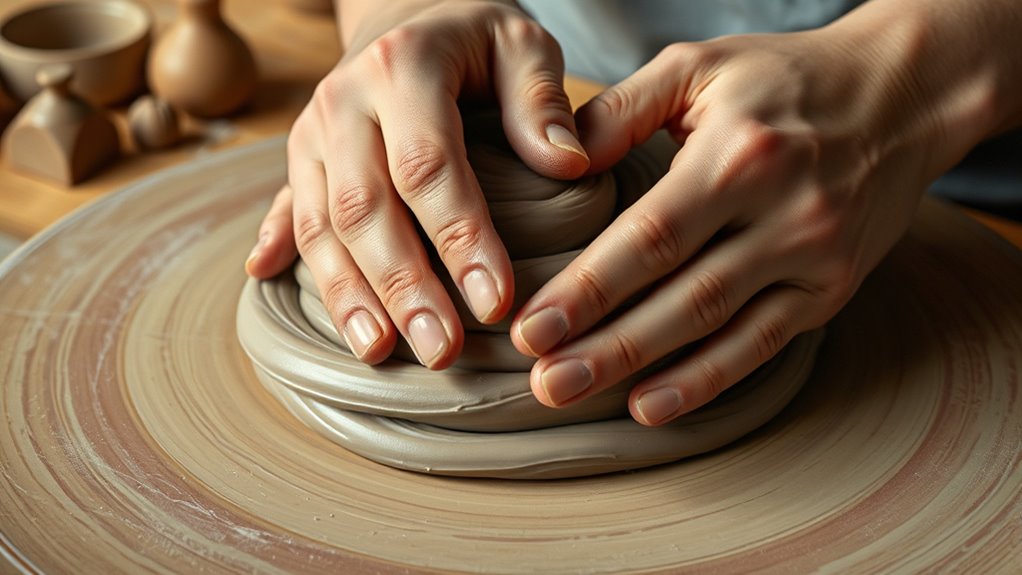
While both wedging and kneading involve working with clay to improve its texture, they serve different purposes and employ distinct techniques. Wedging is primarily used to homogenize clay, remove air bubbles, and prepare it for pottery design. It involves cutting, pressing, and folding the clay to align the particles, resulting in a uniform clay texture. Kneading, on the other hand, is more common in bread-making but can be adapted for clay to incorporate moisture or modify its consistency. It’s a gentler, continuous motion that helps in softening the clay without drastically changing its structure. Understanding these differences helps you choose the right method to achieve the desired clay texture, ensuring better control over your pottery design process. Additionally, proper clay preparation enhances the durability and workability of your finished piece, especially when considering moisture content and how it affects the clay’s behavior during shaping. Using the appropriate technique also minimizes air bubbles, which can cause defects in finished ceramics. For optimal results, considering the natural properties of your clay can also influence which technique is most effective.
How Wedging Prevents Air Bubbles
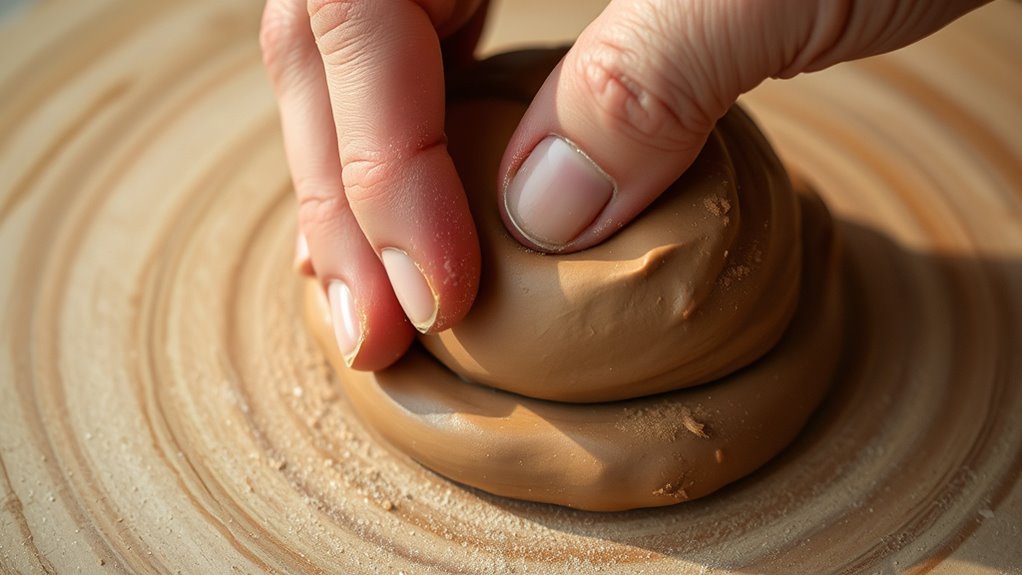
When you wedge clay, you push out trapped air bubbles that can cause cracks or explosions during firing. This process helps achieve a more even consistency, making your piece stronger and more stable. By removing air pockets, wedging guarantees your clay has better structural integrity from start to finish.
Air Bubble Entrapment
Air bubbles can ruin a clay piece by causing weak spots or cracking during firing, but proper wedging helps prevent this problem. When you don’t wedge thoroughly, you risk creating an air pocket inside your clay, which can trap air and lead to defects. To avoid this, focus on removing trapped air during wedging.
Consider these tips:
- Use a spiral or kneading motion to push out air pockets.
- Fold and wedge repeatedly to ensure even moisture and air distribution.
- Check for visible air bubbles before shaping your piece.
Even Clay Consistency
Proper wedging guarantees your clay has a uniform moisture level, which helps create an even consistency throughout the piece. When you wedge correctly, the clay’s color remains consistent, indicating that moisture retention is balanced. This prevents uneven drying or cracking later on. Consistent moisture ensures that the clay responds predictably during shaping and firing. If the moisture is uneven, some areas may dry faster, causing warping or weak spots. By thoroughly wedging, you break up any lumps and distribute moisture evenly, giving you a smooth, uniform clay body. This uniformity minimizes the risk of defects and helps you achieve a professional finish. In short, proper wedging is essential for maintaining an even clay consistency, which directly impacts the quality and stability of your finished piece. AI tools can assist in understanding the best techniques for achieving consistent results.
Enhanced Structural Integrity
Wedging plays a crucial role in enhancing the structural integrity of your clay piece by actively eliminating air bubbles. When air pockets remain, they can cause clay cracking during firing, compromising strength. Proper wedging ensures a uniform surface texture, preventing weak spots that might lead to cracks. It also helps distribute moisture evenly, reducing the risk of uneven drying and warping. By removing trapped air, you create a denser, more cohesive clay body that holds together better under stress. This process not only strengthens your piece but also improves its overall durability. Remember, neglecting proper wedging can leave air bubbles hidden beneath the surface, increasing the chance of issues during firing. Consistent wedging is essential for a solid, crack-free finished product.
The Role of Wedging in Preparing for Throwing
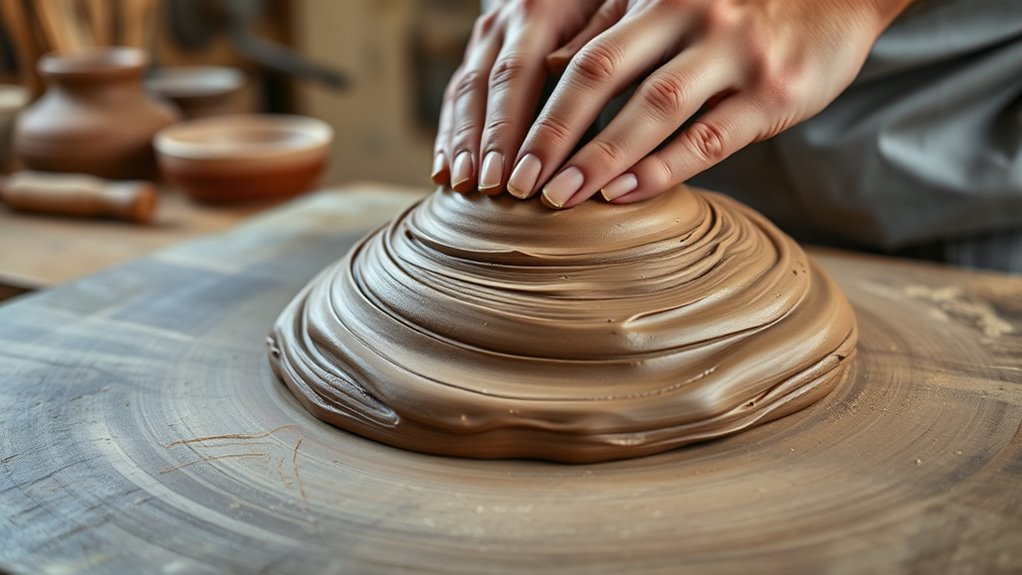
When you wedge clay before throwing, you remove air bubbles that could cause cracks or breaks. It also helps create a consistent, smooth texture by aligning the clay particles evenly. This preparation guarantees your pottery has strength and uniformity from the start.
Eliminates Air Bubbles
Air bubbles can cause weak spots and imperfections in your finished piece, which is why eliminating them is a essential step before throwing. When you wedge your clay, you push out air pockets that can compromise the strength of your work. Proper wedging promotes clay uniformity, ensuring consistent density throughout. To effectively remove air bubbles, focus on:
- Applying firm, even pressure to force out trapped air
- Rotating and folding the clay repeatedly to release air pockets
- Checking for visible bubbles before starting to throw
This process reduces the risk of cracks or explosions during firing. By thoroughly wedging, you create a more reliable, homogenous mass, making your throwing experience smoother and your final piece more durable.
Homogenizes Clay Texture
Have you ever noticed inconsistencies in your clay’s texture that make throwing more difficult? Wedging helps homogenize your clay, ensuring a uniform clay color and consistent porosity throughout. When you wedge, you break down any uneven areas, blending different parts of the clay so it feels smooth and even. This process distributes moisture evenly, preventing dry or overly wet spots that could cause cracking or collapsing during throwing. As a result, your clay becomes more predictable and easier to work with. Homogenizing the texture also improves its workability, making it respond better to shaping and reducing the risk of imperfections. Overall, proper wedging creates a stable, uniform piece of clay, setting a reliable foundation for successful pottery.
Aligns Clay Particles
Wedging plays a crucial role in aligning clay particles, guaranteeing they are evenly distributed and properly oriented for throwing. Proper alignment depends on understanding clay mineralogy, which affects how particles interact. By using wedging tools, you break up air bubbles and organize the clay’s mineral structure, making it more cohesive. When you wedge, you:
- Realign clay particles for consistent workability
- Break down any remaining air pockets that can weaken your piece
- Improve clay plasticity by organizing particles for smoother shaping
This process guarantees the clay’s mineralogy is optimized, leading to better control during throwing. Properly wedged clay has evenly aligned particles, providing the stability needed for intricate forms and reducing the risk of cracks or collapse during shaping.
Mistakes to Avoid When Wedging Clay

Even experienced potters can make mistakes when wedging clay, but being aware of common pitfalls helps you avoid unnecessary setbacks. One mistake is neglecting proper clay storage, which can cause the clay to dry out or become uneven, making wedging more difficult. Always keep your clay wrapped tightly and stored in a moisture-proof container. Another error is ignoring tool maintenance; dull or dirty tools can hinder your technique and damage the clay. Regularly clean and sharpen your tools to ensure smooth, effective wedging. Additionally, rushing through the process or applying uneven pressure can lead to air pockets or inconsistent clay. Taking your time and maintaining your tools helps you achieve a uniform, well-prepared clay body, reducing issues during shaping and firing.
Frequently Asked Questions
Can Wedging Be Skipped Without Affecting the Final Pottery?
You can skip wedging clay, but it’s not recommended if you want high-quality pottery. Proper clay preparation through wedging guarantees even moisture and removes air bubbles, which prevents cracks and defects. While some wedging alternatives exist, like kneading or pounding, they may not achieve the same thoroughness. Skipping wedging can lead to weak spots and uneven textures, ultimately affecting the final piece’s strength and appearance.
How Long Should I Spend Wedging Each Batch of Clay?
Think of your clay like a symphony needing perfect harmony. Spend about 5-10 minutes wedging each batch to guarantee consistent clay, avoiding surprises during shaping. Focus on achieving a uniform clay consistency and maximize wedging efficiency. Rushing through it can leave air pockets or uneven spots that compromise your final piece. So, dedicate enough time, and your pottery will come together smoothly, like a well-tuned orchestra.
Is There a Preferred Technique of Wedging for Different Clay Types?
You should choose a wedging technique based on your clay type, as different methods suit different textures. For plastic clay, spiral wedging works well, while for stiffer clay, ram’s head or slab wedging might be better. Use appropriate wedging tools like a wire cutter or a wooden paddle to prepare your clay thoroughly. Adjust your technique to guarantee even consistency, making your clay easier to work with and preventing air bubbles.
Does Wedging Change the Color or Texture of the Clay?
Wedging doesn’t change the clay’s color or texture permanently, but it can temporarily affect how they appear. As you wedge, you blend air bubbles and evenly distribute moisture, which can make the clay feel smoother and more uniform. This process might slightly alter the clay’s surface look initially, but once fired, the original clay color and texture remain unchanged. You’ll notice a more consistent, workable surface after wedging.
Can Improper Wedging Cause Cracks in Finished Pottery?
Improper wedging can definitely cause cracks in your finished pottery. When you don’t properly remove air bubbles and evenly distribute moisture, the clay’s strength weakens. These trapped air pockets can expand during firing, leading to cracks or even explosions. Proper wedging guarantees the clay is uniform and free of air bubbles, which helps maintain its strength and prevents cracks, giving you a more durable and smooth final piece.
Conclusion
Now that you understand wedging’s true purpose, you hold the key to unfastening smooth, consistent clay. Think of it as sculpting a sturdy foundation beneath your fingertips, ensuring your creations stand tall and flawless. When you wedge with intention, you’re weaving a resilient, bubble-free canvas ready for your artistic journey. Embrace this essential step, and watch your clay transform into masterpieces that stand the test of time.
Flea & tick season Picks
flea and tick prevention
As an affiliate, we earn on qualifying purchases.