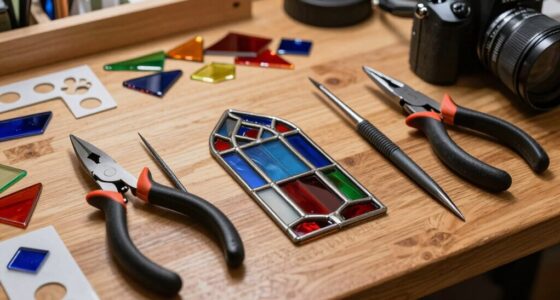
If you need precise, detailed cuts on small projects or intricate designs, a glass cutter is your best choice because it’s easy to use and ideal for thinner glass. However, if your work involves larger panels, complex shapes, or thicker, more durable glass, a ring saw offers better control, power, and accuracy. To choose the right tool for your style and project scale, consider how much detail and scale you’re working with—there’s more to explore ahead.
Key Takeaways
- Use a glass cutter for small, detailed, or intricate designs requiring precision on thin or delicate glass.
- Opt for a ring saw when working with large, thick, or resilient glass panels needing smooth, straight cuts.
- Consider a glass cutter for quick, straightforward cuts on simple projects with fine control.
- Choose a ring saw for complex shapes, large-scale projects, or materials demanding high durability and minimal chipping.
- Maintenance and investment levels influence long-term suitability based on your design complexity and project scope.
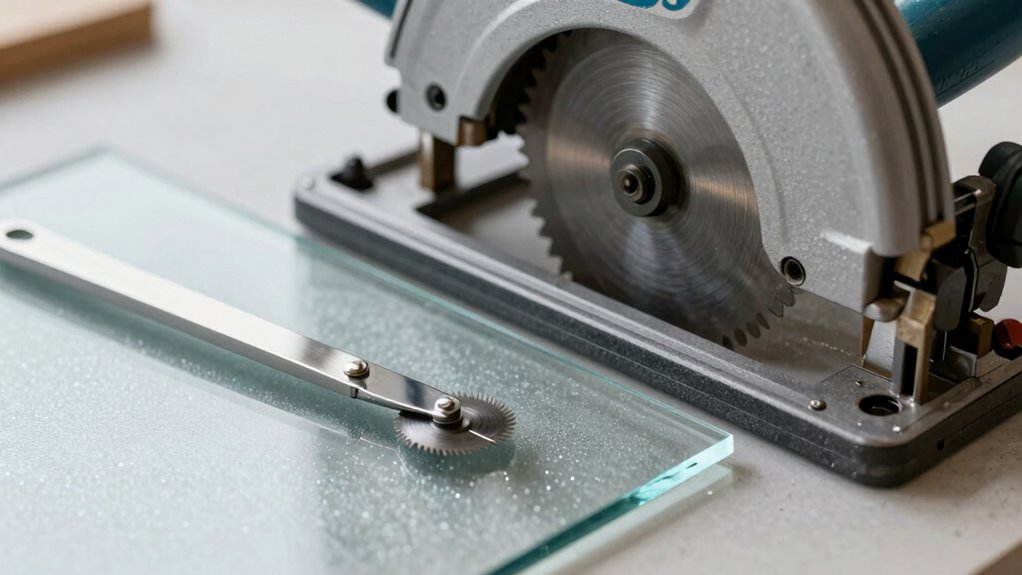
When choosing the right tool for cutting glass, understanding the differences between a ring saw and a glass cutter is essential. Both tools serve specific purposes and suit different project needs, especially when considering material durability and cutting precision. A glass cutter is a simple hand tool, typically featuring a small, hardened steel wheel that scores the glass surface. Its design allows for quick, straightforward cuts, making it ideal for small projects or when you need a precise, clean score line. Because it’s manually operated, you control the pressure and speed, which can enhance cutting precision for detailed or intricate designs. However, its material durability depends largely on the quality of the wheel and your technique. Over time, the wheel wears down, and you’ll need to replace it for consistent results. Despite this, a glass cutter remains a reliable choice for projects that demand fine, accurate cuts on standard glass thicknesses.
On the other hand, a ring saw is a powered cutting tool that uses a circular blade, often with a continuous rim or segmented teeth. It’s designed for heavy-duty applications, capable of slicing through thicker or more durable materials with ease. When working with tough or resilient glass types, a ring saw offers superior material durability because it’s engineered to handle the stress of prolonged cutting. Additionally, it often features advanced cutting technology, which improves efficiency and safety during operation. It also provides excellent cutting precision, especially when you need straight, smooth cuts on larger or more complex pieces. The powered nature of the ring saw reduces manual effort and allows for consistent results, which is particularly beneficial in professional settings or when working on large-scale projects. Its ability to cut through thicker glass without cracking or chipping makes it a versatile tool for various design styles, including those requiring complex shapes or large panels. Moreover, proper maintenance ensures the longevity and optimal performance of these powerful tools, making them a worthwhile investment for serious hobbyists or professionals. It is also important to consider cutting techniques that can help you achieve the best possible finish, especially on delicate or intricate glasswork.
Choosing between a ring saw and a glass cutter ultimately depends on your project scope and style preferences. If you value portability, detailed control, and working with smaller pieces or thinner glass, a glass cutter might be your best fit. Conversely, if you need to handle thicker, more durable materials or require precise, straight cuts on larger surfaces, a ring saw is likely more suitable. Both tools have their strengths, but understanding their material durability and cutting precision helps you decide which one aligns better with your design goals. Keep in mind that investing in the right tool can make all the difference in achieving professional-quality results, whether you’re working on delicate stained glass or large, industrial-style panels.

Glass Cutter 2mm-20mm, Upgrade Glass Cutter Tool, Pencil Style Oil Feed Carbide Tip for Glass Cutting/Tiles/Mirror/Mosaic.
- Upgraded Cutter Head: Sharp, smooth, and precise cutting
- Easy to Use: Ergonomic handle with automatic oil feed
- Multiple Cutting Sizes: Includes 3 heads: 2-6mm, 6-12mm, 12-20mm
As an affiliate, we earn on qualifying purchases.
As an affiliate, we earn on qualifying purchases.
Frequently Asked Questions
Which Tool Is More Cost-Effective for Small Projects?
For small projects, a glass cutter is more cost-effective, especially if you’re mindful of budget considerations. It’s affordable, simple to use, and requires minimal maintenance. While a ring saw offers greater material versatility and precision, its higher initial cost might not be justified for small tasks. If your focus is on saving money and handling straightforward designs, the glass cutter is the smarter choice for your projects.
Can Both Tools Cut All Types of Glass Equally Well?
Like a master artist with a brush, you’ll find that neither tool cuts all types of glass equally well. The ring saw offers remarkable cutting versatility and handles thicker, textured, or patterned glass with ease. Meanwhile, a glass cutter excels in precise, delicate cuts on thinner, smooth glass. Your choice depends on material compatibility and the specific project, ensuring your vision comes to life with the right tool at your side.
How Does User Skill Level Impact Tool Choice?
Your skill level greatly influences your tool choice, as it affects skill adaptation and tool versatility. If you’re a beginner, a glass cutter offers simplicity and precision, making it easier to learn. More experienced users might prefer a ring saw for its versatility and ability to handle complex cuts. Ultimately, choosing the right tool depends on how well you adapt your skills to each, ensuring your design style shines through.
Are There Safety Concerns Unique to Each Tool?
Think of safety gear and handling techniques as your shield and sword. With a ring saw, you face risks of blade kickback and dust inhalation, so wear goggles, gloves, and a mask, and handle it with steady control. For glass cutters, watch out for sharp edges and glass shards—wear protective gloves and gloves, and use gentle, controlled handling techniques. Staying alert and prepared keeps you safe with each tool.
Which Tool Offers Better Precision for Intricate Designs?
A glass cutter offers better precision for intricate designs because it allows you to make detailed, controlled cuts essential for glass shaping. Its simplicity gives you greater tool versatility, letting you work on delicate, complex patterns with ease. With a glass cutter, you can achieve finer, more accurate results, making it ideal for intricate artistry. A ring saw, while powerful, tends to be less precise for delicate, detailed work.
professional ring saw for glass cutting
As an affiliate, we earn on qualifying purchases.
As an affiliate, we earn on qualifying purchases.
Conclusion
Choosing between a ring saw and a glass cutter depends on your specific design needs. Think of the ring saw as a versatile artist’s brush, capable of intricate cuts, while the glass cutter is like a steady hand for simpler, precise lines. If you’re after detailed, complex designs, the ring saw is your best bet. But if clean, straightforward cuts suit your style, the glass cutter will serve you well—like a trusty pen for your creative journey.
As an affiliate, we earn on qualifying purchases.
As an affiliate, we earn on qualifying purchases.