The best woodworking dust collectors balance three things that rarely line up: airflow, filtration fineness, and floor space. My top overall pick is the JET DC-1100VX-CK Vortex Cone, because its 1.5 HP motor and 2-micron canister filter deliver shop-sized performance with filtration most single-stage collectors can’t match. For tighter budgets and smaller shops, the VEVOR 1.5 HP Vortex Cone offers similar vortex-style separation at a lower cost, while the WEN DC1300 wins on raw CFM and capacity per dollar. The main tradeoff in this category is capacity versus footprint — wall-mount units like the POWERTEC DC5371 save space but can’t run multiple machines at once, while floor models move serious air but demand real garage real estate. Keep reading for the full breakdown.

Get business pricing on tools and workshop supplies
- Business-only prices and quantity discounts
- Tax-exempt purchasing
- Multiple users, one account, clear invoices
Complete the kit


Key Takeaways
- Canister filtration was the clearest differentiator: the JET DC-1100VX-CK and VEVOR vortex cone models capture 2–2.5 micron particles, while bag-only machines like the WEN DC1300 prioritize airflow over fine-particle capture.
- Rated CFM numbers are not comparable across brands — the BUCKTOOL 1.5 HP lists up to 1,654 CFM while the JET lists roughly 1,100, yet real-world performance depends more on filter resistance and ducting than on the sticker figure.
- Wall-mount units (VEVOR and POWERTEC DC5371) filled a distinct niche: they suit single-station sanding setups but should be skipped by anyone running a table saw and jointer simultaneously.
- The BUCKTOOL 1.2 HP auto-start model was the only machine with built-on tool-activated startup, making it the natural pick for hobbyists who don’t want to walk to the collector every time they flip on a sander.
- Across the lineup, a mobile base mattered more than expected — the WEN DC1300, POWERTEC DC1081, and portable extractors earned usability points for shops where one collector serves several machines.
| WEN DC1300 1,300 CFM Dust Collector with 50-Gallon Bag and Mobile Base |  | Best Overall for Serious Home Shops | Airflow: 1,300 CFM | Motor: 14 amps | Impeller: 10-inch steel, up to 3,450 RPM | VIEW LATEST PRICE | See Our Full Breakdown |
| VEVOR Wall-Mount Dust Collector, 1 HP, 560 CFM |  | Best Compact Wall-Mount Pick | Airflow: 560 CFM | Motor power: 1 HP | Collection bag capacity: 21 gallons (80 L) | VIEW LATEST PRICE | See Our Full Breakdown |
| WEN DC3474 Woodworking Dust Collector |  | Best Value for Small Workshops | Motor: 7.4-amp induction motor | Impeller: 9 inches | Airflow: Up to 600 CFM | VIEW LATEST PRICE | See Our Full Breakdown |
| JET Vortex Cone Dust Collector with 2-Micron Canister Filter, 1.5 HP, 115/230V, 1-Phase (DC-1100VX-CK) |  | Best Premium Filtration | Motor: 1.5 HP, totally enclosed fan-cooled | Voltage: 115/230V, 1-phase | Filter: 2-micron canister filter | VIEW LATEST PRICE | See Our Full Breakdown |
| BUCKTOOL 1.5 HP Portable Dust Collector, 1100–1654 CFM |  | Best for Ducted Workshop Systems | Motor: 1.5 HP, dual-voltage, fan-cooled induction | Airflow: 1,100 CFM; up to 1,654 CFM with 6-inch duct | Inlets: Dual 4-inch ports plus 6-inch main inlet | VIEW LATEST PRICE | See Our Full Breakdown |
| WEN DC3401 Woodworking Dust Collector |  | Best Lightweight Portable Pick | Motor: 5.7 amps | Impeller: 6 inches | Airflow: Up to 660 CFM | VIEW LATEST PRICE | See Our Full Breakdown |
| VEVOR 1.5 HP Vortex Cone Dust Collector, 1100 CFM, 2.5-Micron Filtration |  | Best High-Capacity Workhorse | Airflow: 1100 CFM | Motor: 1.5 HP induction | Filtration: 2.5 microns | VIEW LATEST PRICE | See Our Full Breakdown |
| BUCKTOOL 1.2 HP Auto-Start Dust Collector, 750 CFM with 5 ft Flexible Hose |  | Best Auto-Start Convenience | Motor: 1.2 HP, 3450 RPM | Airflow: 750 CFM | Voltage: 120V | VIEW LATEST PRICE | See Our Full Breakdown |
| DYNAVEX 10-Amp Portable Woodworking Dust Extractor, 12-Gallon |  | Best Fine-Dust Filtration | Motor: 1.5 HP, 10A | Airflow: 142 CFM | Filter: 0.5-micron HEPA | VIEW LATEST PRICE | See Our Full Breakdown |
| POWERTEC 1 HP Wall-Mount Dust Collector, 560 CFM, with 1-Micron Filter Bag (DC5371) |  | Best Zero-Floor-Footprint Option | Motor: 1 HP induction, 3450 RPM | Voltage: 120V/240V (12A at 120V; 6A at 240V) | Airflow: 560 CFM | VIEW LATEST PRICE | See Our Full Breakdown |
| POWERTEC DC5372 1 HP Portable Dust Collector, 560 CFM |  | Best for Machine-by-Machine Collection | Motor Power: 1 HP induction motor | Airflow Capacity: 560 CFM | Filtration: Reusable 1-micron dust collector bag | VIEW LATEST PRICE | See Our Full Breakdown |
| POWERTEC 1 HP Dust Collector with 1-Micron Filter Bags and Mobile Base (DC1081) |  | Best Budget Starter System | Motor Power: 1 HP | Motor Speed: 3450 RPM | Voltage: 120V/240V | VIEW LATEST PRICE | See Our Full Breakdown |
| woodworking dust collector | Airflow | Motor | Voltage |
|---|---|---|---|
| WEN DC1300 1,300 CFM Dust Coll | 1,300 CFM | 14 amps | — |
| VEVOR Wall-Mount Dust Collecto | 560 CFM | — | 120 volts |
| WEN DC3474 Woodworking Dust Co | Up to 600 CFM | 7.4-amp induction motor | — |
| JET Vortex Cone Dust Collector | — | 1.5 HP, totally enclosed fan-cooled | 115/230V, 1-phase |
| BUCKTOOL 1.5 HP Portable Dust | 1,100 CFM; up to 1,654 CFM with 6-inch duct | 1.5 HP, dual-voltage, fan-cooled induction | — |
| WEN DC3401 Woodworking Dust Co | Up to 660 CFM | 5.7 amps | — |
| VEVOR 1.5 HP Vortex Cone Dust | 1100 CFM | 1.5 HP induction | 120V AC |
| BUCKTOOL 1.2 HP Auto-Start Dus | 750 CFM | 1.2 HP, 3450 RPM | 120V |
| DYNAVEX 10-Amp Portable Woodwo | 142 CFM | 1.5 HP, 10A | — |
| POWERTEC 1 HP Wall-Mount Dust | 560 CFM | 1 HP induction, 3450 RPM | 120V/240V (12A at 120V; 6A at 240V) |
| POWERTEC DC5372 1 HP Portable | — | — | 120V/240V dual voltage |
| POWERTEC 1 HP Dust Collector w | — | — | 120V/240V |
More Details on Our Top Picks
WEN DC1300 1,300 CFM Dust Collector with 50-Gallon Bag and Mobile Base
The DC1300 earns the top spot because it solves the two problems that frustrate most hobbyist collectors: limited capacity and awkward mobility. A 50-gallon bag means far fewer trips to empty chips than the WEN DC3474’s 15-gallon bag, and the dual 4-inch inlets let two machines run without constant hose swapping. Compared with the BUCKTOOL DC1100, you give up the finer filtration and 6-inch ducting option, but the DC1300 is simpler to live with if you just want to plug in and cut wood.
That simplicity comes with tradeoffs. There’s only one speed, so small-tool sessions run at full blast, and the bag filtration won’t catch the finest sanding dust that a 2-micron canister like the JET’s does.
Pros:- 1,300 CFM airflow handles table saws and planers comfortably
- 50-gallon bag reduces emptying frequency dramatically
- Dual 4-inch inlets support two tools at once
- Four swivel casters make repositioning easy
Cons:- Single-speed motor offers no flexibility for lighter tasks
- Bag filtration misses fine particles below a few microns
Best for: Garage and basement woodworkers running multiple machines who want big capacity without a premium price
Not ideal for: Anyone needing fine-dust filtration for sanding-heavy work or variable speed control
- Airflow:1,300 CFM
- Motor:14 amps
- Impeller:10-inch steel, up to 3,450 RPM
- Inlets:2 x 4-inch
- Collection bag capacity:50 gallons
- Wheels:4 swivel casters
- Intended use:Garage, home, workshop
Our verdict“If you run a two- or three-machine home shop and want set-and-forget dust collection, this is the most sensible anchor machine in the lineup.”
VEVOR Wall-Mount Dust Collector, 1 HP, 560 CFM
When floor space is the constraint, this VEVOR wall-mount unit makes sense where the WEN DC1300 would be a non-starter — it takes up zero floor footprint and weighs just 24 pounds. The 2.5-micron filtration actually out-filters the DC1300’s standard bag, making it a smarter match for sanding stations than the bigger WEN. Its 560 CFM is comparable to the WEN DC3474’s output, but here it comes in a package that hangs beside a miter saw or bench rather than rolling around the shop.
The tradeoff is scale. A 21-gallon bag fills faster than the DC1300’s 50-gallon bag, 560 CFM can’t keep up with a planer throwing chips, and the ≤90 dB noise level means you’ll want hearing protection and some distance from your work area.
Pros:- Zero floor footprint frees up shop space entirely
- 2.5-micron filtration handles fine sanding dust well
- Bottom zipper empties the bag without detaching it
- Overload-resistant induction motor built for steady duty
Cons:- Up to 90 dB noise is loud for a unit mounted close to the workbench
- Requires a structurally sturdy wall to safely hold the unit
Best for: Small-shop owners and miter-saw or sanding-station users with no spare floor space
Not ideal for: Woodworkers running chip-heavy machines like planers or jointers — 560 CFM won’t keep up
- Airflow:560 CFM
- Motor power:1 HP
- Collection bag capacity:21 gallons (80 L)
- Filtration:2.5 microns
- Noise level:≤ 90 dB
- Weight:24 pounds
- Mounting:Wall mount
- Voltage:120 volts
Our verdict“This is the pick for a dedicated stationary tool where floor space matters more than raw airflow.”
WEN DC3474 Woodworking Dust Collector
For a first dust collector, the DC3474 hits a sweet spot the bigger machines don’t: it’s light at 41 pounds, rolls on swivel casters, and can even convert to wall mounting if your layout changes. Its 600 CFM covers a single tool at a time — a table saw or a bandsaw — which is honest capability rather than a limitation for a one-machine-at-a-time hobbyist. Compared with the VEVOR wall-mount, you get mounting flexibility instead of a fixed position, though you sacrifice the VEVOR’s finer 2.5-micron filtration (the WEN bag is rated at 5 microns).
Against the WEN DC1300, the gap is capacity: a 15-gallon bag empties three times as often, and there’s only one inlet. That’s the price of the smaller footprint and lighter frame.
Pros:- 600 CFM is plenty for a single hobby machine
- Mobile base plus optional wall mount gives layout flexibility
- Light 41-pound frame is easy to reposition alone
- Zippered 15-gallon bag simplifies emptying
Cons:- 5-micron bag lets fine dust pass through
- Single inlet means hose swapping between tools
Best for: Beginners and hobbyists collecting from one machine at a time in a small shop
Not ideal for: Woodworkers with multiple machines running simultaneously or heavy chip producers
- Motor:7.4-amp induction motor
- Impeller:9 inches
- Airflow:Up to 600 CFM
- Dust port:4 inches
- Collection bag:15-gallon, 5-micron zippered
- Mounting:Mobile base or optional wall mount
- Weight:41.1 pounds
- Warranty:2 years
Our verdict“The most sensible entry point in this roundup if you’re dust-collecting one tool at a time and want room to grow later.”
JET Vortex Cone Dust Collector with 2-Micron Canister Filter, 1.5 HP, 115/230V, 1-Phase (DC-1100VX-CK)
The JET DC-1100VX-CK justifies its premium positioning through 2-micron canister filtration and Vortex Cone chip separation, two features none of the WEN or VEVOR options here match. The canister pleated filter captures fine dust that a standard bag passes straight back into your shop air — a real difference if you sand a lot or work in a shared space. The Vortex Cone also packs chips into the bag more evenly, so you empty less often than a plain single-stage unit like the BUCKTOOL without a baffle would demand.
It’s still a single-stage design, so it lacks the separation quality of a true two-stage cyclone system, and bag changes still mean removal and reinstallation rather than a zipper dump. Dual-voltage wiring adds setup friction for buyers who just want 115V plug-and-play.
Pros:- 2-micron canister filter captures fine dust standard bags miss
- Vortex Cone improves chip separation and bag packing
- Quick-connect bags speed up bag changes
- Dual 115/230V voltage suits wired shop circuits
Cons:- Single-stage design can’t match a true two-stage cyclone
- Bag removal and reinstallation is still messier than a zipper or drum dump
Best for: Serious hobbyists and small professional shops prioritizing fine-dust capture and air quality
Not ideal for: Budget-focused buyers or those wanting cyclone-level chip separation in a single-stage machine
- Motor:1.5 HP, totally enclosed fan-cooled
- Voltage:115/230V, 1-phase
- Filter:2-micron canister filter
- Operation:Single-stage
- Chip separation:Vortex Cone technology
- Mobility:Four casters
- Model:DC-1100VX-CK
Our verdict“If lung protection and cleaner shop air are your priorities and budget allows, this is the strongest filtration package in the roundup.”
BUCKTOOL 1.5 HP Portable Dust Collector, 1100–1654 CFM
The BUCKTOOL DC1100 stands out as the only option here built to grow into a ducted system: its 6-inch main inlet unlocks up to 1,654 CFM when connected directly to hard ducting, well beyond anything the WEN DC1300 or JET can claim. The internal baffle also separates heavy chips into the lower bag before they reach the filter, which extends filter life — a step toward two-stage performance that the JET achieves differently with its Vortex Cone. Flexible inlet options (dual 4-inch ports or the 6-inch main) let you start with hoses and upgrade to ductwork later.
Realistically, at 125.3 pounds, calling it portable is generous — the mobile stand helps, but this is a machine you position once. And hitting the advertised 1,654 CFM requires that direct 6-inch connection; through the 4-inch ports you’re working with substantially less.
Pros:- Up to 1,654 CFM with direct 6-inch duct connection
- Internal baffle separates heavy chips and extends filter life
- Multiple inlet configurations support flexible or hard ducting
- Permanently lubricated motor requires minimal maintenance
Cons:- 125.3-pound weight limits true portability despite the mobile stand
- Peak airflow only achievable with a 6-inch direct connection
Best for: Woodworkers planning permanent ductwork across multiple machines in a dedicated shop
Not ideal for: Small or shared garages — its weight and footprint assume a fixed shop location
- Motor:1.5 HP, dual-voltage, fan-cooled induction
- Airflow:1,100 CFM; up to 1,654 CFM with 6-inch duct
- Inlets:Dual 4-inch ports plus 6-inch main inlet
- Filtration:Captures up to 98% of 5-micron particles
- Chip separation:Internal baffle
- Weight:125.3 pounds
- Warranty:1-year limited
Our verdict“The right choice if you’re building out a permanently ducted multi-machine shop and want headroom to grow into it.”
WEN DC3401 Woodworking Dust Collector
At 17 pounds, the DC3401 is the easiest machine in this roundup to pick up and move, and that alone defines its role. Compared with the BUCKTOOL 1.2 HP Auto-Start, it gives up power and automation but wins on sheer portability — you can carry it between job sites or stash it on a shelf. The 660 CFM airflow is respectable for a machine this size, enough to serve a single tool at a time, though well short of the VEVOR 1100 CFM unit for ducted shops. The 5-micron bag is the real compromise: it catches chips and coarse dust but lets fine particles through, so it isn’t a health solution for sanding-heavy work. Buyers who want flexibility — floor, caster, or optional wall mount — get three setups in one package here.
Pros:- Featherlight at 17 pounds with a carrying handle for true portability
- 660 CFM is strong for its size class
- Flexible setup: casters, floor, or optional wall mount
- 12-gallon zippered bag empties without spills
Cons:- 5-micron filtration misses fine, hazardous dust
- Brushed motor will wear faster than the induction motors on rivals
Best for: Hobbyists with small garages or shared spaces who need to move a collector between tools or store it away after each session
Not ideal for: Woodworkers concerned with fine dust exposure — the 5-micron bag passes particles that a HEPA machine like the DYNAVEX captures
- Motor:5.7 amps
- Impeller:6 inches
- Airflow:Up to 660 CFM
- Dust port:4 inches
- Collection bag:12 gallons, 5-micron zippered
- Weight:17 pounds
- Warranty:Two years
Our verdict“Buy it if you value grab-and-go mobility over filtration and raw airflow; skip it if fine dust is your main concern.”
VEVOR 1.5 HP Vortex Cone Dust Collector, 1100 CFM, 2.5-Micron Filtration
This is the volume play of the batch. With 1100 CFM and a 42-gallon collection bag, it out-collects nearly everything else here, including the WEN DC3401, whose 12-gallon bag would need emptying several times for every one cycle of the VEVOR. The 2.5-micron filtration sits between the WEN’s 5-micron bag and the DYNAVEX’s HEPA filter — decent for fine sawdust, not medical-grade for sanding dust. Compared with the JET DC-1100VX-CK, it matches the airflow class while trading away the canister filter and build refinement, which is the expected bargain at this tier. The induction motor should outlast the brushed unit on the WEN, but noise near 90 dB means hearing protection is non-negotiable, and at 68 pounds plus a tall frame, this is a stationary machine, not something you shuffle around the shop.
Pros:- 1100 CFM handles multiple machine types and heavy chip producers
- 42-gallon bag dramatically extends time between emptying
- 2.5-micron filtration catches fine sawdust the WEN DC3401 misses
- Clip-style bag access makes emptying less of a chore
Cons:- Operation near 90 dB is loud for residential workshops
- Large footprint and 68-pound frame resist repositioning
Best for: Serious hobbyists or small production shops running table saws, planers, and jointers who hate emptying bags
Not ideal for: Tight garages or basement shops — the 75-inch height and 90 dB operation make it intrusive in shared or cramped spaces
- Airflow:1100 CFM
- Motor:1.5 HP induction
- Filtration:2.5 microns
- Collection bag:42 gallons (159 L)
- Noise level:Under 90 dB
- Voltage:120V AC
- Weight:68.1 pounds
- Dimensions:36.22 x 29.13 x 75.59 inches
Our verdict“The pick for shops that prioritize collection volume and capacity over compactness and quiet.”
BUCKTOOL 1.2 HP Auto-Start Dust Collector, 750 CFM with 5 ft Flexible Hose
The standout feature here is the auto-start outlet: plug in a tool up to 7A and the collector fires up automatically, which removes the most annoying habit in hobby woodworking — forgetting to switch on dust collection. Compared with the DYNAVEX extractor, the BUCKTOOL accepts a 7A tool load versus the DYNAVEX’s 550-watt ceiling, making it compatible with beefier saws, though neither handles a 15A table saw. Its 750 CFM splits the difference between the WEN DC3401’s 660 and the VEVOR’s 1100, and the 2-micron upper bag actually filters finer than the WEN’s 5-micron. The accessory bundle — hose, five reducers, and multiple bags — means it works with varied port sizes out of the box. The tradeoff is that 5-foot hose: fine for parking next to one machine, limiting if you want to serve a whole bench.
Pros:- Auto-start outlet eliminates manual switching with tools up to 7A
- 2-micron cloth bag filters finer than the WEN DC3401’s 5-micron
- Generous accessory kit with hose, five reducers, and multiple bags
- Caster base switches between mobile and stationary use
Cons:- 5 ft hose restricts reach to a single nearby station
- 7A connected-tool ceiling excludes most full-size stationary machines
Best for: Hobbyists running handheld or benchtop tools under 7A who want dust collection to happen automatically
Not ideal for: Shops with 15A stationary machines or long tool-to-collector distances — the 7A limit and short hose rule both out
- Motor:1.2 HP, 3450 RPM
- Airflow:750 CFM
- Voltage:120V
- Maximum connected tool load:7A
- Hose:5 ft x 4 in flexible
- Upper bag:2-micron cloth
- Certification:CSA listed
Our verdict“The convenience pick for single-tool stations — automatic, well-filtered, and ready out of the box, as long as your tools are modest.”
DYNAVEX 10-Amp Portable Woodworking Dust Extractor, 12-Gallon
The 0.5-micron HEPA filter is the reason this machine exists. Every other product here — the WEN DC3401, the VEVOR, the BUCKTOOL — tops out between 2 and 5 microns, which means sanding dust passes straight through. The DYNAVEX catches it, making it the health-conscious choice for finish work and anyone sensitive to airborne particles. But the numbers reveal the tradeoff: 142 CFM is a tenth of the VEVOR’s airflow. This is a different tool category — a high-vacuum extractor for fine dust, not a high-volume collector for planer shavings. The auto-start outlet with a 550-watt ceiling and a one-hour continuous-use limit further narrows it to intermittent handheld-tool duty, and unlike the BUCKTOOL it arrives without wheels installed. If your priority is lungs over chip volume, nothing else in this lineup competes.
Pros:- 0.5-micron HEPA filtration is the finest in this lineup
- 12-gallon tank extends working time between emptying
- Auto-start outlet syncs with a connected tool
- Includes spare filters, hose adaptors, and wheel fittings
Cons:- 142 CFM airflow is far too low for stationary chip-producing machines
- 550W tool limit and one-hour continuous-use restriction cap its flexibility
- Wheels require self-installation before it rolls
Best for: Woodworkers focused on sanding, routing, and fine-dust capture who value clean air over raw collection volume
Not ideal for: Anyone running planers or jointers — 142 CFM will choke instantly on heavy chip loads the VEVOR swallows easily
- Motor:1.5 HP, 10A
- Airflow:142 CFM
- Filter:0.5-micron HEPA
- Tank capacity:12 gallons
- Auto-start tool limit:550 watts
- Continuous tool use limit:1 hour
- Hose:4 in x 6.5 ft
Our verdict“A fine-dust specialist, not a general-purpose collector — buy it for your sander, not your planer.”
POWERTEC 1 HP Wall-Mount Dust Collector, 560 CFM, with 1-Micron Filter Bag (DC5371)
Where the VEVOR 1 HP wall-mount unit competes in the same category, the DC5371 differentiates with a 1-micron reusable bag featuring a viewing window and disposal zipper — you can check fill level and empty it without unlatching anything. Its 560 CFM handles one machine at a time, and the dual-voltage 120/240V motor gives wiring flexibility most rivals here don’t offer. The Vortex Base design aims to keep air moving efficiently, though the honest tradeoff is maintenance: the protected inlet grate needs regular checks, because debris buildup quietly strangles performance — this is a machine that rewards attention. Compared with the WEN DC3401, it gives up portability entirely but frees your floor completely, which matters most in garages that double as parking spaces.
Pros:- Wall mounting takes up zero floor space in tight shops
- 1-micron reusable bag with viewing window and disposal zipper
- 120V/240V dual-voltage wiring flexibility
- 560 CFM is adequate for single-machine service
Cons:- Inlet grate collects debris and needs frequent checking to keep airflow up
- Fixed mounting means no mobility between workstations
Best for: Space-constrained shops that need the floor clear and want better-than-basic 1-micron filtration
Not ideal for: Woodworkers who want to reposition the collector — once it’s bolted to a wall, its service area is fixed
- Motor:1 HP induction, 3450 RPM
- Voltage:120V/240V (12A at 120V; 6A at 240V)
- Airflow:560 CFM
- Filter bag:Reusable 1-micron with window and zipper
- Inlet port:4 inches
- Mounting:Wall mount with bracket
Our verdict“The right pick when floor space is your scarcest resource and one wall-adjacent machine is your dust source.”
POWERTEC DC5372 1 HP Portable Dust Collector, 560 CFM
The DC5372 makes sense for woodworkers who roll a collector from tool to tool rather than ducting a whole shop. Its 560 CFM output matches the VEVOR Wall-Mount unit, but the casters and floor-standing frame give it an advantage if you’d rather not sacrifice wall space. The 1-micron reusable bag with a viewing window and disposal zipper is genuinely practical — you can see when the bag is filling and empty it without a cloud of dust, something the WEN DC1300’s larger but coarser bag setup doesn’t offer as cleanly. POWERTEC’s Vortex Cone-style base is claimed to boost separation efficiency by about 10% over comparable models, which should mean less fine dust caking the filter. The tradeoff is airflow: at 560 CFM it sits near the bottom of this lineup, well short of the BUCKTOOL 1.5 HP’s 1100–1654 CFM range, so it’s not a match for wide jointers or serious planer chip volume.
Pros:- Reusable 1-micron bag with a clear viewing window and zipper for clean, mess-free disposal
- Casters make it easy to reposition between machines instead of hard-piping a shop
- Dual-voltage 120V/240V motor adds wiring flexibility as a shop evolves
- Vortex Base design is claimed to improve dust separation efficiency by up to 10% over comparable models
Cons:- The 4-inch inlet grate can trap debris and needs regular inspection and cleaning to maintain airflow
- Only accepts a 4-inch hose connection, so adapting to smaller tool ports will cost static pressure
- 560 CFM is modest compared with larger 1.5 HP options in this category
Best for: Hobbyists with a small shop who move a collector between a table saw, bandsaw, and thickness planer one at a time
Not ideal for: Woodworkers running high-volume chip producers like a 13-inch planer or dedicated jointer — 560 CFM won’t keep up with sustained hogging
- Motor Power:1 HP induction motor
- Airflow Capacity:560 CFM
- Filtration:Reusable 1-micron dust collector bag
- Voltage:120V/240V dual voltage
- Current Draw:12A at 120V; 6A at 240V
- Motor Speed:3450 RPM
- Inlet Port:4 inches
- Mobility:Casters
Our verdict“A sensible pick if you want fine 1-micron filtration and portability for one-machine-at-a-time collection, but not for high-chip-volume workshops.”
POWERTEC 1 HP Dust Collector with 1-Micron Filter Bags and Mobile Base (DC1081)
Positioned as an entry point into real dust collection, the DC1081 pairs a 1 HP motor with a stronger 800 CFM suction rating than its sibling DC5372 — a meaningful jump if you’re feeding it from a jointer or planer rather than a single benchtop tool. Like the DC5372, it filters down to 1 micron, which puts it ahead of the VEVOR 1.5 HP’s 2.5-micron bag for fine-dust capture, an important distinction for anyone breathing shop air all day. Its mobile base also lets it double as the heart of a centralized ducted system later on, something a wall-mounted unit like the VEVOR 1 HP can’t grow into as easily. The honest tradeoffs: it arrives requiring assembly, and it can’t touch the 1100+ CFM class of the WEN DC1300 or BUCKTOOL 1.5 HP when chips are flying fast. As a first collector, though, it covers the fundamentals without asking much.
Pros:- 800 CFM output outperforms other 1 HP portables like the POWERTEC DC5372 by a wide margin
- 1-micron filtration captures finer particles than the 2-micron and 2.5-micron options in this class
- Works as a portable unit or as the hub of a centralized ducted collection system
- Mobile base with casters makes repositioning across a small shop simple
Cons:- Requires assembly out of the box, so expect some setup time before first use
- Airflow still trails the 1100+ CFM 1.5 HP machines in this roundup
- Woodworking-specific design means it’s not suitable for other shop dust types without added filtration
Best for: New woodworkers setting up a first garage shop who want a collector that can later grow into a ducted system
Not ideal for: established shops running multiple machines simultaneously — 800 CFM won’t support simultaneous high-volume collection
- Motor Power:1 HP
- Motor Speed:3450 RPM
- Voltage:120V/240V
- Phase:Single phase
- Air Suction Capacity:800 CFM
- Filtration:1-micron filter bag
- Base Dimensions:15-1/4 x 25-1/2 inches
- Mobility:Casters
Our verdict“A smart first dust collector for a growing garage shop, especially if you value fine 1-micron filtration and may duct your machines later.”
How We Picked
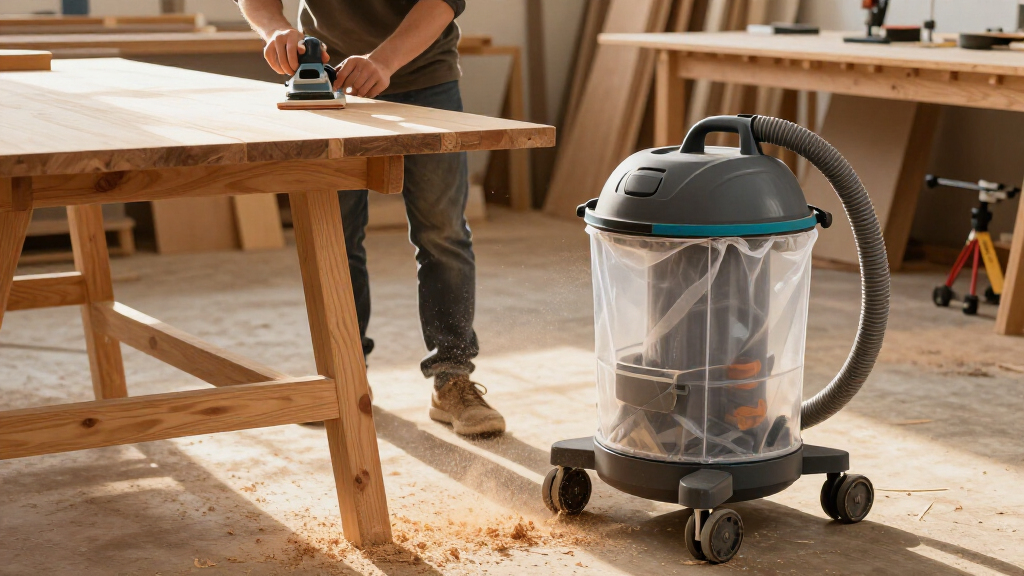
I evaluated these twelve woodworking dust collectors against the factors that actually decide whether a machine works in a real shop: airflow against resistance (not just peak CFM), filtration fineness (bag filtration versus canister filtration down to 1–2 microns), capacity and maintenance burden (bag size, cleanout access, filter cleaning), and footprint and mobility. Machines that separate chips before air hits the filter — the vortex cone designs — ranked higher because clogged filters are the single biggest performance killer in single-stage collectors.
The ranking logic followed buyer fit rather than raw specs. The JET took best overall because its canister filter and dual-voltage motor suit a permanent shop installation. Value picks went to machines that kept 1.5 HP-class airflow while cutting costs elsewhere, like the VEVOR vortex cone and WEN DC1300. Wall-mount and portable units were ranked for the specific scenarios they serve — single-station sanding and small-shop flexibility — rather than compared head-to-head against floor models they were never meant to replace.
Factors to Consider When Choosing Woodworking Dust Collectors
Before choosing between these twelve machines, it helps to understand what actually separates a dust collector that works from one that collects dust for six months and then sits clogged in a corner. These are the factors that shaped my rankings.CFM Ratings Only Tell Part of the Story
Manufacturers quote CFM under ideal conditions — no ducting, a clean filter, and short runs — which is nothing like a real shop with 10 feet of hose and a blast gate. A machine rated at 1,100 CFM might deliver 400 CFM at the tool once you account for hose resistance, and that difference decides whether your table saw actually stays clear. Filter fineness makes this worse: a 1-micron bag restricts airflow far more than a 30-micron collection bag, so a collector with fine filtration needs a bigger motor to compensate. When comparing machines, look at the motor horsepower and filter type together, not the CFM number alone. A common mistake is buying a high-CFM machine with coarse filtration, then wondering why fine sanding dust still coats every surface in the shop.
Filtration Micron Rating and Lung Health
Wood dust below 10 microns is the fraction that reaches your lungs, and it’s invisible in the air — by the time you see a haze, you’re already breathing it. A standard collection bag only captures chips and coarse dust; the fine particles pass straight through and back into the shop. Canister filters rated at 1–2 microns, like those on the JET and VEVOR vortex cone models, capture the fraction that matters for long-term health. The honest tradeoff: finer filters cost more upfront, restrict airflow, and require periodic cleaning — usually a paddle or crank system that knocks caked dust off the filter pleats. If you sand regularly with hardwoods or any exotic species, I’d treat fine filtration as non-negotiable rather than an upgrade.
Single-Stage, Two-Stage, and Vortex Separation
A single-stage collector pulls everything — chips and fine dust — through the impeller and into one bag. It’s simple and affordable, but chips wear the impeller over time and the filter clogs faster. Two-stage designs separate heavy chips into a collection drum before air reaches the filter, and vortex cone designs approximate this with a cone that spins debris out of the airstream. For a hobbyist running a small shop a few hours a week, single-stage is usually fine. For anyone generating serious chip volume from a planer or jointer, separation pays for itself in filter life and consistent suction. This is why the vortex cone machines ranked above comparable flat-bag models despite similar price points.
Footprint, Mobility, and Shop Layout
The right collector depends on how your shop is laid out, and this is where buyers most often misjudge their own needs. If you have one dedicated sanding station, a wall-mount unit frees your entire floor for lumber and work-in-progress. If you run machines scattered across a two-car garage, a floor model on a mobile base that you wheel between stations beats a permanently ducted system you can’t afford yet. Portable extractors on casters fill the gap for apartment woodworkers and those working outside. Be honest about whether you’ll actually run ductwork — many buyers plan for a centralized system, never install it, and end up dragging one machine around anyway. In that case, mobility should outrank raw capacity in your decision.
Noise, Voltage, and Installation Reality
Single-stage collectors are loud — often louder than the tool they’re serving — and this matters more than most buyers expect in attached garages or shared buildings. Canister models tend to run quieter than bag models because the canister dampens impeller noise slightly, but none of these machines are quiet. Voltage is the other practical gate: most 1.5 HP machines run on standard 115V circuits but can be wired for 230V, which is worth doing if your panel allows it, since it reduces circuit load and startup strain. Check whether your circuit is dedicated; a collector sharing a circuit with a table saw will trip breakers. Also measure your ceiling and doorway heights — a 50-gallon bag inflated on its frame adds surprising height to the listed footprint, and more than one buyer has discovered their collector doesn’t fit under a low garage door track.
Maintenance Burden Over Time
The collector you’ll still be happy with in three years is the one whose maintenance you can actually keep up with. Bag emptying is the constant: a 50-gallon bag means fewer trips, but a heavy, awkward trip when it comes; smaller drums empty easily but weekly. Filter cleaning is the bigger cost — pleated canisters need regular cleaning to maintain suction, and replacement canisters cost far more than bags. Machines with built-in cleaning mechanisms (a paddle or shaker handle) save you from disassembling the filter monthly. My advice: budget for consumables, not just the machine. Buyers who compare only purchase price often end up spending more on replacement filters in two years than the price gap between a bag machine and a canister machine.
Frequently Asked Questions
Is a 1 HP dust collector enough for a table saw?
It depends on the saw and the connection. A 1 HP wall-mount or portable unit producing around 560 CFM can handle a small contractor saw with a 4-inch port, especially for capturing the dust that falls below the blade. Where 1 HP machines fall short is the dust that a blade guard throws upward — a downdraft or overhead collection is needed for that regardless of collector size. If you run a cabinet saw with a 4-inch port and long duct runs, or you plan to serve multiple machines through blast gates, a 1.5 HP machine is the safer choice. The wall-mount units in this roundup are best treated as single-station machines rather than whole-shop solutions.
What’s the difference between a dust collector and a shop vac, and do I need both?
They solve different problems. A dust collector moves a large volume of air at low suction — ideal for capturing the massive chip output of a table saw, planer, or jointer through a 4-inch port. A shop vac moves a small volume of air at high suction — ideal for handheld power tools with 1.5 to 2.5-inch dust ports like routers, sanders, and track saws. Most home shops genuinely benefit from both, or from a portable extractor like the DYNAVEX that bridges the gap with a 12-gallon tank and tool-compatible hose sizing. Trying to run a sander off a dust collector usually fails because the 4-inch hose kills velocity, and trying to capture planer chips with a shop vac fills the drum in minutes and kills the motor.
How much better is a canister filter than a standard collection bag?
The difference is substantial for anything fine-dust related. A typical lower bag captures particles down to roughly 30 microns — chips and visible dust — while a 1 or 2-micron canister captures the particles that stay airborne and reach your lungs. In practice, that means less dust settling on every surface in the shop and meaningfully better air quality during and after sanding sessions. The costs are real too: canisters restrict airflow more, need periodic cleaning, and cost noticeably more to replace than bags. If you occasionally rip lumber and clean up with a broom, bags are fine. If you sand finishes or work with hardwoods regularly, the canister upgrade is the single best money you can spend in this category.
Do I need an auto-start feature on a dust collector?
Auto-start — where the collector powers on when it senses current from your tool — is one of those features that sounds like a luxury until you’ve lived with it. For anyone working at a single station, especially with handheld tools, it removes the friction of walking back and forth to flip a switch, which in practice means you’ll actually use collection instead of skipping it. The tradeoff is capacity: auto-start units like the BUCKTOOL 1.2 HP are typically smaller machines, so you’re trading whole-shop airflow for convenience. For a permanently ducted shop with blast gates at each machine, auto-start matters less because switching is part of your workflow. It’s most valuable for the small-shop hobbyist with one or two benchtop tools.
Can I duct multiple machines to one dust collector?
Yes, but only if you size the collector and ducting honestly. A 1.5 HP machine can typically serve two or three machines through 4-inch ducting with blast gates, provided only one gate is open at a time — running two machines simultaneously halves your airflow at each. Keep runs short and straight: every 90-degree elbow costs you real suction, and long horizontal runs let chips settle and clog the pipe. The other limit is static pressure — fine cartridge filters and long duct runs together can choke a machine that looked powerful on paper. Many hobbyists eventually add a separator (like a cyclone lid on a trash can) before the collector to catch chips, which extends filter life dramatically without upgrading the whole system.
Conclusion
The right choice here depends less on specs and more on the shop you actually have. For the best overall pick, the JET DC-1100VX-CK stands out for permanent installations — its vortex separation, 2-micron canister, and dual-voltage motor make it the machine that grows with a serious hobby shop. The best value is a close call between the VEVOR 1.5 HP vortex cone and the WEN DC1300: choose the VEVOR if fine-dust filtration matters more, and the WEN if raw chip-moving capacity and a 50-gallon bag at a lower price matter more. Best premium goes to the JET outright, simply because nothing else in this lineup combines canister filtration with that level of build for a dedicated shop.
For beginners and small shops, the BUCKTOOL 1.2 HP auto-start model makes the most sense — its tool-activated startup removes the habit barrier that makes new woodworkers skip dust collection, and its size fits a garage corner. The wall-mount crowd — anyone with a single sanding station and zero floor to spare — should choose between the VEVOR wall-mount and the POWERTEC DC5371, with the POWERTEC’s 1-micron bag winning for anyone concerned about fine dust. Finally, for portable and mixed-tool work, the DYNAVEX 12-gallon extractor handles handheld tools in a way none of the 4-inch machines can. Match the machine to your layout and your lungs will thank you for years.
Fall yard work Picks
leaf blowers
As an affiliate, we earn on qualifying purchases.