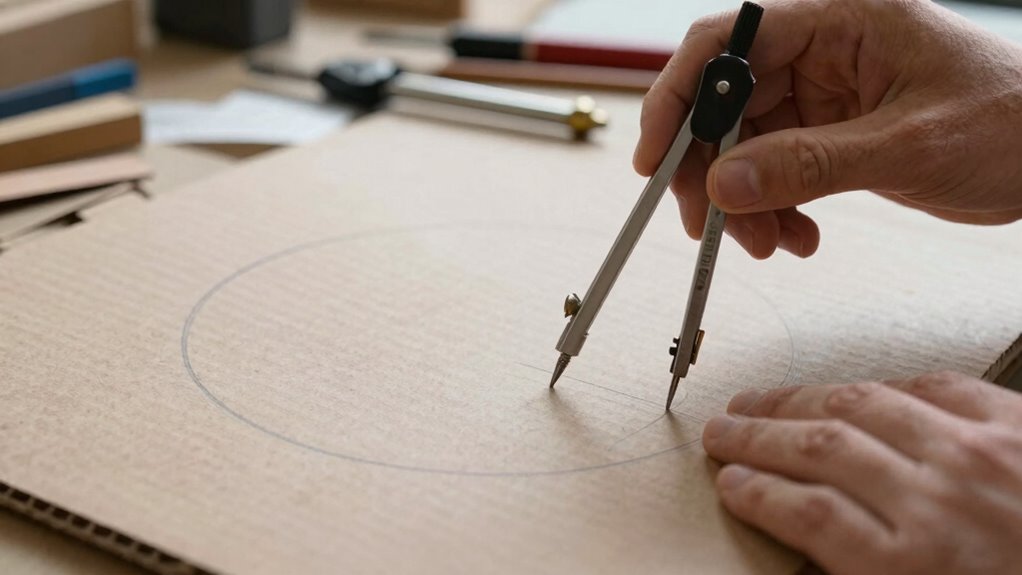

To cut perfect circles without a circle cutter, use a template with pre-made circles or draw your own guides with a compass or improvised tools like a string and pencil. Secure the template or material to prevent slipping, then carefully trace the edge. For even better accuracy, consider designing and printing your circles, then cut them out. Want more tips and tricks? Keep going to learn how to make your circles flawless every time.
Key Takeaways
- Use a stencil or template with a circular edge and trace carefully to ensure a perfect outline.
- Create a makeshift compass with a pin and string to draw consistent, smooth circles on your material.
- Print or draw your circle on paper, then cut along the lines for precise, reusable templates.
- For larger circles, secure a pin at the center and rotate a sharp blade or scissors around it for accuracy.
- Take your time, use proper tools, and secure the material to maintain control and achieve clean, perfect circles.

Have you ever struggled to cut a perfect circle? It’s a common challenge, especially when you don’t have a circle cutter on hand. But don’t worry—there are simple, effective ways to achieve clean, precise circles using everyday tools and techniques. One of the easiest methods involves using circle templates, which are handy stencils with various-sized circles. These templates give you a clear guide, making it easier to trace perfect circles onto your material. If you’re working with paper, cardboard, or thin plastic, simply place the template over your surface, hold it steady, and trace around the edge with a pencil or pen. Then, cut along the traced line with scissors or a craft knife. For thicker materials, you might want to secure the template in place with tape to prevent slipping, ensuring your circle remains accurate.
Using circle templates makes tracing perfect circles quick and easy.
If you’re into digital design, you can also create your circle templates digitally. Most graphic design software, like Adobe Illustrator or free options such as Inkscape, allow you to generate perfect circles with precise measurements. Once you’ve designed your circle, you can print it out on regular paper and cut around the printed edge. This method guarantees a high level of accuracy, especially if you need multiple circles of the same size. After cutting out your printed circle template, you can use it as a stencil for various projects. This approach works well for crafts, decorating, or even creating templates for sewing or woodworking.
For larger circles, you can draw your own using a compass, which is a traditional tool for creating perfect circles. Set the compass to your desired radius, anchor it at a point on your surface, and swing the pencil arm around to draw the circle. If you don’t have a compass, you can improvise with a piece of string or wire. Tie one end to a pencil and the other to a pin or thumbtack, then anchor the pin at the center point. Keep the string taut while you draw the circle by moving the pencil around the center. This simple trick helps you get a smooth, even circle without specialized tools. Additionally, understanding the precision of tools can help you achieve the best results in your projects.
In all cases, patience is key. Take your time to trace carefully and cut slowly along your lines. Using these techniques, whether with physical circle templates, digital designs, or improvised tools, you can cut perfect circles with confidence—even without a dedicated circle cutter.
Frequently Asked Questions
Can I Cut Perfect Circles on Uneven Surfaces?
You can cut perfect circles on uneven surfaces by focusing on surface stability and using precise cutting techniques. Secure the material firmly to prevent slipping, and consider using a template or stencil to guide your cut. Use a steady hand and slow, controlled motions with a sharp blade or craft knife. This approach helps you maintain accuracy despite the uneven surface, ensuring a cleaner, more precise circle.
What Tools Work Best for Small Diameter Circles?
Did you know that a craft knife can easily cut circles as small as 1/4 inch? For small diameter circles, a sharp craft knife is your best tool. Use stencil templates to trace perfect circles, then carefully cut along the lines. This method provides precision and control, making it ideal for detailed projects. Just make certain your blades are sharp, and work slowly to achieve clean, accurate cuts.
How Do I Prevent My Paper From Tearing?
To prevent tearing your paper, choose high-quality paper that’s less prone to ripping. Maintain a steady cutting speed, avoiding rushing, which can cause tears. Use a sharp blade or craft knife to guarantee clean cuts and reduce stress on the paper. Support your paper with a cutting mat or a firm surface, and take your time. These tips help you achieve smooth, tear-free circles every time.
Is It Possible to Cut Circles Freehand Accurately?
With steady hands and sharp focus, you can achieve stunning, smooth, and satisfying circles freehand. Practice precision by carefully sketching your circle first, then slowly and steadily following the traced line. Using a fine pen or craft knife helps maintain control, ensuring circle accuracy. Remember, patience and persistence are key—your freehand finesse will improve over time, turning imperfect beginnings into impressive, professional-looking perfect circles.
How Do I Measure for Perfect Circle Dimensions?
To measure perfect circle dimensions, start with precise measuring techniques like using a ruler or tape measure to determine the diameter. Mark the center point, then use circle templates to trace the desired size accurately. Make certain your measurements are clear and double-checked. This combination of measuring techniques and templates helps you create perfect circles, even without specialized tools, giving you professional-looking results every time.
Conclusion
Now that you’ve mastered cutting perfect circles without a cutter, you’ve uncovered your creative potential. Think of each circle as a tiny universe, a complete world within your hands. With patience and practice, you’ll craft endless shapes that symbolize harmony and balance. Remember, your steady hand is the compass guiding you through this artistic journey. Keep honing your skills, and soon, every cut will reflect your confidence, turning simple materials into beautiful, meaningful circles that speak of your craftsmanship.