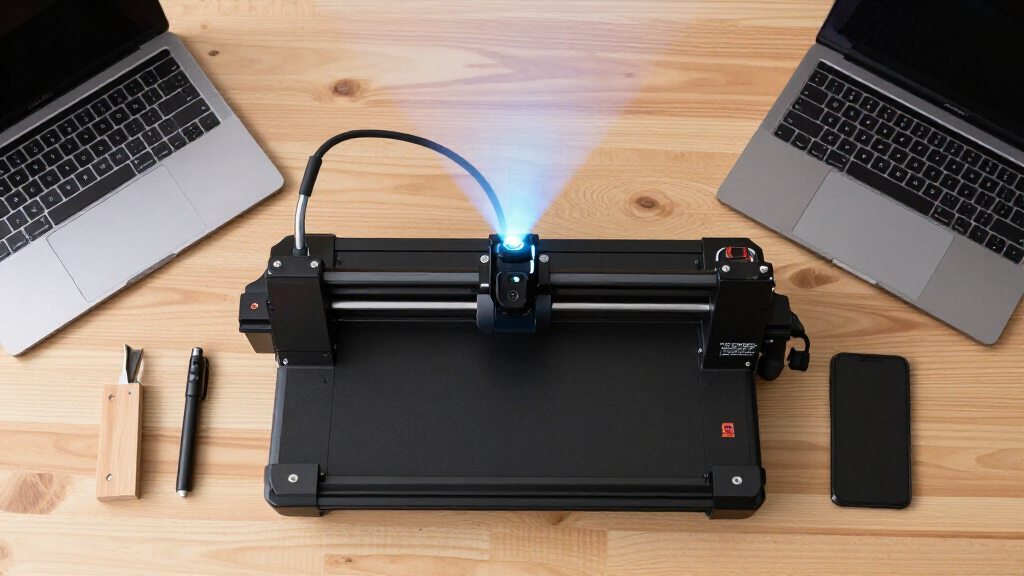

TL;DR

Get business pricing on tools and workshop supplies
- Business-only prices and quantity discounts
- Tax-exempt purchasing
- Multiple users, one account, clear invoices
A team of engineers has demonstrated that a conventional pen plotter can be used to create 3D holographic images. This breakthrough could make holography more accessible and affordable. The development is still in experimental stages, with further testing needed.
Researchers have demonstrated a method to produce holograms using a standard pen plotter, a device typically used for drawing on paper. This breakthrough, announced in March 2024, suggests a new, accessible approach to creating 3D images, potentially lowering the barrier to holography technology. The development involves using precise control of the plotter’s pen to manipulate light and create three-dimensional visual effects. This innovation could impact fields ranging from entertainment to medical imaging, making holographic displays more widely available.
The research team, led by engineers at a university laboratory, adapted a common pen plotter by integrating a laser and a reflective surface to project light in specific patterns. By controlling the movement of the pen and the laser’s focus, they managed to produce dynamic, three-dimensional images visible without special glasses. The process involves modulating light interference patterns, a technique similar to traditional holography but implemented with a desktop device.
According to the project’s lead researcher, Dr. Emily Carter, “This method leverages the precise motion control of a standard plotter combined with laser manipulation to generate holographic images in mid-air.” The team demonstrated a series of floating 3D shapes and animations, which appeared to hover in space when viewed from different angles. The setup is relatively simple and inexpensive compared to conventional holography equipment, which often requires costly lasers and complex optics.
While the prototype has shown promising results, the team emphasizes that it is still in the experimental stage. They are currently working to improve image clarity, stability, and color fidelity, which are challenges common to early holographic technologies.
Potential Impact on Accessible Holography
This development could democratize holography by providing a low-cost, easy-to-use method for creating 3D images. Unlike traditional holographic setups that require expensive lasers and specialized equipment, a standard pen plotter combined with simple optical components could enable hobbyists, educators, and small businesses to generate holograms. It may also inspire new applications in virtual reality, medical imaging, and advertising.
However, the current limitations in image resolution and stability mean that widespread commercial use is still some distance away. Still, the approach offers a promising avenue for research and development in accessible holography.
As an affiliate, we earn on qualifying purchases.
Innovative Use of Common Devices in Holography
The idea of using everyday devices for advanced imaging is not new, but this is one of the first instances where a pen plotter—a device typically used for drafting or artistic drawing—has been adapted for holographic display. Previous efforts in holography involved complex optical setups, but recent advances focus on miniaturization and cost reduction.
This project builds on prior research into laser manipulation and light interference, applying these principles through a familiar, accessible device. The concept aligns with broader trends in making advanced imaging technology more affordable and portable, similar to how 3D printing evolved from industrial to desktop use.
While other prototypes have used digital projectors or specialized displays, the plotter-based approach is unique in its simplicity and potential for widespread adoption. The researchers have been working on this concept since 2022, with the latest results emerging in early 2024.
“This method leverages the precise motion control of a standard plotter combined with laser manipulation to generate holographic images in mid-air.”
— Dr. Emily Carter
As an affiliate, we earn on qualifying purchases.
Unresolved Challenges in Image Quality and Stability
It is not yet clear how well the technology will scale for commercial or consumer use. Challenges such as improving image resolution, color accuracy, and stability over time remain unresolved. The team is actively researching solutions, but these issues could take years to fully address.
Additionally, there is uncertainty about how easily the setup can be adapted for different applications or integrated into existing display systems. Further testing and development are needed to determine its practical viability.
As an affiliate, we earn on qualifying purchases.
Next Steps in Development and Testing
The research team plans to refine the hologram production process, focusing on enhancing image clarity and stability. They aim to develop a portable prototype that could be tested in real-world scenarios, such as educational demonstrations or small-scale advertising displays. Further collaboration with optical engineers and industry partners is also anticipated to accelerate development.
Expect additional publications detailing technical improvements and potential commercial pathways over the next 12 to 24 months. The team also intends to explore more complex animations and multi-color holograms.
As an affiliate, we earn on qualifying purchases.
Key Questions
Can this technology produce full-color holograms?
Currently, the prototype primarily produces monochrome images, but researchers are exploring methods to incorporate color through advanced laser modulation and additional optical components.
How affordable is this setup compared to traditional holography equipment?
Because it uses a standard pen plotter and simple optical components, the cost is significantly lower—potentially a fraction of traditional holography systems, which require expensive lasers and optics.
Is this technology ready for commercial use?
No, the technology is still in the experimental stage. Further development is needed to improve image quality, stability, and ease of use before commercial deployment.
What applications could benefit from this innovation?
Potential applications include educational demonstrations, artistic installations, advertising displays, and medical imaging prototypes, especially where low-cost, portable solutions are advantageous.
Source: hn
Fall yard work Picks
leaf blowers
As an affiliate, we earn on qualifying purchases.