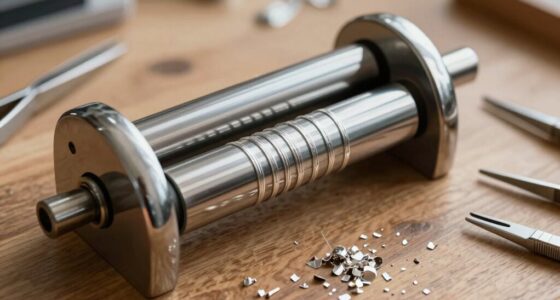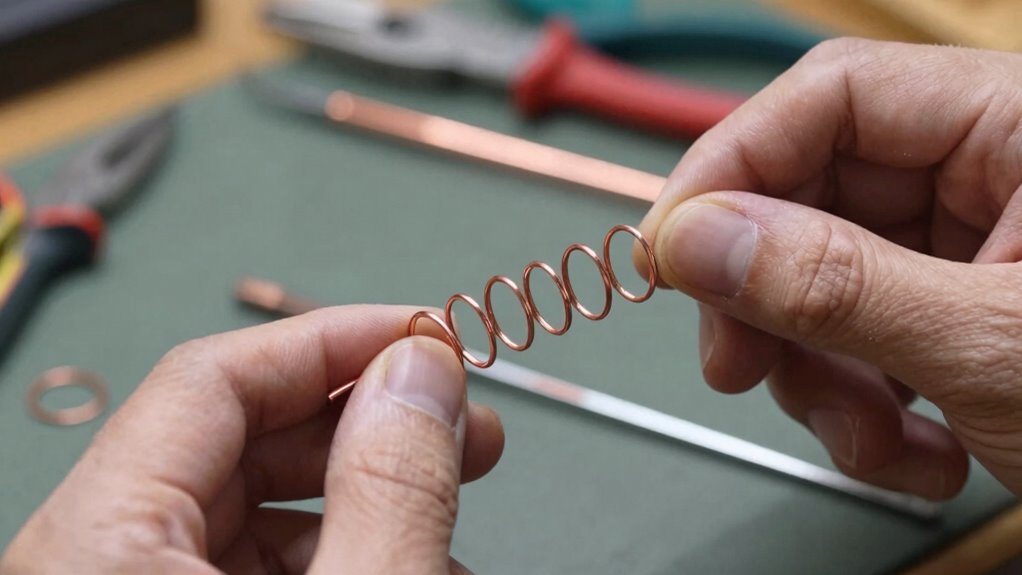

To make wire loops even every time, start by selecting the right gauge of wire for your project and measure each piece carefully before bending. Use a round-nose plier that fits the desired loop size, gripping the wire just above the bend point. Bend the wire around the plier with steady pressure, keeping your hand movements consistent. Check each loop against your target size, and refine as needed. Keep practicing these techniques, and you’ll master creating uniform loops with ease.

Get business pricing on tools and workshop supplies
- Business-only prices and quantity discounts
- Tax-exempt purchasing
- Multiple users, one account, clear invoices
Key Takeaways
- Measure and mark wire lengths consistently before forming each loop.
- Use a jig or template to replicate exact loop sizes repeatedly.
- Select the appropriate wire gauge based on desired loop size and strength.
- Use round-nose pliers that fit the loop size and bend wire with steady, even pressure.
- Regularly compare loops to measurements and gently reshape for uniformity.

Have you ever struggled to make wire loops even? If so, you’re not alone. Achieving perfectly uniform wire loops can be tricky, especially when you’re just starting out. The key lies in understanding how wire gauge and loop size influence each other. Wire gauge determines the thickness of your wire—thinner wires are easier to manipulate, but thicker wires hold their shape better. Loop size refers to how big or small your loops are, and it’s essential to keep them consistent for a professional look. When you choose the right wire gauge and set a specific loop size, you’ll find it easier to produce uniform loops every time.
Mastering wire gauge and loop size is essential for creating uniform, professional-looking wire loops every time.
Start by selecting the appropriate wire gauge for your project. Thinner gauges, such as 24 or 26 gauge, are more flexible and easier to work with when making small or delicate loops. However, if you need sturdy, larger loops, a thicker gauge like 18 or 20 might be better. Knowing your desired loop size helps you determine which wire gauge to use because thicker wire naturally results in larger, more rigid loops, while thinner wire creates smaller, more delicate loops. Before you begin, measure out the wire length you need for each loop—this step ensures consistency and helps you avoid wasting wire.
Next, focus on your tools and technique. Use a round-nose plier that comfortably fits the size of the loops you want to create. To make uniform loops, grip the wire just above the point where you want the loop to start, then bend the wire around the jaw of the plier, maintaining even pressure. Keep your wrist steady and use the same motion each time. To ensure each loop is the same size, mark the starting point on your wire with a marker or a small piece of tape for consistency. As you bend the wire around the plier, keep your hands steady and use the same amount of pressure for each loop. Developing a consistent technique is essential for professional results.
Once you’ve formed a loop, check its size against your desired measurement. If it’s too small or large, gently reshape it by adjusting the wire with your fingers or pliers. For perfect uniformity, you might consider creating a jig—a simple guide that helps you bend each loop to the exact same size. This could be as simple as a piece of scrap wire with marked measurements or a small dowel or tube of the same diameter as your desired loop size. Using this method, each new loop will match perfectly, saving you time and frustration. With practice and attention to detail, you’ll develop a steady hand and a keen eye for consistent, even wire loops every time.
As an affiliate, we earn on qualifying purchases.
Frequently Asked Questions
Can Different Wire Gauges Affect Loop Consistency?
Yes, different wire gauges considerably affect loop consistency. Thicker wires are stiffer and harder to bend, making it more challenging to create uniform loops, while thinner gauges are more flexible and easier to shape evenly. When considering wire gauge considerations, you should understand how gauge impacts flexibility and stiffness, which are key loop consistency factors. Adjust your tools and technique accordingly to guarantee your loops stay even regardless of wire gauge.
What’s the Best Tool for Making Uniform Wire Loops?
A pair of round-nose pliers is your best bet for making uniform wire loops. You’ll want to choose the right wire gauge—thinner wire often forms neater, more consistent loops—and follow some loop forming tips like gripping the wire firmly at the base and turning smoothly. These tools help you maintain control and precision, ensuring each loop looks polished and professional, no matter your skill level.
How Do Temperature Changes Impact Wire Loop Formation?
Temperature changes impact wire loop formation through thermal expansion and wire contraction. When it gets hotter, your wire expands, making loops slightly larger and easier to shape. Conversely, cooling causes the wire to contract, tightening the loops and potentially making them uneven. You should work in a controlled environment, and if needed, gently heat or cool the wire to maintain consistent size, ensuring your loops stay uniform every time.
Are There Techniques for Making Large Loops Evenly?
Like a seasoned artist with a compass, you can make large loops evenly by mastering precise loop measurement and wire bending techniques. Use calipers or a ruler to mark consistent lengths, ensuring each loop matches. Employ pliers for controlled bends and practice steady hands. Remember, patience is key—just as a craftsman in a bygone era would perfect their work—so take your time to achieve perfect, large, and uniform wire loops.
How to Fix Uneven Loops Without Starting Over?
To fix uneven loops without starting over, first measure your loop carefully to identify where it’s off. Use pliers to gently reshape and adjust the loop, focusing on even loop shaping. For larger discrepancies, carefully enlarge or reduce the loop size, then re-measure to guarantee consistency. This quick adjustment helps you achieve uniform loops, saving time and maintaining your project’s neat appearance.
As an affiliate, we earn on qualifying purchases.
Conclusion
With practice, you’ll find that making even wire loops becomes second nature, almost as if the universe aligns to guide your hands. Sometimes, it’s those small, unexpected moments—the perfect grip or a slight bend—that turn an ordinary loop into something flawless. Coincidences like these remind you that craftsmanship is as much about patience and intuition as technique. Keep at it, and you’ll notice your loops becoming more consistent, almost as if they’re destined to be perfectly even every time.
As an affiliate, we earn on qualifying purchases.
professional wire loop forming tools
As an affiliate, we earn on qualifying purchases.
As an affiliate, we earn on qualifying purchases.
Fall yard work Picks
leaf blowers
As an affiliate, we earn on qualifying purchases.