
TL;DR

Get business pricing on tools and workshop supplies
- Business-only prices and quantity discounts
- Tax-exempt purchasing
- Multiple users, one account, clear invoices
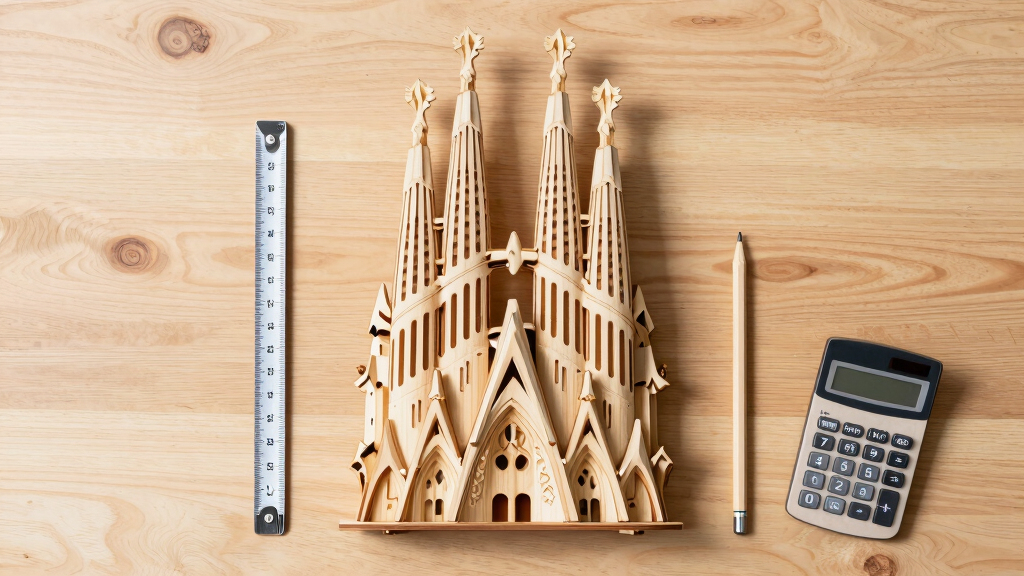
A team of researchers has uncovered previously unknown mathematical patterns in the design of Barcelona’s Sagrada Familia. These findings shed light on Gaudí’s use of complex geometry, influencing the basilica’s architecture. The discovery enhances understanding of the monument’s structural and aesthetic principles.
Researchers have uncovered new mathematical patterns embedded in the design of Barcelona’s Sagrada Familia, revealing Gaudí’s sophisticated use of geometry that influences the basilica’s structure and aesthetics. This discovery offers fresh insights into the architect’s methods and the basilica’s enduring complexity.
The research, conducted by a team of mathematicians and architectural historians, identified intricate geometric arrangements within the basilica’s structure, including specific ratios and symmetrical patterns that Gaudí employed consciously. These patterns involve complex arrangements of hyperbolic paraboloids, catenary arches, and the use of the Fibonacci sequence and golden ratio in key proportions.
According to Dr. Laura Martinez, lead researcher from the University of Barcelona, the team used advanced computational analysis to map the basilica’s design, revealing mathematical relationships that were previously unrecognized. “Gaudí’s work was deeply rooted in mathematical principles, which he integrated seamlessly into the organic forms of the basilica,” she explained.
The findings suggest that Gaudí’s design was not only artistically inspired but also based on precise mathematical frameworks, which contributed to the stability and harmony of the structure. The research also indicates that these mathematical patterns could inform ongoing construction efforts, ensuring structural integrity and aesthetic consistency.
Implications for Architectural and Structural Understanding
This discovery enhances understanding of Gaudí’s architectural genius, highlighting how advanced mathematics underpinned his organic and innovative designs. It also has practical implications for the ongoing construction and preservation of the basilica, potentially guiding future engineering approaches. For visitors and scholars, it deepens appreciation of the basilica as a masterpiece of mathematical and artistic integration, reinforcing its status as a UNESCO World Heritage Site.
geometric architectural model kits
As an affiliate, we earn on qualifying purchases.
As an affiliate, we earn on qualifying purchases.
Historical Use of Geometry in Gaudí’s Work
Gaudí’s architectural approach has long been associated with organic forms and innovative structural techniques. Previous studies have suggested that he employed geometric principles, such as catenary arches and hyperboloids, but detailed mathematical analysis has been limited. The Sagrada Familia, begun in 1882, remains unfinished but continues to be a focus of scholarly research. Recent advances in computational analysis have allowed researchers to revisit Gaudí’s designs with new tools, revealing hidden mathematical relationships.
The basilica’s complex shapes and proportions have long fascinated architects and mathematicians, but until now, specific underlying mathematical frameworks remained largely speculative. This new research provides concrete evidence of Gaudí’s deliberate use of advanced geometry, which may have contributed to the structure’s resilience and aesthetic harmony.
“Gaudí’s work was deeply rooted in mathematical principles, which he integrated seamlessly into the organic forms of the basilica.”
— Dr. Laura Martinez
architectural drawing tools for complex designs
As an affiliate, we earn on qualifying purchases.
As an affiliate, we earn on qualifying purchases.
Unresolved Aspects of Gaudí’s Mathematical Approach
While the research has identified specific mathematical patterns, it remains unclear how consciously Gaudí employed these principles during the design process. The extent to which these patterns influenced all aspects of the basilica’s construction, or if they were discovered posthumously through analysis, is still under investigation. Additionally, the practical application of these findings to ongoing construction efforts has yet to be fully tested.
mathematical pattern books for architects
As an affiliate, we earn on qualifying purchases.
As an affiliate, we earn on qualifying purchases.
Future Research and Construction Applications
Researchers plan to further analyze other parts of the basilica to determine whether Gaudí’s use of mathematics was more widespread than previously thought. Structural engineers involved in the ongoing construction aim to incorporate these mathematical insights to enhance stability and aesthetic precision. Public exhibitions and academic publications are also expected to disseminate these findings more broadly, deepening appreciation for Gaudí’s innovative methods.
Gaudí inspired architectural puzzles
As an affiliate, we earn on qualifying purchases.
As an affiliate, we earn on qualifying purchases.
Key Questions
How did researchers uncover the mathematical patterns in Sagrada Familia?
Using advanced computational analysis and geometric mapping, researchers identified specific ratios and arrangements within the basilica’s structure, revealing underlying mathematical principles.
What specific mathematical concepts did Gaudí use in his design?
The research points to hyperbolic paraboloids, catenary arches, Fibonacci sequences, and the golden ratio as key elements in Gaudí’s design.
Does this change how the basilica is being built today?
Yes, ongoing construction efforts are considering these mathematical insights to improve structural integrity and aesthetic accuracy.
Was Gaudí aware of these mathematical principles?
It remains uncertain whether Gaudí consciously employed these specific patterns or if they were discovered through later analysis, though evidence suggests deliberate integration.
Source: hn
Halloween Picks
halloween
As an affiliate, we earn on qualifying purchases.