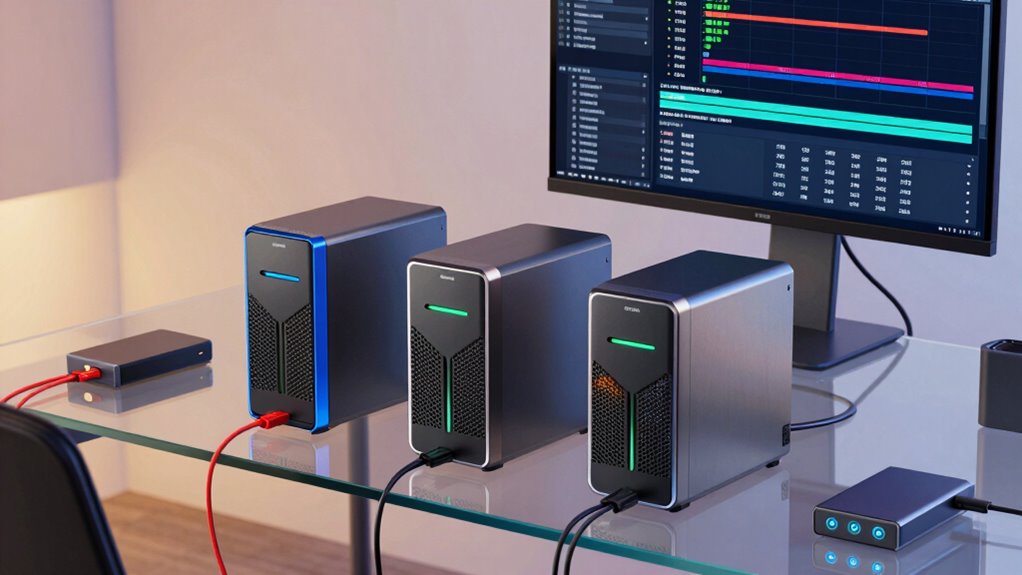

For creative studios in 2026, I recommend the TerraMaster F8 SSD Plus NAS for scalable capacity and fast SSD performance, perfect for large projects. The QNAP TS-433eU offers a compact design with 2.5GbE ports, ensuring swift access and transfer speeds. finally, the OWC Mercury Elite Pro 8TB RAID enclosure provides flexible backup options with robust RAID support. Keep exploring to discover more about choosing the ideal storage setup for your needs.
Key Takeaways
- Prioritize NAS models with high storage capacity and scalability, such as 8-bay or 2-bay systems, for long-term backup needs.
- Select NAS devices with multi-gigabit Ethernet (10GbE or 2.5GbE) for fast data transfer of large creative files.
- Opt for SSD-based NAS for lower latency and higher speeds essential for creative workflows.
- Ensure robust security features like encrypted protocols, MFA, and regular updates to protect valuable creative data.
- Consider budget-friendly options that balance performance, capacity, and future expandability for a creative studio environment.
| TERRAMASTER F8 SSD Plus NAS (Diskless) | 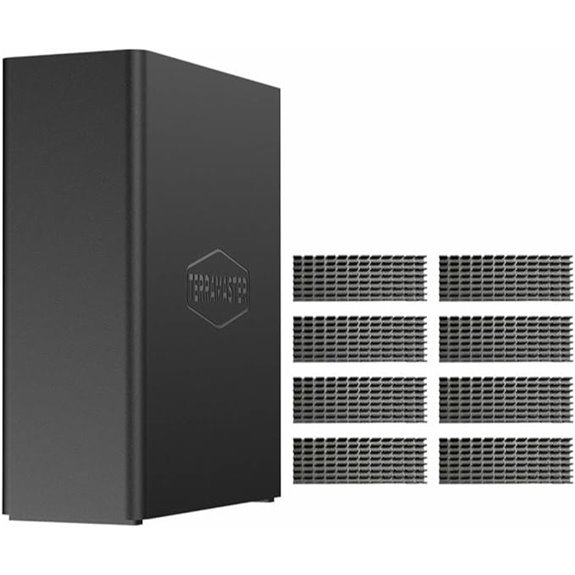 | High-Performance Powerhouse | Storage Capacity: Up to 64TB (8x8TB NVMe SSDs) | Connectivity: 10GbE port | Drive Bays: 8 NVMe SSD slots | VIEW LATEST PRICE | See Our Full Breakdown |
| QNAP TS-433eU Compact 2.5GbE NAS with NPU |  | Space-Saving AI-Enabled | Storage Capacity: Not specified (designed for network storage, likely scalable) | Connectivity: Dual 2.5GbE ports | Drive Bays: 2 drive bays (SSD or HDD support implied) | VIEW LATEST PRICE | See Our Full Breakdown |
| OWC Mercury Elite Pro 8TB 2-Bay RAID Enclosure | 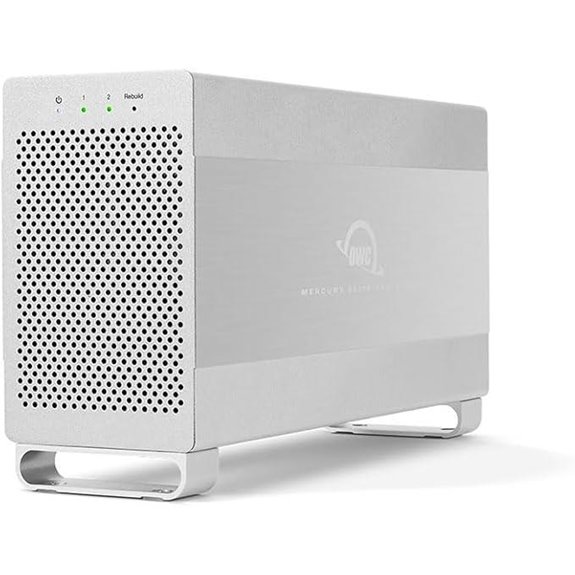 | Versatile RAID Storage | Storage Capacity: 8TB (2x4TB HDDs in RAID) | Connectivity: USB 3.2, eSATA, network (not specified) | Drive Bays: 2 SATA bays | VIEW LATEST PRICE | See Our Full Breakdown |

More Details on Our Top Picks
-

QNAP TS-433eU Compact 1U Short-Depth rackmount 2.5GbE NAS, Affordable Edge Storage with NPU Acceleration (Diskless)
- Processor: ARM 4-core Cortex-A55 2.0GHz
- Memory: 4GB DDR4 RAM
- Network Speed: Dual 2.5GbE ports
As an affiliate, we earn on qualifying purchases.
TERRAMASTER F8 SSD Plus NAS (Diskless)
If you’re looking for a high-performance NAS that’s perfect for creative studios, the TERRAMASTER F8 SSD Plus NAS stands out with its all-SSD design and blazing transfer speeds. I appreciate its 8-bay setup that supports up to 64TB with NVMe SSDs, perfect for demanding tasks. Powered by an 8-core Core i3 processor and 16GB DDR5 RAM, it handles virtualization, multimedia, and backups effortlessly. Its compact, lightweight form makes placement flexible, while advanced cooling keeps noise below 19dB. With 10GbE connectivity and enterprise backup features, it’s reliable for high-speed workflows and data security, making it an excellent choice for professional environments.
- Storage Capacity:Up to 64TB (8x8TB NVMe SSDs)
- Connectivity:10GbE port
- Drive Bays:8 NVMe SSD slots
- Processor Type:Core i3-N305 (x86)
- Target Use:Virtualization, multimedia, small business/home
- Backup/Software Features:TerraMaster BBS, snapshot ransomware protection
- Additional Feature:Tool-free SSD upgrades
- Additional Feature:Ultra-quiet operation below 19dB
- Additional Feature:Compact, palm-sized form factor
-

OWC Mercury Elite Pro Dual 8TB RAID USB 5Gb/s + eSATA Storage Solution
- Drive Bays: Supports two 3.5-inch SATA drives
- RAID Modes: Supports RAID 0, 1, SPAN, JBOD
- Pre-configured RAID: High-speed RAID 0 for maximum throughput
As an affiliate, we earn on qualifying purchases.
QNAP TS-433eU Compact 2.5GbE NAS with NPU
The QNAP TS-433eU Compact 2.5GbE NAS with NPU stands out as an ideal choice for creative studios that need reliable, space-saving storage with advanced AI features. Its compact 1U rackmount design fits well in tight spaces, offering affordability without sacrificing performance. Powered by a 4-core Cortex-A55 processor and 4GB RAM, it handles large data transfers smoothly. Dual 2.5GbE ports facilitate fast sharing, while the built-in NPU enhances AI tasks like face recognition with QuMagie. Plus, it supports backing up Google Workspace and Microsoft 365, with ransomware protection and snapshot features, making it a versatile solution for studio backups.
- Storage Capacity:Not specified (designed for network storage, likely scalable)
- Connectivity:Dual 2.5GbE ports
- Drive Bays:2 drive bays (SSD or HDD support implied)
- Processor Type:ARM Cortex-A55
- Target Use:Edge storage, AI, data protection
- Backup/Software Features:Backup for cloud services, snapshot protection
- Additional Feature:Built-in AI NPU
- Additional Feature:Short-depth 1U rackmount
- Additional Feature:Supports Google/Microsoft backups
OWC Mercury Elite Pro 8TB 2-Bay RAID Enclosure
Designed for high-demand production studios and serious creative professionals, the OWC Mercury Elite Pro 8TB 2-Bay RAID Enclosure offers flexible RAID configurations and fast transfer speeds, making it an excellent choice for those needing reliable, high-performance storage. It supports two 3.5-inch SATA drives and works seamlessly with Mac and PC systems. With options like RAID 0 for speed and RAID 1 for security, it adapts to various workflows. Connectivity includes USB 3.2 Gen 1 and eSATA, supporting high-speed data transfer. The included accessories, simple setup, and a one-year warranty make it a solid, versatile solution for HD video, backups, and secure storage.
- Storage Capacity:8TB (2x4TB HDDs in RAID)
- Connectivity:USB 3.2, eSATA, network (not specified)
- Drive Bays:2 SATA bays
- Processor Type:Not specified (RAID enclosure, no CPU)
- Target Use:HD video workflows, backup, data security
- Backup/Software Features:RAID modes, quick setup, backup options
- Additional Feature:Multiple RAID mode options
- Additional Feature:USB 3.2 Gen 1 interface
- Additional Feature:Supports 7200 RPM HDDs
Factors to Consider When Choosing NAS Storage for Creative Studio Backups
When choosing NAS storage for my creative studio backups, I focus on several key factors. I consider how much storage capacity I need, how fast the system should perform, and which connectivity options fit my setup. Additionally, I evaluate data security features and make certain the solution fits within my budget to meet my specific requirements.
Storage Capacity Needs
To choose the right NAS storage for your creative studio backups, you need to carefully evaluate your current and future data needs. Start by examining the size of your projects, like high-res videos or large design files, to determine your storage requirements. Think about how your data volume might grow over time and select a scalable solution that allows adding or replacing drives easily. Be aware of the capacity limits of different NAS configurations—whether you need an 8-bay or 2-bay system—to ensure it can handle your long-term backup needs. Additionally, consider redundancy options like RAID to protect your valuable data, balancing storage capacity with data security. Planning ahead now helps you avoid costly upgrades later.
Performance Requirements
Choosing the right NAS storage for creative studio backups means paying close attention to performance factors that impact your workflow. Fast network interfaces, like 10GbE or 2.5GbE ports, are essential for transferring large files quickly. Utilizing SSD-based NAS provides lower latency and higher read/write speeds, which is critical for editing and real-time projects. Multi-core processors and ample RAM ensure smooth multitasking and support multiple creative applications simultaneously. RAID configurations, such as RAID 0 or RAID 10, can boost performance by striping data across drives, increasing throughput. Additionally, an easily upgradable or expandable storage system guarantees scalability as your data needs grow. Prioritizing these performance factors helps maintain efficiency, minimizes bottlenecks, and keeps your creative work flowing seamlessly.
Connectivity Options
Selecting the right connectivity options for your NAS is essential to guarantee smooth data transfer and seamless integration with your creative workflow. I look for NAS devices with multi-gigabit Ethernet ports, like 2.5GbE or 10GbE, to handle large files quickly and efficiently. It’s also important to evaluate the variety of ports available, such as USB, eSATA, and Thunderbolt, to ensure compatibility with all my devices. Multiple network interfaces allow link aggregation, boosting bandwidth and providing redundancy, which is critical for uninterrupted work. I also consider Wi-Fi support for flexible placement without compromising wired speed. Finally, reliable network protocols like SMB, AFP, and NFS are essential for smooth file sharing across different operating systems, keeping my creative processes flowing effortlessly.
Data Security Measures
Reliable data security measures are essential for protecting my creative studio backups from cyber threats and data loss. I prioritize regular firmware updates and automatic security patches, which help close vulnerabilities before they can be exploited. Using encrypted protocols like SMB 3.0 or NFS ensures data remains secure during transfer, preventing unauthorized access. I also enable multi-factor authentication (MFA) for NAS login, adding an extra layer of protection against unauthorized attempts. Scheduled automated backups with versioning and snapshots give me recovery options in case of ransomware or corruption. To minimize exposure, I restrict network access through IP whitelisting and VLAN segmentation. These measures collectively strengthen my data security, giving me confidence that my creative assets are protected against evolving cyber threats.
Budget Considerations
When evaluating NAS storage options for my creative studio, I focus on balancing my budget with the device’s features and performance. I start by determining my budget range and comparing the total costs, including drives and accessories, to guarantee affordability. I consider the price difference between all-SSD solutions and traditional HDD-based systems, weighing performance needs against expenses. It’s important to account for future costs like additional drives, expansion units, or software upgrades. I also evaluate the long-term value—investing in higher-capacity or higher-performance NAS units can be more cost-effective over time than cheaper, lower-capacity options. Keep in mind that cheaper models may have limited features or slower speeds, which could lead to additional costs later if upgrades become necessary.
Frequently Asked Questions
How Scalable Are These NAS Options for Future Storage Needs?
These NAS options are quite scalable, and I’ve found they can adapt to my future storage needs. I typically choose models that support expansion units or additional drive bays, which makes upgrading straightforward. While some might have limits, I prefer systems with flexible configurations. That way, I guarantee my studio’s storage grows with my projects without constant replacements, giving me peace of mind for years to come.
What Are the Energy Consumption Differences Among These NAS Devices?
Energy consumption varies among NAS devices, and I’ve noticed that models with multiple drives or more powerful processors tend to use more power. For instance, high-end NAS units can consume around 50-70 watts during operation, while more energy-efficient models use as little as 20-30 watts. I recommend checking each device’s specifications, especially if you’re looking to minimize energy costs and environmental impact in your studio.
Do They Support Remote Access and Collaboration Features?
Yes, these NAS devices support remote access and collaboration features. I can easily connect to my storage from anywhere, whether I’m in the studio or on the go. They often include apps or web portals that allow me to share files securely and collaborate with my team in real-time. This flexibility boosts my productivity and guarantees my creative projects stay accessible and up-to-date, no matter where I am.
How Do They Perform Under Heavy Workload or Multiple Simultaneous Users?
Often, it’s surprising how well a NAS handles heavy workloads, almost like it’s built for chaos. I’ve found that top-tier models in 2026 are designed to sustain multiple users and intense tasks without breaking a sweat. They efficiently manage read/write speeds, ensuring everyone stays productive. So, whether it’s simultaneous editing or large backups, these NAS devices deliver seamless performance, making them reliable partners in a busy creative environment.
What Are the Warranty and Customer Support Options for Each Device?
I always check the warranty and support options before choosing a NAS. Most brands offer at least a two-year warranty, with some providing extended coverage. Customer support varies—some offer 24/7 live chat or phone support, while others rely on online knowledge bases. I prefer devices with responsive support teams and clear warranty policies, so I can get quick help if issues arise, ensuring my studio’s data stays protected and accessible.
Conclusion
Choosing the right NAS storage is like finding the perfect safety net for your creative jump. Whether I go for the versatile TERRAMASTER F8 SSD Plus, the compact QNAP TS-433eU, or the robust OWC Mercury Elite Pro, each offers unique strengths. Remember, the right choice depends on your needs. Invest wisely, and your backups will be as secure as a vault, giving you peace of mind to focus on what you do best—creating.