
TL;DR
Start your woodworking tool set with the tools your first project needs: accurate measuring and marking tools, a way to cut, a drill, clamps, a stable work surface, and safety gear. Add tools as you learn what you use repeatedly, and count blades, bits, batteries, dust control, and sharpening supplies in your budget.
A box can go from square and sturdy to wobbly because one board was marked a few millimeters off. That is why a beginner woodworking setup needs more than a pile of shiny tools: it needs the right tools for accurate, safe work.

Get business pricing on tools and workshop supplies
- Business-only prices and quantity discounts
- Tax-exempt purchasing
- Multiple users, one account, clear invoices
This guide helps you choose woodworking tool sets for beginners around the projects you actually want to build. You’ll see what belongs in a practical starter kit, how hand and power tools compare, what hidden costs to plan for, and how to buy one useful tool at a time.
If you’re a beginner building a small shelf in a garage or a box at a kitchen table, you don’t need to fill a workshop first. Start with the project, the space you have, and a setup that lets you work steadily.
Choose tools by listing the operations your first project requires.
Start with measuring and marking tools, a way to cut, a drill, clamps, a stable surface, and safety gear.
Compare kit quality, included accessories, battery compatibility, warranty, and replacement parts.
Budget for blades, bits, batteries, sharpening, sandpaper, dust control, and storage.
Buy the next tool when repeated projects show a real gap.
Start with your first project to choose a useful tool set
Woodworking tool sets for beginners work best when you choose them around a first project, because a box, a shelf, and a table each ask for different cuts and joinery. Make a short list of the operations you’ll do: measure, mark, cut, drill, join, and smooth. That list tells you more than a kit’s tool count.
For example, a small pine box needs accurate measurements, straight cuts, a drill or another way to fasten its corners, clamps, and sanding supplies. A wall shelf may need a saw suited to longer boards, a square, a drill/driver, and a way to locate and fasten the shelf securely. A furniture project usually adds more demands for repeatable cuts and sturdy workholding.
Think of a tool set like a recipe: you need the ingredients your chosen dish calls for, not every spice in the store. A large kit can look like a bargain, but its extra tools may gather dust while you still lack enough clamps or a decent square. Start with the project, then buy the tools that let you complete it safely and accurately.
Write down what you already own and what you can borrow. If a supplier can cut boards to size, you may delay buying a saw. That small decision can keep a first project within budget and help you learn whether you enjoy hand cutting, power cutting, or both.
Popular right now

Dyson V8 Cyclone Cordless Vacuum

Vitamix 5-Speed Immersion Blender, 625-Watt, Stainless Steel/Black

Samsung 65-Inch S90H OLED 4K Smart TV Bundle with HW-B630F Soundbar, Subwoofer, and Screen Cleaner (2026)
As an affiliate, we earn on qualifying purchases.
Build a compact core kit that covers the basics
A beginner’s core woodworking set needs measuring and marking tools, a cutting tool, a drill, clamps, a stable work surface, and safety gear. Together, these cover the basic cycle of making parts, fitting them, and holding them steady. You can add specialty tools when a project gives you a reason.
Consider a first project: two shelves and a pair of simple side supports. A tape measure and combination square help you lay out consistent parts; a pencil or marking knife makes cut lines; a hand saw, circular saw, or jigsaw cuts the boards; and a drill/driver makes pilot holes and drives fasteners. Clamps keep pieces from shifting during glue-up, while a sanding block smooths rough edges.
Keep an edge tool such as a chisel or utility knife only if your project needs trimming or fitting, and plan for sharpening supplies if you choose chisels. For power tools, include suitable bits, blades, and any compatible batteries or charger. Eye protection belongs in the kit from day one; add hearing protection and dust control for the tools and materials you use.
A stable bench does not have to be elaborate. In a small garage, a sturdy folding work support and a clamped board can handle modest work. The key is that the material stays secure and your cutting path stays clear. If a tool’s guard, switch, or adjustment does not work properly, don’t use it until it’s fixed.
Choose hand tools, power tools, or a practical mix
Hand tools suit quiet, compact work; power tools speed up repeated cuts and drilling. Your choice depends on the projects you plan, the noise and dust your space can handle, and how much time you want to spend learning each tool. Many beginners use a mix rather than committing to one camp.
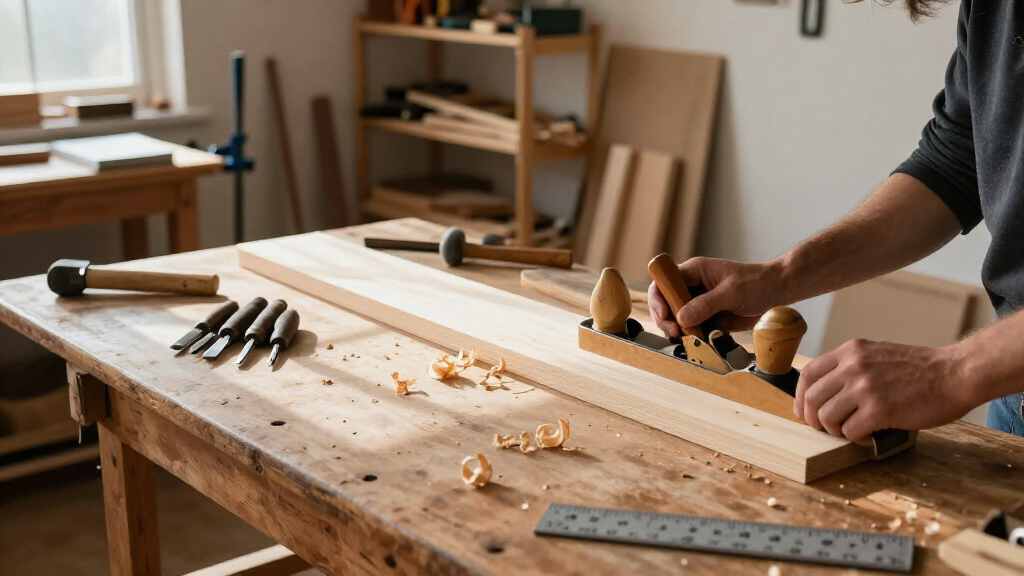
A hand saw, chisels, and a plane take little storage space and make less noise than powered equipment. But hand tools need practice, sharp edges, and careful setup. A cordless drill/driver and jigsaw can make common tasks faster, though they bring battery costs, noise, dust, and a need for safe workholding.
Imagine building a small planter on a balcony. A hand saw and a drill may be enough, especially if the lumber yard cuts long boards for you. In a shared garage where you plan several shelves, a circular saw and suitable guide may save time, but you still need eye protection, secure support for the board, and attention to the blade path.
There’s a satisfying bittersweet tradeoff: hand work can feel slower, yet it can give you more control over a tiny fitting cut; power tools can make a clean cut quickly, yet a rushed setup can create a poor result. For electrical, gas, structural, or roof work, hire a licensed professional and follow local code and permit requirements. Woodworking tools do not replace that expertise.
Compare starter kit parts before you buy
A useful tool kit earns its place through reliable performance, comfortable handling, and parts you can replace. Compare what each bundle includes against your project list, and check what it leaves out. A low headline price can grow once you add clamps, blades, bits, batteries, and protective gear.
| What to compare | Why it matters | Example check |
|---|---|---|
| Measuring and marking | Accurate layout helps parts fit | Check whether the square sits firmly and reads clearly |
| Cutting tools | Different saws suit different cuts | Match blade type and capacity to your stock |
| Clamps and workholding | Secure material is easier to control | See whether the kit includes clamps or you must buy them separately |
| Power platform | Batteries and chargers add cost | Compare bare-tool and battery bundles |
| Support and upkeep | Parts and adjustment affect usable life | Look for replacement parts, warranty terms, and sharpening needs |
Suppose one bundle includes a drill with useful bits but no battery, clamps, or glasses. Another costs more but includes a battery you can use with later tools. The second may be a better value if you plan to stay on that battery platform. If you only need one project’s worth of drilling, a different arrangement may suit you better.
For hand tools, look for comfortable grips and adjustments that hold their settings. For power tools, check guards, switches, and adjustments before use. Read reviews as clues, then judge whether the tool fits your work. Bundle size alone does not prove value.
Budget for the accessories that make tools usable
The tool price is only part of a beginner’s woodworking budget. Blades, drill bits, sandpaper, batteries, chargers, clamps, sharpening supplies, storage, and dust control can add substantially to what you spend. List those costs beside the main tool price before you choose a bundle.
Take a compact shelf project. You might buy a drill/driver and a saw, then discover that you also need a suitable blade, a bit set, a straightedge for laying out cuts, clamps for glue-up, and sandpaper for rough board edges. If your drill is sold as a bare tool, a battery and charger add another line to the total.
Set the budget around the project, not a vague promise to build anything. If the total strains your limit, see whether a supplier can cut the boards or whether you can borrow a tool. Keep money for safety glasses, hearing protection, and dust control rather than spending every dollar on the tool itself.
Buying individual woodworking tool sets for beginners can be sensible when the parts match your plan. One dependable drill and a good square may serve you better than a crowded bundle with awkward accessories. Cordless tools are convenient in a small shop or outdoors, but a battery platform can tie your next purchases together, so compare battery compatibility before you commit.
Work safely in a small shop or shared space
Safe woodworking starts with secured material, working guards, clear cutting paths, and suitable protection. A small workspace can work well, but it asks you to plan where the tool, board, dust, and finished parts will go. Don’t make a cut while balancing a board across an unstable chair or a cluttered counter.
For example, before cutting a shelf board in a garage, place it on stable supports, clamp it so it cannot shift, put on eye protection, and check that the saw’s guard and controls work. Keep hands away from the cutting path and manage the cord or battery tool position so it does not snag. Use hearing protection around loud tools and suitable dust extraction or respiratory protection when the material and task call for it.
A foldable work support or compact bench can help in a shared garage, but plan for storage too: blades and chisels need protection, and tools should not sit where children or visitors can reach them. Dust can drift into living areas, so ventilation and cleanup matter in an apartment or attached garage.
If you work on a home project that involves electrical wiring, gas lines, structural changes, or roofing, bring in a licensed professional and follow applicable permits and codes. For electrical work, power must be shut off and verified before work; professionals use appropriate PPE and safety procedures. A beginner tool set does not make regulated work a safe DIY job.
Use your first projects to decide what to buy next
Your next tool should solve a repeated problem you have already met. Track what you borrow, what slows you down, and which operation you find difficult. That gives you a practical buying signal instead of a guess based on a bundle advertisement.
Say you build two boxes and a wall shelf. You borrow a pair of clamps every time, and your boards keep shifting during glue-up. Clamps may be the clearest next purchase. If your cuts are consistently rough, practice with the saw you own before buying a more expensive one; if long cuts remain awkward after practice, a guide or different saw may help.
Keep a brief project note with the tool, material, and difficulty. After a few projects, you might see that a random-orbit sander would save time, or that a hand plane would help fit edges. For occasional cuts, asking the supplier to cut stock may still be the smarter choice. Repeated use beats imagined need.
Small boxes or a simple shelf are good practice because they teach measuring, squaring, cutting, and fastening without demanding a large shop. As your skills grow, your set can grow too. A modest collection that you know how to use safely is a stronger foundation than a shelf full of tools you have never adjusted.
Frequently Asked Questions
What tools do I need to start woodworking?
Begin with a tape measure, combination square, marking tool, a way to cut, a drill/driver, clamps, a stable work surface, and eye protection. Add bits, blades, sanding supplies, hearing protection, and dust control to suit your project. A small box is a useful way to learn what you actually use.
Should I buy hand tools or power tools first?
Either can work. Hand tools take less space and make less noise, but they need sharpening and practice; power tools speed up many jobs but need safe workholding, guarding, and dust management. A drill plus a hand saw or jigsaw is a practical mixed start for many beginners.
Are beginner woodworking kits worth buying?
They can be convenient if the included tools match your project list and work reliably. Check for missing essentials such as clamps, safety glasses, batteries, chargers, or useful blades. A smaller set with dependable tools can be a better buy than a large bundle of parts you will not use.
Do I need a table saw to start woodworking?
No. A hand saw, circular saw, or jigsaw can cover many beginner cuts, and a lumber supplier may cut boards to size. A table saw takes space and requires careful setup and safe operating practices, so buy one only when your projects and experience call for it.
How much should I spend on my first tool set?
There is no single right amount; set a limit around your first project and include accessories and safety gear in the total. Blades, bits, clamps, sandpaper, batteries, sharpening supplies, and dust control all affect the final cost. Borrowing a specialty tool or ordering pre-cut stock can keep the first project affordable.
Conclusion
Build your first woodworking set around one real project, then add tools when experience shows you what’s missing. A carefully chosen square, saw, drill, clamps, work surface, and safety gear can take you further than a crowded kit with no clear purpose.
Start with a small box or shelf, make the measurements carefully, and let each finished piece teach you what belongs in your shop next. The best starter set is the one that helps you make the next clean cut safely.