
TL;DR

Get business pricing on tools and workshop supplies
- Business-only prices and quantity discounts
- Tax-exempt purchasing
- Multiple users, one account, clear invoices
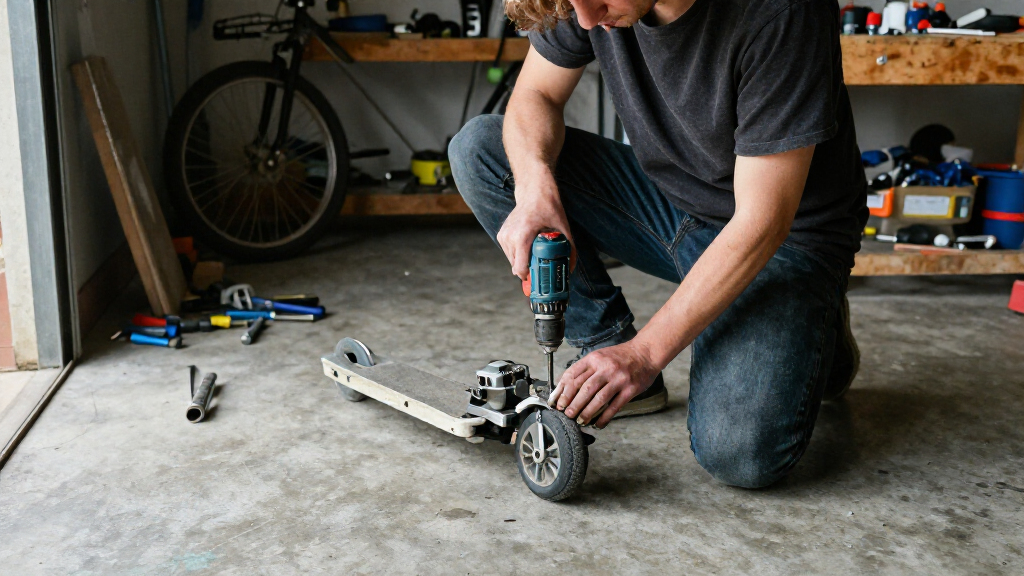
A maker says he converted a Razor A5 Lux push scooter into a front-wheel-drive electric scooter using a Hercules 20-volt cordless drill and a custom wheel assembly. He reports a top speed of about 10 mph and about two miles of riding from a 5-amp-hour battery; the project was built for fun, not as a money-saving alternative or a tested commercial design.
A maker has converted a Razor A5 Lux push scooter into a drill-powered, front-wheel-drive vehicle, reporting a top speed of about 10 mph and roughly two miles per 5-amp-hour battery. In a first-person report on his website, he describes a custom wheel and a Hercules 20-volt cordless drill powering the scooter, while warning through his account that the drill’s throttle is touchy and its torque can cause the wheel to spin during takeoff.
The builder said he mainly uses the scooter to get around autocross events while working on the course. He already owned the push scooter and did not want to buy an electric one that might sit unused, so he decided to try a conversion. He said the project involved a welder, a 3D printer, and components sourced from Harbor Freight, Amazon and McMaster.
The drill drives the front wheel through a keyed shaft and one-way bearings, allowing the wheel to spin freely when the drill is off. The original drill trigger was relocated to the handlebars. The builder said moving it was harder than expected because the trigger had many wires, which he cut and extended using 12- and 18-gauge wire. He wrote that the wiring still needs protective loom.
For the custom wheel, he said he 3D-scanned the scooter and printed the wheel and tire in three pieces. The wheel is made from ASA plastic and the tire from TPU, according to his account. Ten M6 bolts and nuts secure the two wheel halves; keys in the spokes and a shaped fit are intended to stop the tire from slipping. The builder said the drill must run in its lower-speed setting because of its torque, and that he usually kick-pushes once or twice before applying power.
A Workshop Build, Not a Product
The project is a hands-on example of adapting common power-tool parts for a different use, but the builder’s account does not establish that the conversion is suitable for general road travel. His reported figures describe his own scooter and riding conditions, not independently tested performance. He also says the drill’s trigger is difficult to feather and that the wheel can spin during acceleration, details that matter to anyone considering a similar build.
The report may interest makers because it documents a working prototype and identifies the core components: a drill, one-way bearings, keyed shaft, custom wheel and relocated trigger. It also offers a candid measure of the trade-off: the builder said he had fun, but did not save money compared with buying an electric scooter. The source does not provide a full cost breakdown or a safety evaluation.
Cordless drill conversion kit for scooters
As an affiliate, we earn on qualifying purchases.
As an affiliate, we earn on qualifying purchases.
Why He Reused a Push Scooter
The builder said he came up with the idea in July after watching people use electric scooters at autocross events. His existing Razor A5 Lux worked for getting around the course, but was not designed by its manufacturer for electric conversion. He wrote that he chose to modify it rather than buy another scooter that could go unused.
His parts list includes a Hercules 20-volt drill, two one-way dual-keyway bearings, two 6201-2RS bearings, a 200-millimeter keyed shaft, shaft collars, keys, bolts and nuts. The report gives a broad account of assembly but says the project began without much of a plan, and the builder had limited build notes and photographs. The account is therefore a personal project report rather than a complete set of tested construction instructions.
“It can top out at about 10mph with me onboard.”
— The scooter’s builder, writing on eddieabbondanz.io
As an affiliate, we earn on qualifying purchases.
Performance and Safety Still Untested
The source does not report the scooter’s total weight, the rider’s weight, the route or conditions used for the speed and battery estimates, or how those estimates were measured. It also gives no full budget, braking tests, durability results or independent review. The builder describes the throttle as sensitive and says the wheel can spin when starting, but does not document formal safety testing.
It is also unclear whether the conversion complies with rules for powered scooters in any particular location. The report is a description of one maker’s build, not evidence that the design has been certified or that its parts and wiring are appropriate for other scooters. No broader availability or commercial release is described.
As an affiliate, we earn on qualifying purchases.
No Further Testing Announced
The builder’s report does not announce a production version, a follow-up test or plans to sell conversion parts. He said he may add wire loom to protect the extended wiring, but gave no schedule. For now, the next step reported is limited to that possible protection work; whether the scooter will receive further testing or revisions is unknown.
Readers should treat the speed and battery figures as the builder’s own estimates and the project as a personal experiment, not a ready-made conversion guide. Any future update would need to clarify how the scooter performs under repeatable conditions and whether changes address the throttle response, wiring protection and other safety questions.
electric scooter throttle controller
As an affiliate, we earn on qualifying purchases.
As an affiliate, we earn on qualifying purchases.
Key Questions
How fast did the drill-powered scooter go?
The builder reported a top speed of about 10 mph with him riding. The source does not give details of an independent or standardized speed test.
How far could it travel on one battery?
The builder estimated about two miles on a 5-amp-hour battery. That figure reflects his own setup and use; the report does not specify a controlled test or conditions.
What powered the converted scooter?
A Hercules 20-volt cordless drill drove the front wheel through a keyed shaft and one-way bearings. The drill’s trigger was extended and relocated to the handlebars.
Did the conversion save money?
No. The builder said he did not save money compared with buying an electric scooter, though he enjoyed making the conversion. He did not provide a detailed cost comparison.
Has the design been safety-tested?
The report does not describe formal safety testing or certification. The builder says the throttle is sensitive and the wheel can spin when accelerating, so the account should not be treated as proof that the conversion is safe for other riders or scooters.
Source: hn
Halloween Picks
halloween
As an affiliate, we earn on qualifying purchases.