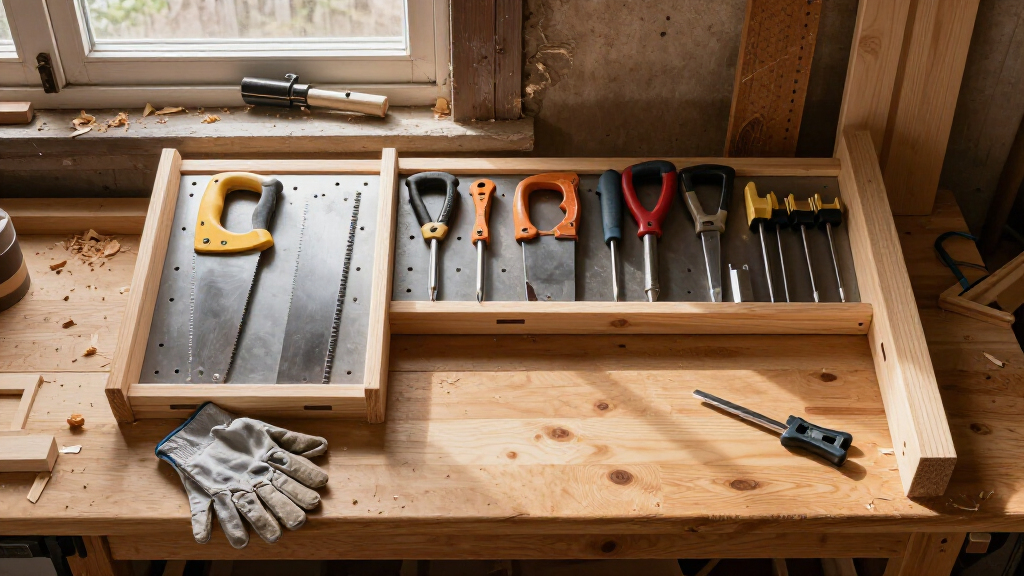
Finding the right woodworking tool storage solution usually comes down to one question: do you want a flexible system that grows with your tool collection, or a dedicated holder that does one job extremely well? That tension shapes this entire roundup. After comparing the current field, two picks stand out to me. The O’SKOOL Modular Chisel Storage Rack earns my top spot because its expandable, reconfigurable design handles chisels, files, screwdrivers, and plane irons in one footprint — a rarity at its price. For wood turners who need targeted storage, the WOODRIVER Turning Tool Storage Rack is the specialist choice, holding six lathe tools in dense EVA foam that protects edges better than any open shelf could.
The tradeoffs you’ll weigh throughout this guide are specialization versus flexibility, tabletop versus wall-mounted placement, and finished product versus DIY kit. The two O’SKOOL options, for example, look nearly identical until you realize one ships ready to use and the other arrives as a hardware kit you assemble yourself — a difference that matters a lot depending on your shop setup and patience. Meanwhile, the walnut carving organizer trades capacity for aesthetics. I’ve ordered these picks so that each fills a distinct slot in a workshop, and I’ll explain exactly why they’re ranked this way.
Complete the kit


Key Takeaways
- The O’SKOOL Modular Chisel Storage Rack (B0CL9TG1GB) is the best overall pick because its birch plywood build and expandable modular design handle the widest range of hand tools under 5/16″ thick.
- The WOODRIVER Turning Tool Storage Rack is the only specialist option here — it holds six lathe tools in EVA foam but is essentially useless for anything other than turning tools.
- The walnut carving organizer (B0GZWJRP9G) is the aesthetic pick: 16 slots, wall or desk mounting, and a finish nice enough to display, but capacity is capped.
- The O’SKOOL DIY Kit (B0CL9SH1XX) costs the least per fence block but requires assembly and leaves material quality unspecified — best for tinkerers on a budget.
- Every option in this lineup shares one hard limit: tools with tangs or blades thicker than 5/16″ won’t fit the O’SKOOL fence-block systems, so measure your chisels before buying.
| O’SKOOL Modular Chisel Storage Rack for Woodworking Workshop Tool Organization |  | Best Overall | Material: Birch Plywood, Carbon Steel, Plastic | Fence Blocks: 10 modular compartments | Tool Compatibility: Chisels, screwdrivers, plane irons, files, carving chisels | VIEW LATEST PRICE | See Our Full Breakdown |
| Wood Carving Tools Organizer Holder for 16 Knives and Tools |  | Best for Display and Small Collections | Number of Slots: 16 (1 large, 15 standard) | Large Slot Dimensions: 2.54 x 1.38 inches | Standard Slot Dimensions: 1.3 x 1.1 inches | VIEW LATEST PRICE | See Our Full Breakdown |
| WOODRIVER Turning Tool Storage Rack |  | Best for Woodturners | Capacity: 6 turning tools | Material: EVA foam | Dimensions: 16-1/4″ L x 1-3/8″ H x 2-3/8″ D | VIEW LATEST PRICE | See Our Full Breakdown |
| O’SKOOL Modular Chisel Rack DIY Kit, 10 Pack |  | Best Value for DIYers | Fence Blocks: 10 per kit | Includes: T-slot router bit, square nuts, machine screws, instructions | Compatible Tools: Chisels, screwdrivers, files, carving chisels, plane irons | VIEW LATEST PRICE | See Our Full Breakdown |
| woodworking tool storage solution | Material | Fence Blocks | Design |
|---|---|---|---|
| O’SKOOL Modular Chisel Storage | Birch Plywood, Carbon Steel, Plastic | 10 modular compartments | Modular, open access with detachable shelf |
| Wood Carving Tools Organizer H | Natural walnut wood | — | — |
| WOODRIVER Turning Tool Storage | EVA foam | — | — |
| O’SKOOL Modular Chisel Rack DI | Not specified | 10 per kit | Modular, open-design, self-built |
More Details on Our Top Picks
O’SKOOL Modular Chisel Storage Rack for Woodworking Workshop Tool Organization
This option stands out for solving the problem most chisel racks ignore: your collection changes. With ten modular fence blocks mounted on CNC-carved birch plywood, the rack can be rearranged to fit bench chisels, carving tools, files, screwdrivers, or plane irons without buying anything new. Compared with the walnut carving organizer later in this list, the O’SKOOL trades beauty for adaptability — the lacquered birch looks like shop furniture rather than display furniture, but it will still be useful after your tenth tool purchase.
The open back panel design is a genuine safety feature, not marketing fluff. Chisels stored edge-out in a drawer are how fingers get cut; here, handles face you and blades sit captured behind the blocks, so you grab the handle without ever touching an edge. The quick-access back panel also means you can pull a tool mid-cut without breaking workflow.
The real limitations are physical. The 5/16″ fence block thickness ceiling rules out heavier mortise chisels and some older socket chisels with thick tapered tangs, and this is a tabletop-mounted unit — if your bench surface is already contested territory, you’ll need to dedicate roughly a linear foot of it permanently. Compared with the DIY kit version of the same system, this assembled rack costs more but arrives ready to deploy, which matters if your weekends are for woodworking rather than assembly.
Pros:- Modular fence blocks reconfigure for chisels, files, screwdrivers, and plane irons
- Birch plywood construction with lacquered finish holds up to shop conditions
- Open design keeps blade edges captured and handles accessible for safer grabbing
- Expandable system grows with your collection instead of being outgrown
Cons:- Fence blocks only accept tools under 5/16″ thick
- Requires permanent tabletop space
- Workshop-oriented design may be overkill for casual hobbyists
Best for: Woodworkers with a growing collection of hand tools under 5/16″ thick who want one rack that adapts instead of being replaced
Not ideal for: Anyone with thick-tanged chisels, or shops with zero spare bench space
- Material:Birch Plywood, Carbon Steel, Plastic
- Fence Blocks:10 modular compartments
- Tool Compatibility:Chisels, screwdrivers, plane irons, files, carving chisels
- Fence Block Thickness:Under 5/16″
- Mounting Type:Tabletop
- Finish:Lacquered
- Design:Modular, open access with detachable shelf
Our verdict“The most versatile and safest general-purpose storage pick here, and the one I’d buy first for a mixed hand-tool collection.”
Wood Carving Tools Organizer Holder for 16 Knives and Tools
Where the O’SKOOL rack is engineered to disappear into a working shop, this organizer is designed to be looked at. The natural walnut body and vintage styling make it the only pick here I’d describe as furniture-adjacent, and for carvers who work in a shared space — a corner of a garage, a spare room, a studio visitors see — that difference matters. The 16 slots break down into one oversized compartment at 2.54 x 1.38 inches and fifteen standard slots at 1.3 x 1.1 inches, which covers typical carving knives, small gouges, and detail chisels.
The dual mounting options are the practical highlight. Desk placement keeps tools at hand during carving sessions; wall mounting frees the surface entirely and, honestly, displays a nice tool set the way a cook displays knives. Compared with the O’SKOOL assembled rack, this organizer wins on footprint flexibility but loses badly on adaptability — those slot dimensions are fixed, so a tool either fits or it doesn’t. There’s no reconfiguring.
That rigidity is the core tradeoff. Where the modular O’SKOOL system can absorb a new chisel purchase, this organizer hits a hard ceiling at sixteen tools, and larger carving mallets or bent gouges simply won’t fit the standard slots. The walnut construction also demands secure mounting if you go the wall route — a loosely anchored organizer full of sharp tools coming off drywall is a genuinely bad outcome. This pick makes the most sense for carvers whose collections are stable and who value presentation alongside function.
Pros:- 16 slots including one oversized compartment for bulkier tools
- Solid walnut construction with an attractive vintage finish
- Wall-mount or desk placement adapts to any workspace layout
- Displays tools visibly while keeping them protected and organized
Cons:- Fixed slot dimensions cannot accommodate large or unusual tools
- Capacity is hard-capped at 16 slots
- Requires secure anchoring if wall mounted to avoid failure
Best for: Woodcarvers with a settled set of 16 or fewer knives and small chisels who want attractive, visible storage
Not ideal for: Owners of growing collections or anyone with oversized carving tools like bent gouges and mallets
- Number of Slots:16 (1 large, 15 standard)
- Large Slot Dimensions:2.54 x 1.38 inches
- Standard Slot Dimensions:1.3 x 1.1 inches
- Material:Natural walnut wood
- Mounting Options:Wall-mount or desk placement
- Style:Vintage / display-oriented
Our verdict“The best-looking storage option in this lineup, best treated as display-grade organization for a finished carving kit.”
WOODRIVER Turning Tool Storage Rack
Every other product in this roundup tries to be flexible; this one doesn’t, and that’s exactly why it works. The WOODRIVER rack holds six turning tools in EVA foam fingers, and that foam does something no fence block or wooden slot can: it grips long, heavy lathe tools along their length without marring handles or contacting the cutting edge. If you’ve ever tried to store a 20-inch roughing gouge in a chisel rack, you know the problem — standard woodworking storage simply isn’t built for tools that long and that heavy.
The 16-1/4 inch length is compact enough to mount behind or beside a lathe, which is where turning storage belongs. Keeping gouges and skews within arm’s reach of the lathe, edges down in foam, is both faster and safer than leaning them against a bench. The included mounting hardware means setup is a drill-and-screw job, not a project.
The tradeoffs are obvious and I won’t soften them. Six tools per rack is a modest ceiling — most turners own more than that — though the expandable design lets you chain racks together, and the cost per rack is low enough that two or three units is a reasonable plan. More fundamentally, this rack is close to useless outside the lathe room: carving knives, bench chisels, and files don’t sit well in the foam fingers. Compared with the O’SKOOL modular rack, this is a specialist tool for a specialist discipline, and I ranked it third only because most woodworkers don’t turn — if you do, treat it as your first buy.
Pros:- EVA foam fingers protect edges and grip tools along their length
- Expandable — chain multiple racks for larger turning sets
- Mounting hardware included for simple installation
- Compact 16-1/4″ footprint mounts near the lathe
Cons:- Holds only six tools per rack
- Effectively limited to turning tools only
- Requires wall space near the lathe
Best for: Woodturners who need lathe tools stored safely and within reach of the lathe
Not ideal for: General woodworkers or anyone who doesn’t own turning tools
- Capacity:6 turning tools
- Material:EVA foam
- Dimensions:16-1/4″ L x 1-3/8″ H x 2-3/8″ D
- Expandability:Connects with additional racks
- Mounting Hardware:Included
- Intended Tools:Lathe gouges, skews, parting tools
Our verdict“A narrow-purpose rack that outperforms general storage for lathe work, provided turning is actually part of your woodworking.”
O’SKOOL Modular Chisel Rack DIY Kit, 10 Pack
This kit is the same fence-block concept as my top pick, stripped down to its components: ten fence blocks plus a T-slot router bit, square nuts, machine screws, and instructions. The difference is philosophy. The assembled rack gives you birch plywood; here, you supply the backing material and machine the slots yourself with a router. For woodworkers who already own a router and offcuts, that’s not a burden — it’s an invitation to build storage that exactly fits a custom bench, a cabinet door, or an odd corner no commercial rack could occupy.
That freedom of placement is the kit’s real advantage over its assembled sibling. The B0CL9TG1GB is a tabletop unit, full stop. The DIY kit can become a wall panel, an inside-of-cabinet rack, a mobile cart accessory — wherever you can rout a T-slot track. The included T-slot router bit is the thoughtful touch that makes this approachable rather than intimidating.
But I ranked it last for good reasons. The material is unspecified, so you’re trusting the fence blocks and fasteners without knowing the grade, and the same 5/16″ thickness limit applies to the blocks. The assembly requirement also means this is storage you get around to eventually, not storage you have tomorrow. Compared with buying the pre-built rack, you save money and gain placement freedom at the cost of an afternoon of shop time and some uncertainty about hardware quality. This pick makes the most sense for woodworkers for whom building the storage is half the point.
Pros:- Lowest-cost path to the same modular fence-block system
- Router bit and all fasteners included in the kit
- Complete freedom to mount on walls, cabinets, or custom locations
- Reconfigurable blocks adapt as tool needs change
Cons:- Material quality is not specified by the manufacturer
- Same 5/16″ tool thickness restriction as the assembled rack
- Requires DIY assembly and router work before any storage exists
Best for: Budget-minded woodworkers with a router who want custom-placement storage and don’t mind assembling it
Not ideal for: Anyone who wants storage working out of the box, or who doesn’t own a router
- Fence Blocks:10 per kit
- Includes:T-slot router bit, square nuts, machine screws, instructions
- Compatible Tools:Chisels, screwdrivers, files, carving chisels, plane irons
- Material:Not specified
- Design:Modular, open-design, self-built
- Thickness Limit:Under 5/16″
- Assembly:Required (router needed)
Our verdict“The tinkerer’s value pick — cheaper and more placement-flexible than the assembled version, if you supply the labor.”
How We Picked
My ranking logic for this comparison rests on three pillars: versatility, build material, and expandability. Woodworking tool storage fails most often not because it breaks, but because it stops fitting your collection six months later. That’s why I weighted modular and expandable designs heavily — a rack you can add sections to beats a fixed holder you outgrow.
I also compared material transparency. The O’SKOOL assembled rack specifies birch plywood with a lacquered finish, which tells you something about durability and moisture resistance. The DIY kit lists no material at all, and that uncertainty costs it a rank even though the underlying design is nearly identical. The walnut organizer sits in between: the material is premium, but the fixed slot dimensions limit what it can actually hold.
Finally, I judged each product against the alternatives in this lineup rather than in a vacuum. The WOODRIVER rack scores poorly on versatility but earns its place by doing something no other pick can — protecting long-handled turning tools in soft foam. Capacity per dollar, mounting flexibility, and edge safety rounded out the evaluation. I deliberately skipped products that were just generic toolboxes or pegboard accessories, since none of those address the specific problem of storing edged woodworking hand tools safely and visibly.
| woodworking tool storage solution | Material | Design |
|---|---|---|
| O’SKOOL Modular Chisel Storage | Birch Plywood, Carbon Steel, Plastic | Modular, open access with detachable shelf |
| Wood Carving Tools Organizer H | Natural walnut wood | — |
| WOODRIVER Turning Tool Storage | EVA foam | — |
| O’SKOOL Modular Chisel Rack DI | Not specified | Modular, open-design, self-built |
Factors to Consider When Choosing Woodworking Tool Storage Solutions
Choosing between these four storage solutions comes down to matching the storage type to your tools, your space, and how much building you’re willing to do. Here’s how I’d think through the decision.Match the Storage to the Tool Class
The single biggest mistake is buying general storage for specialized tools. Turning tools are long, heavy, and edge-sensitive — they belong in foam-finger racks like the WOODRIVER, not wooden slots. Bench and carving chisels with tangs under 5/16″ work beautifully in fence-block systems. Carving knives with their slim profiles fit the walnut organizer’s standard slots. Before buying anything, measure your thickest tool at the point where it will rest in the rack.
Fixed Slots vs. Modular Systems
A fixed-slot organizer like the walnut holder is predictable, attractive, and dead simple — but it cannot adapt. A modular fence-block system can be rearranged every time your collection changes. My rule of thumb: if your tool set is stable and you value appearance, go fixed. If you’re still acquiring tools, modularity pays for itself within a year.
Tabletop, Wall, or Built-In
Placement dictates the pick more than most buyers expect. Tabletop racks like the assembled O’SKOOL consume bench space but keep tools at working height. Wall-mounted options — the walnut organizer and WOODRIVER rack — free surfaces but demand solid anchoring, since a rack full of sharp tools detaching from drywall is dangerous. The DIY kit sidesteps the question by letting you rout mounting tracks into whatever substrate you choose, including cabinet interiors.
Assembled vs. Kit
The two O’SKOOL products illustrate this tradeoff cleanly. The assembled rack gives you known birch plywood construction and works the day it arrives. The DIY kit is cheaper and infinitely more placement-flexible, but the material is unspecified and you need a router plus an afternoon. Be honest about whether you want storage or a project.
Planning for Growth
Two of these four options — both O’SKOOL systems and the WOODRIVER rack — are explicitly expandable. That matters because tool collections rarely shrink. Buying into an expandable ecosystem means your second and third purchases cost less and integrate cleanly, rather than spawning a mismatched shelf of orphan holders.
Frequently Asked Questions
Can the O’SKOOL fence-block racks hold tools thicker than 5/16″?
No — both the assembled rack and the DIY kit are limited to tools with tangs or blades under 5/16 inch thick, and this is the most common frustration buyers hit. Most Western bench chisels, carving tools, files, and screwdrivers fit comfortably, but heavy mortise chisels, some socket chisels with thick tapered tangs, and certain vintage tools will not seat properly. My advice is to measure your thickest tool with calipers before ordering anything in this system. If you own several oversized chisels, a foam-finger solution like the WOODRIVER rack or a custom-built rack from the DIY kit with wider spacing may serve you better, though the kit’s blocks carry the same 5/16″ restriction.
Is the DIY kit actually cheaper once I factor in materials?
Usually yes, but not always by much. The kit’s sticker price is lower than the assembled rack, but you need to supply your own backing board — a piece of quality plywood suitable for routing T-slot tracks costs real money if you don’t have suitable offcuts. You also need a router, which the kit’s included T-slot bit assumes you own. Where the economics genuinely favor the kit is scale and placement: building storage into a cabinet interior, a wall panel, or a custom bench location is something the tabletop assembled rack simply cannot do at any price. If you’re only replicating a single tabletop rack and buying plywood new, the savings may shrink to pocket change.
Is wall mounting safe for racks full of sharp tools?
It can be, but only with proper anchoring — and this applies especially to the walnut carving organizer, which is heavy solid wood before you add sixteen tools. Mount into studs whenever possible, or use heavy-duty toggle anchors rated well above the loaded weight of the rack. The WOODRIVER turning rack is lighter and its foam contents weigh less, but lathe tools are still substantial, so stud mounting remains my recommendation there too. A rack shedding sharp tools is one of the few storage failures that can actually injure someone, so I’d rather over-anchor than match the weight rating exactly. If your walls are questionable, desk or bench placement of the walnut organizer is the safer fallback.
Can the WOODRIVER rack store anything besides turning tools?
Not usefully, and I’d steer you away from trying. The EVA foam fingers are spaced and sized for the long handles and shafts of lathe gouges, skews, and parting tools. Bench chisels are too short to engage multiple fingers, carving knives lack the shaft mass to sit securely, and files will contact the foam with their teeth, which chews the foam up over time. This is a specialist rack and I ranked it accordingly. If you only own a couple of turning tools, skip it and use the O’SKOOL system for everything; but if turning is a major part of your work, the WOODRIVER does its one job better than any general-purpose rack in this lineup can.
Which option is best for a beginner just starting out?
For most beginners I’d point to the assembled O’SKOOL Modular Chisel Storage Rack. A beginner’s collection is by definition still forming, so the modular, expandable design means you won’t outgrow the storage as you add tools, and the open design teaches good habits — handles forward, edges captured — from day one. It also works immediately with no assembly or routing skills required. The walnut organizer is better suited to someone whose tool set has stabilized, and the DIY kit assumes router competence that a true beginner may not have yet. The WOODRIVER rack only makes sense for a beginner who knows woodturning will be their focus.
Conclusion
After comparing all four, my recommendations break cleanly along buyer type. General woodworkers building a hand-tool collection should start with the O’SKOOL Modular Chisel Storage Rack — its adaptability, safety-focused open design, and known birch plywood construction make it the strongest all-around choice and the reason it tops this list. Woodturners should ignore the general rankings entirely and buy the WOODRIVER rack, ideally two, since nothing else here protects long lathe tools as well.
Carvers with a settled set of knives and small chisels who want storage they’re happy to look at will get more satisfaction from the walnut organizer, provided they anchor it properly and accept the 16-tool ceiling. And budget-conscious makers who own a router — or anyone who wants storage built into a cabinet or custom location — get the best value from the O’SKOOL DIY kit, trading an afternoon of assembly for placement freedom and a lower price.
Whichever direction you take, measure your thickest tool first: the 5/16″ limit shared by both O’SKOOL systems is the one spec that disqualifies buyers more often than any other. Match the storage to the tools you actually own, buy into an expandable system where you can, and you’ll spend less time reorganizing and more time at the bench.