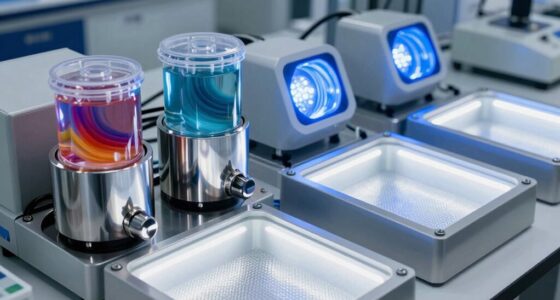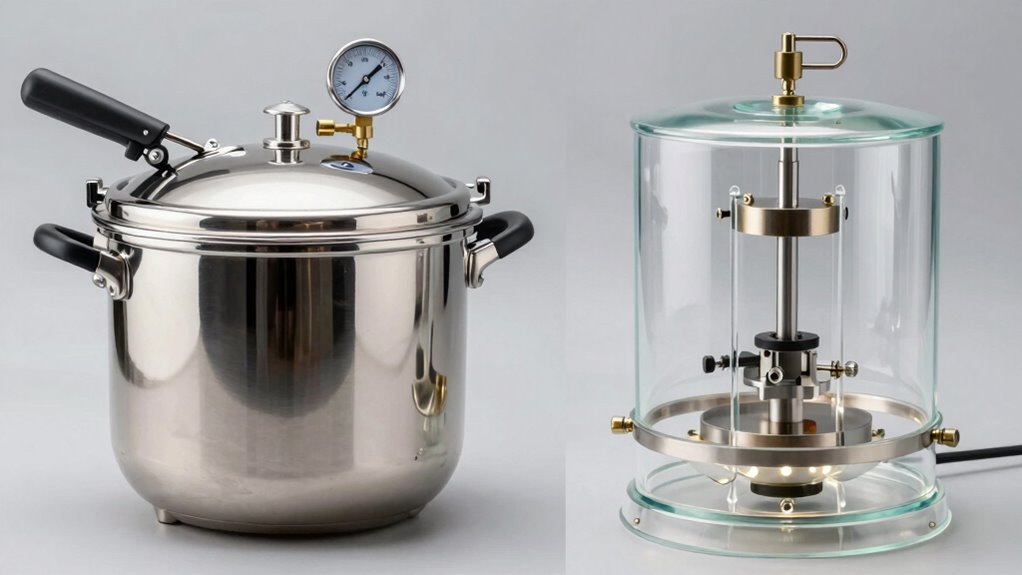

If you want to minimize surface imperfections during curing, a pressure pot is your best choice, as it compresses bubbles into tiny pockets and guarantees a smooth, high-gloss finish. If your goal is to remove dissolved air before pouring to prevent bubbles from forming, a vacuum chamber is more effective. Both tools target different bubble issues, so understanding your specific problem will help you choose the right method. Keep exploring to find the best solution for your project.

Get business pricing on tools and workshop supplies
- Business-only prices and quantity discounts
- Tax-exempt purchasing
- Multiple users, one account, clear invoices
Key Takeaways
- Use a pressure pot to minimize surface imperfections and improve finish during curing, especially for larger or thicker resin projects.
- Opt for a vacuum chamber to remove dissolved air before pouring, preventing internal bubbles and enhancing clarity.
- Combining both methods offers the best results for bubble reduction and a crystal-clear final product.
- Choose based on whether you need to prevent bubble formation (vacuum) or compress existing bubbles during curing (pressure).
- Proper mixing and degassing are essential, regardless of the method chosen, to maximize bubble elimination.
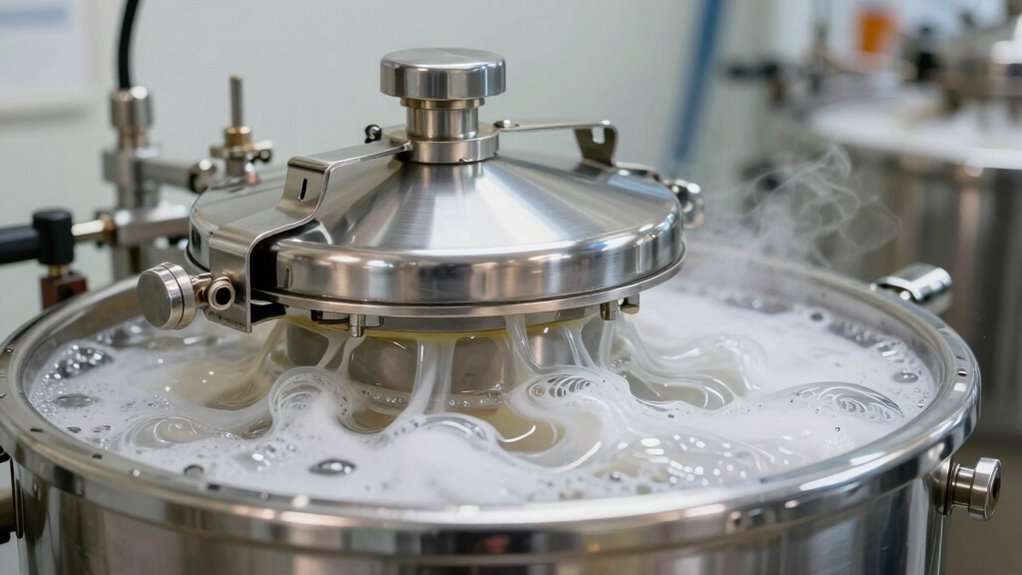
When working with resin, choosing the right method to reduce bubbles and improve clarity can make a significant difference in your final project. Both pressure pots and vacuum chambers aim to tackle the issue of air entrapment, but they do so in different ways, each impacting the curing consistency of your resin. If you’re striving for a crystal-clear finish with minimal imperfections, understanding how each tool works helps you decide which is best suited for your needs.
Choosing the right method to reduce bubbles and enhance clarity is key for a flawless resin finish.
A pressure pot applies high pressure to your resin, compressing any trapped air bubbles into tiny, often invisible, pockets. This method is particularly effective during the curing process, as it prevents the bubbles from expanding or rising to the surface. The key advantage here is that the resin cures under pressure, ensuring fewer surface imperfections and a more uniform appearance. It’s a straightforward approach that delivers consistent results, especially when working with thicker resins or larger projects. The pressure essentially forces air out of the resin, leading to a smooth, high-gloss finish. However, it’s important to note that pressure pots aren’t as effective at removing air that’s already dissolved within the resin before pouring, so proper mixing and degassing beforehand remain crucial.
On the other hand, a vacuum chamber works by removing air from the resin before you pour it, creating a low-pressure environment. When you place the resin in the chamber and evacuate the air, trapped bubbles rise to the surface and pop, significantly reducing the air entrapment in the mixture. This process is especially useful for degassing, ensuring your resin is as free of bubbles as possible before pouring. The result is a cleaner, clearer cast with fewer imperfections. The main benefit of vacuum degassing is its ability to eliminate dissolved air, which can cause tiny bubbles to form during curing. Additionally, understanding air entrapment and how it forms can help you better prevent it in your projects. However, because vacuum chambers don’t apply pressure during curing, some residual bubbles may still appear if the resin isn’t properly degassed beforehand. Additionally, vacuum chambers can be a bit more complex to operate and require extra safety precautions.
Ultimately, your choice depends on what problem you’re trying to solve. If your main concern is ensuring a smooth, bubble-free surface with excellent clarity, a pressure pot is highly effective during the curing process. If you want to minimize air entrapment from the start, preventing bubbles from forming altogether, a vacuum chamber offers a proactive solution. Both tools improve curing consistency and reduce imperfections, but their effectiveness hinges on your specific project needs and how you prepare your resin beforehand.
As an affiliate, we earn on qualifying purchases.
Frequently Asked Questions
Which Method Is Faster for Degassing Resin?
A vacuum chamber is faster for degassing resin because it quickly removes trapped air, leading to clearer resin and smoother curing. When you use a vacuum, you reduce bubbles efficiently, which improves resin clarity and speeds up the curing process. A pressure pot, on the other hand, takes longer to eliminate bubbles and might not achieve the same level of clarity, making the vacuum chamber your best choice for faster degassing.
Can Pressure Pots Prevent Bubbles Without Vacuum Chambers?
Did you know that pressure pots can greatly reduce bubbles, with some users reporting up to 80% fewer imperfections? Yes, pressure pots can prevent bubbles without vacuum chambers, but only if you guarantee chemical compatibility and proper equipment maintenance. Using the right materials prevents leaks and damage, making your process more efficient. Just remember, pressure pots are best for small to moderate bubbles, while vacuum chambers excel at thorough degassing.
Is One Method Safer for Hobbyists Than the Other?
A pressure pot is generally safer for hobbyists because it operates at lower pressure levels and requires less complex setup. You should still follow safety protocols, like wearing gloves and eye protection, and regularly check equipment maintenance to prevent accidents. Vacuum chambers involve higher risks due to stronger vacuum forces, so if safety is a priority, a pressure pot offers a more manageable, safer option for resin casting.
How Much Do Pressure Pots and Vacuum Chambers Typically Cost?
You might worry about costs, but both pressure pots and vacuum chambers vary widely. Expect a basic pressure pot to start around $50-$200, while more durable, professional-grade models can go up to $500 or more. Vacuum chambers often cost between $100-$300 for hobbyist sizes, with higher-end, industrial versions reaching thousands. Consider equipment durability—investing in quality guarantees longevity and better results, saving you money over time.
Which Technique Is Better for Large Resin Pieces?
For large resin pieces, a pressure pot generally works better because it applies even pressure, reducing bubbles and ensuring clarity. A vacuum chamber can also help, but it’s less effective for large resin items since it can be harder to achieve a uniform vacuum across big surfaces. In this technique comparison, using a pressure pot is usually the more efficient choice to get smooth, bubble-free large resin pieces.
As an affiliate, we earn on qualifying purchases.
Conclusion
Imagine your resin masterpiece, perfectly clear and bubble-free, resting gently in your chosen setup. Whether you opt for a pressure pot, holding back tiny air pockets like an invisible shield, or a vacuum chamber, pulling out every bubble with a whisper of suction, your work transforms. Each tool shapes your vision—pressurized or vacuumed—into a flawless, glassy finish. Your art becomes a shimmering reflection of your skill, crafted with precision and care.
As an affiliate, we earn on qualifying purchases.
As an affiliate, we earn on qualifying purchases.
Halloween Picks
halloween
As an affiliate, we earn on qualifying purchases.