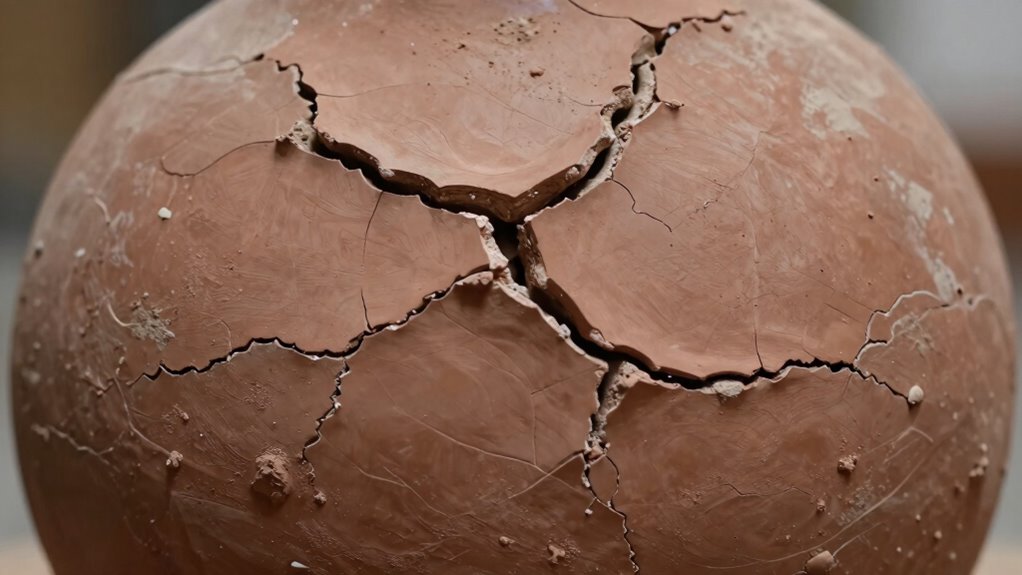

Even if you follow all the best techniques, your clay project may still crack due to subtle issues like uneven moisture distribution or slight temperature inconsistencies. Small changes in humidity or rapid drying can cause internal stress, leading to cracks. Proper conditioning, slow drying, and even thickness help prevent this, but tiny environmental shifts can still cause problems. Keep exploring to understand how these hidden factors might be affecting your work and how to avoid them.

Get tools and workshop supplies delivered free — and shop member deals
- Fast, free delivery on millions of items
- Access to Prime Big Deal Days deals on October 6–7
- Prime Video, Amazon Music and more included
Key Takeaways
- Uneven moisture distribution within the clay causes internal stress, leading to cracks during drying.
- Variations in clay thickness result in inconsistent drying, increasing crack risk despite proper techniques.
- Rapid surface drying, even with initial covering, can create tension and cracks in the interior.
- Insufficient kneading or improper conditioning causes uneven moisture, making the project prone to cracking.
- External environmental fluctuations, like sudden humidity or temperature changes, can induce cracks despite correct methods.
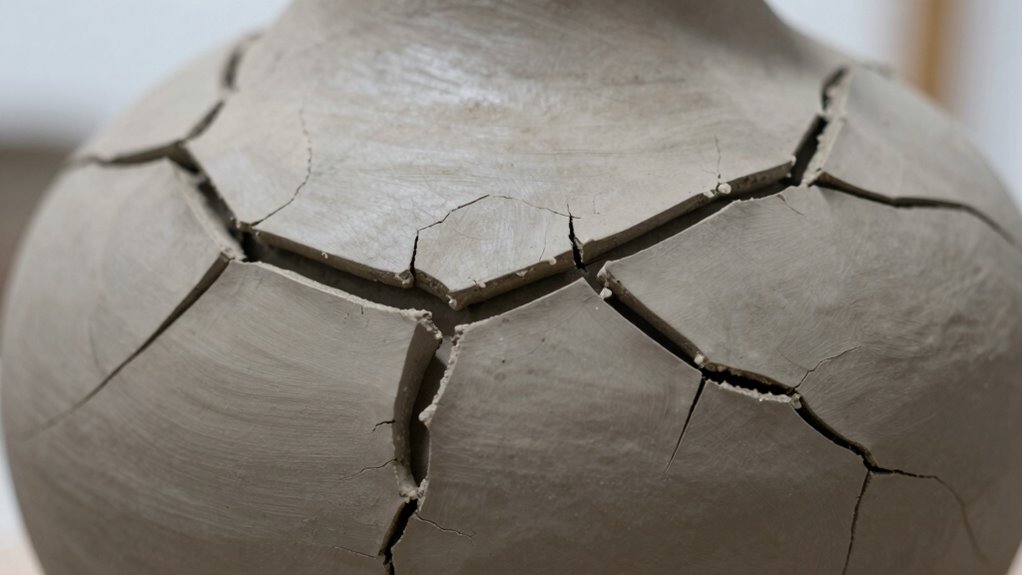
Even when you follow all the recommended techniques, your clay projects can still crack, leaving you frustrated and wondering what went wrong. Cracking during air drying is a common issue, even for those who are experienced with clay. The key factors often come down to moisture management and environmental conditions. Air drying clay relies heavily on proper humidity control. When the environment is too dry, the outer surface of your project dries too quickly, while the interior remains moist. This uneven drying creates tension that results in cracks. Conversely, if the air is overly humid, the clay takes longer to dry, increasing the risk of warping or cracking as moisture escapes unevenly.
To prevent this, it’s essential to monitor and control humidity levels in your workspace. Use a dehumidifier if the air is too humid or a humidifier in overly dry environments. Maintaining a consistent humidity level helps your project dry evenly, reducing stress on the clay’s structure. When you’re working with air drying clay, cover your project loosely with plastic wrap or a damp cloth during the initial drying phase. This slows down the surface drying, allowing moisture to escape gradually and evenly. Removing the cover gradually as the piece dries helps prevent sudden shrinkage that causes cracks. Additionally, ensuring proper moisture distribution throughout your clay before beginning can make a significant difference. Proper moisture balance is crucial to avoid uneven shrinkage and cracking. It’s also beneficial to measure and adjust the clay’s moisture content to achieve optimal drying conditions.
Even with humidity control, other factors can contribute to cracking. If your clay is too thin in certain areas, it’s more prone to cracking as it shrinks during drying. Thick sections should be smoothed and evenly shaped to promote uniform drying. Additionally, working with overly moist or overly dry clay can compromise the integrity of your project. Always knead your clay thoroughly to ensure even moisture distribution before starting. Properly conditioned clay is less likely to develop cracks as it dries. Also, understanding the clay’s shrinkage rate can help you plan your project size and thickness more effectively.
Another tip is to let your project dry slowly at room temperature. Rapid drying increases the risk of cracks. Avoid placing your clay project near direct heat sources or in direct sunlight. Patience is key; slow, steady drying allows moisture to evaporate evenly, preserving the shape and structure of your piece. Remember, even small adjustments to your environment, like improving humidity control and handling techniques, can make a significant difference in preventing cracks. By paying close attention to moisture levels and drying conditions, you give your project the best chance to dry smoothly and stay crack-free. Proper clay conditioning and careful drying are fundamental to successful, crack-free projects.
As an affiliate, we earn on qualifying purchases.
Frequently Asked Questions
Can Improper Storage Cause Clay Cracks?
Yes, improper storage can cause clay cracks. If you store your clay in poor storage conditions, it can dry out unevenly or absorb too much moisture, leading to cracks. To prevent this, keep your clay in a sealed container or wrap it tightly with plastic to maintain consistent moisture levels. Proper clay sealing during storage helps keep your clay pliable and crack-free, ensuring better results for your projects.
Does Humidity Affect Cracking During Drying?
Yes, humidity impacts the drying process and can cause cracking in clay projects. High humidity slows evaporation, leading to uneven drying and increased stress on the clay. Conversely, low humidity speeds up drying, risking cracks from rapid moisture loss. To prevent this, control humidity levels, dry your piece slowly in a consistent environment, and cover your project loosely with plastic to regulate moisture during the drying process.
How Does Clay Composition Influence Cracking?
Clay composition greatly influences cracking, just as the right clay mineralogy can prevent it, while the wrong can cause chaos. If your clay has a high flux content, it might shrink unevenly during drying and firing. Firing temperature also plays a role—too high or too low can weaken the structure. You need to match your clay’s mineralogy with proper firing conditions to minimize cracks and achieve a smooth, durable piece.
Can Overworking the Clay Lead to Cracks?
Yes, overworking the clay can lead to cracks. When you knead or manipulate it excessively, you introduce air bubbles and disturb surface tension, weakening its structure. These air bubbles can expand or burst during drying, causing cracks. To prevent this, work the clay just enough to achieve the right consistency, and avoid overhandling. Properly wedging and controlling surface tension help maintain the clay’s integrity throughout the drying process.
Are Certain Brands More Prone to Cracking?
Some brands are more prone to cracking, like a delicate house of cards, especially if glazing techniques or firing temperatures aren’t carefully controlled. You need consistent firing temperatures and proper glazing to prevent cracks. Cheaper brands might use inconsistent clay bodies, which expand and contract differently under heat. So, choose reputable brands, and always follow recommended glazing and firing instructions to keep your projects intact and crack-free.
As an affiliate, we earn on qualifying purchases.
Conclusion
Even when you follow every step carefully, your clay projects still crack, much like the unpredictable twists of fate in a Greek tragedy. Remember, perfection isn’t always the goal; imperfections tell your story and add character. Embrace these cracks as part of your artistic journey, knowing that even in chaos, there’s beauty—much like the resilience of Icarus endeavoring to touch the sun. Sometimes, the flaws make your work truly unique.
humidity control for clay projects
As an affiliate, we earn on qualifying purchases.
As an affiliate, we earn on qualifying purchases.
As an affiliate, we earn on qualifying purchases.
Fall yard work Picks
leaf blowers
As an affiliate, we earn on qualifying purchases.