Choosing the right vacuum chamber kit for resin degassing depends largely on your production volume and budget constraints. The VIVOHOME 1.5-Gallon Vacuum Chamber Kit stands out as the best overall pick for hobbyists who need reliable performance without excessive bulk, offering a solid balance of 3.5 CFM pump power and ease of use. For those scaling up, the VEVOR 5-Gallon Vacuum Chamber provides the necessary capacity for larger molds, though it demands more workspace. Buyers must weigh the tradeoff between acrylic versus stainless steel durability and decide if they need a single-stage or dual-stage pump for deeper vacuums. Continue reading to see how these twelve options stack up against one another in practical application.

Get business pricing on tools and workshop supplies
- Business-only prices and quantity discounts
- Tax-exempt purchasing
- Multiple users, one account, clear invoices
Complete the kit



Key Takeaways
- Most kits in this category utilize a 3.5 CFM single-stage pump, meaning degassing speed is largely dictated by chamber size rather than pump strength.
- Acrylic chambers offer better visibility for monitoring bubbles but are more susceptible to cracking under thermal stress compared to stainless steel alternatives.
- The VIVOHOME brand dominates the entry-to-mid-level market by bundling user-friendly gauges and intuitive valve designs that reduce the learning curve for beginners.
- Capacity scaling follows a strict rule: a 1.5-gallon chamber typically fits molds up to 8×8 inches, while a 5-gallon chamber accommodates projects up to 12×12 inches.
- Stainless steel kits, such as those from BACOENG, command a higher price point but provide superior resistance to resin spills and chemical degradation over time.
| VIVOHOME 1.5-Gallon Vacuum Chamber Kit with 3.5 CFM Vacuum Pump |  | Best Balanced Starter Kit | Chamber capacity: 1.5 gallons | Chamber material: 304 stainless steel | Lid material and thickness: Acrylic, 0.55 in | VIEW ON AMAZON | See Our Full Breakdown |
| BACOENG 1.2 Quart Stainless Steel Vacuum Chamber Kit for Resin, Silicone, and Epoxies |  | Best Compact Chamber | Chamber capacity: 1.2 quarts | Chamber dimensions: 5.7 in internal diameter × 3.9 in high | Chamber material: Stainless steel | VIEW ON AMAZON | See Our Full Breakdown |
| VEVOR 3-Gallon Vacuum Chamber and 3.5 CFM Single-Stage Pump Kit | 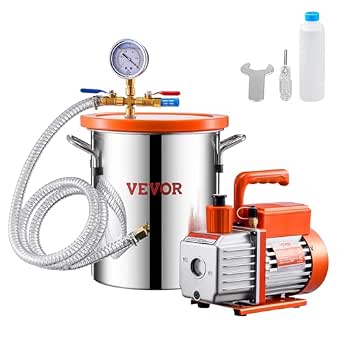 | Best Mid-Size Capacity | Chamber capacity: 3 gallons | Chamber material: Stainless steel | Lid material: Acrylic | VIEW ON AMAZON | See Our Full Breakdown |
| VIVOHOME 3 Gallon Acrylic Vacuum Chamber with 3.5 CFM 1 Stage Vacuum Pump |  | Best for Visible Process Monitoring | Chamber capacity: 3 gallons | Chamber material: 304 stainless steel, 0.04 in thick | Lid material and thickness: Acrylic, 0.55 in | VIEW ON AMAZON | See Our Full Breakdown |
| VEVOR 5-Gallon Vacuum Chamber and 3.5 CFM Pump Kit |  | Best for Large Batches | Chamber capacity: 5 gallons | Chamber material: Stainless steel | Lid material: Acrylic | VIEW ON AMAZON | See Our Full Breakdown |
| VEVOR 3-Gallon Vacuum Chamber Kit with 3.5 CFM Single-Stage Pump |  | Best Overall for Routine Resin Batches | Chamber capacity: 3 gallons | Pump capacity: 3.5 CFM | Pump type: Single-stage | VIEW ON AMAZON | See Our Full Breakdown |
| VEVOR 1.5-Gallon Vacuum Chamber and 3.5 CFM Pump Kit |  | Best Compact Stainless Starter Kit | Chamber capacity: 1.5 gallons | Pump flow rate: 3.5 CFM | Pump type: Single-stage | VIEW ON AMAZON | See Our Full Breakdown |
| BACOENG 1 Gallon Acrylic Vacuum Chamber for Resin, Silicone, and Epoxies |  | Best Chamber-Only Compact Option | Material: Acrylic | Size: 8.1 × 6.5 × 7.1 in | Vacuum gauge range: 0–30 inHg | VIEW ON AMAZON | See Our Full Breakdown |
| VIVOHOME 5-Gallon Vacuum Chamber Kit with 3.5 CFM Single-Stage Pump |  | Best for Larger Resin Batches | Chamber capacity: 5 gallons | Chamber material: 304 stainless steel | Chamber wall thickness: 0.04 in | VIEW ON AMAZON | See Our Full Breakdown |
| BACOENG 3-Gallon Stainless Steel Vacuum Chamber Kit with Tempered Glass Lid and Pump | 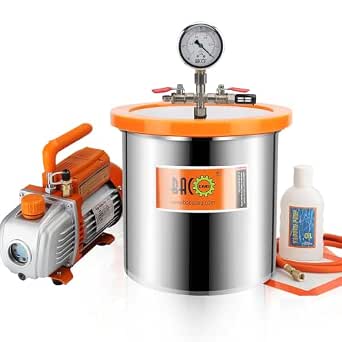 | Best for Multi-Purpose Workshop Use | Chamber capacity: 3 gallons | Chamber material: Stainless steel | Chamber dimensions: 9.8 in ID × 9.8 in H | VIEW ON AMAZON | See Our Full Breakdown |
| OMT 3 Gallon Vacuum Chamber & 3.5 CFM Pump Kit for Resin Degassing, Blue |  | Best Heavy-Duty Steel Option | Chamber Capacity: 3 gallons | Pump Airflow: 3.5 CFM | Maximum Vacuum: 37.5 microns | VIEW ON AMAZON | See Our Full Breakdown |
| BACOENG Acrylic Vacuum Chamber Kit with 3.5 CFM Pump, 1.5 Gallon |  | Best Compact Acrylic Kit | Chamber Capacity: 1.5 gallons | Chamber Material: Acrylic | Lid Light Transmittance: 92% | VIEW ON AMAZON | See Our Full Breakdown |
| vacuum chamber kit for resin degassing | Chamber capacity | Chamber material | Hose length | Lid material |
|---|---|---|---|---|
| VIVOHOME 1.5-Gallon Vacuum Cha | 1.5 gallons | 304 stainless steel | 5 ft | — |
| BACOENG 1.2 Quart Stainless St | 1.2 quarts | Stainless steel | 5 ft | Acrylic |
| VEVOR 3-Gallon Vacuum Chamber | 3 gallons | Stainless steel | 4.92 ft | Acrylic |
| VIVOHOME 3 Gallon Acrylic Vacu | 3 gallons | 304 stainless steel, 0.04 in thick | 5 ft | — |
| VEVOR 5-Gallon Vacuum Chamber | 5 gallons | Stainless steel | 4.92 ft | Acrylic |
| VEVOR 3-Gallon Vacuum Chamber | 3 gallons | Stainless steel | 4.92 ft | Tempered glass |
| VEVOR 1.5-Gallon Vacuum Chambe | 1.5 gallons | Stainless steel | 4.92 ft | Acrylic |
| BACOENG 1 Gallon Acrylic Vacuu | — | — | — | — |
| VIVOHOME 5-Gallon Vacuum Chamb | 5 gallons | 304 stainless steel | 5 ft | — |
| BACOENG 3-Gallon Stainless Ste | 3 gallons | Stainless steel | 5 ft | Tempered glass |
| OMT 3 Gallon Vacuum Chamber & | 3 gallons | Brushed 201 stainless steel | 5 ft | Tempered glass |
| BACOENG Acrylic Vacuum Chamber | 1.5 gallons | Acrylic | 5 feet | — |
More Details on Our Top Picks
VIVOHOME 1.5-Gallon Vacuum Chamber Kit with 3.5 CFM Vacuum Pump
For resin makers who want a complete setup without moving straight to a large vessel, this VIVOHOME pairs a 1.5-gallon stainless steel chamber with a 3.5 CFM pump and the core accessories needed to start degassing. Its clear acrylic lid lets you watch bubbles rise, while the included silicone pad and tools reduce the need to source small parts separately. Compared with the BACOENG 1.2 Quart kit, it offers substantially more chamber capacity and includes its own pump, making it a better fit for larger batches. The tradeoff is a larger, heavier footprint than a chamber-only option, and the lid needs to be pressed down to begin sealing. Its acrylic lid is also not the right choice for wood stabilization.
Pros:- Includes chamber, 3.5 CFM pump, gauge, hose, oil, silicone pad, and tools
- 304 stainless steel chamber is designed to resist warping and chemical damage
- Clear acrylic lid makes it possible to monitor bubbling
- Oil-filled dual-scale gauge is designed to reduce pointer vibration
Cons:- Acrylic lid is not recommended for wood stabilization
- Lid must be pressed down to start the seal
- At 19.3 pounds, it is less convenient to move than the smaller BACOENG chamber
Best for: Resin and silicone crafters who want a pump-and-chamber bundle for small to medium batches and value a visible degassing process.
Not ideal for: Wood stabilizers and buyers who need a compact chamber-only setup; the acrylic lid is not recommended for wood stabilization, and the full kit weighs 19.3 pounds.
- Chamber capacity:1.5 gallons
- Chamber material:304 stainless steel
- Lid material and thickness:Acrylic, 0.55 in
- Pump capacity:3.5 CFM
- Pump motor:1/4 HP copper motor
- Ultimate vacuum:5 Pa
- Gauge range and accuracy:-30 to 0 inHg / -1 to 0 bar; ±2.5%
- Hose length:5 ft
- Dimensions and weight:8.6 × 8.6 × 6.7 in; 19.3 lb
Our verdict“Choose this kit for a well-equipped, mid-size resin degassing setup, but skip it if you need a wood-stabilization lid or the smallest possible footprint.”
BACOENG 1.2 Quart Stainless Steel Vacuum Chamber Kit for Resin, Silicone, and Epoxies
The BACOENG is the space-saving pick for small resin pours, sample batches, or a workbench where a larger pot would be awkward. Its 1.2-quart stainless steel chamber and 3.15-pound weight make it far easier to store and handle than the pump-and-chamber bundles from VIVOHOME or VEVOR, but this listing describes a chamber rather than a complete pump kit. The clear acrylic lid gives a view of bubbles, and the reinforced hose has swivel ends for easier connection. That compactness limits batch size: it is a poor match for projects that need room for a tall container or substantial foam expansion. The acrylic lid also restricts material compatibility, and the maker rules out solvents such as alcohol, ethanol, and acetone.
Pros:- Compact 1.2-quart capacity suits small batches and tight workspaces
- Stainless steel construction is intended for repeated use
- Transparent acrylic lid lets users watch the degassing process
- Reinforced hose with swivel ends eases connection
Cons:- Much less capacity than the VIVOHOME 1.5-gallon and VEVOR 3-gallon kits
- No vacuum pump is listed as included
- Not compatible with alcohol, ethanol, acetone, or soft plastics
Best for: Crafters who degas small resin or silicone batches and already own a compatible vacuum pump and hose setup.
Not ideal for: Buyers processing large pours, using solvent-based materials, or needing an all-in-one pump kit; the chamber is small and the listed product does not include a pump.
- Chamber capacity:1.2 quarts
- Chamber dimensions:5.7 in internal diameter × 3.9 in high
- Chamber material:Stainless steel
- Lid material:Acrylic
- Vacuum gauge range:0–30 inHg
- Hose length:5 ft
- Hose connection:1/4 in SAE
- Weight:3.15 lb
Our verdict“Pick this compact chamber for small, non-solvent resin batches when you already have a pump, not as a complete first-time kit.”
VEVOR 3-Gallon Vacuum Chamber and 3.5 CFM Single-Stage Pump Kit
This VEVOR gives resin workers more headroom than the 1.5-gallon VIVOHOME without stepping up to the 5-gallon VEVOR. The 3-gallon stainless steel chamber is a useful middle ground for larger pours or batches that foam up, while its 3.5 CFM single-stage pump and stated 5 Pa ultimate vacuum provide a matched starting setup. A gauge, shut-off valve, hose, silicone pad, and pump oil are included, so the buyer gets more than a bare chamber. The acrylic lid supports visual monitoring, but the product is not suitable for wood stabilization. Compared with the 5-gallon VEVOR, this model takes less chamber capacity in exchange for a smaller vessel; buyers who regularly degas bulky containers may prefer the larger version.
Pros:- 3-gallon chamber offers a practical step up from the VIVOHOME 1.5-gallon kit
- Includes a 3.5 CFM pump, gauge set, shut-off valve, hose, silicone pad, and oil
- Stainless steel chamber is designed to resist warping or deformation
- Cooling fan supports extended pump operation
Cons:- Not suitable for wood stabilization
- Pump requires oil for operation and upkeep
- Less capacity than the VEVOR 5-gallon kit for oversized batches
Best for: Resin and epoxy makers who need more room than a compact chamber provides but do not need the VEVOR 5-gallon kit’s full capacity.
Not ideal for: Wood stabilizers and users who routinely process large molds or bulky containers; the acrylic lid is not suitable for wood stabilization, and the 3-gallon chamber may be restrictive for oversized work.
- Chamber capacity:3 gallons
- Chamber material:Stainless steel
- Lid material:Acrylic
- Pump capacity and type:3.5 CFM, single-stage
- Ultimate vacuum:5 Pa
- Hose length:4.92 ft
- Pump oil volume:0.35 qt (330 ml)
- Model:VP125
- Item weight:20 lb
Our verdict“Choose this VEVOR when a 1.5-gallon chamber feels limiting but a 5-gallon vessel would be more space than your resin work needs.”
VIVOHOME 3 Gallon Acrylic Vacuum Chamber with 3.5 CFM 1 Stage Vacuum Pump
For buyers who want a complete 3-gallon resin degassing station and a clear view of the chamber, this VIVOHOME combines a 0.55-inch acrylic lid with a 304 stainless steel vessel, silicone sealing components, and a 3.5 CFM pump. The listing states a maximum vacuum of -29.9 inHg above sea level and a lid temperature limit of 160°F, useful reference points when matching the kit to resin and silicone workflows. It fills a similar capacity role to the VEVOR 3-gallon kit, while its supplied 5-foot hose and tool kit make the included package explicit. As with the VEVOR, the acrylic lid rules out wood stabilization. The available product data also gives less pump detail than the VEVOR listing, so buyers comparing pump specifications have fewer stated figures here.
Pros:- 3-gallon stainless steel chamber is suited to larger resin batches
- Clear 0.55-inch acrylic lid allows process monitoring
- Silicone gasket and O-ring are specified for a tight seal
- Kit listing includes pump, gauge, 5-foot hose, oil, silicone pad, and tools
Cons:- Acrylic lid is not recommended for wood stabilization
- Pump stage and ultimate vacuum are not specified in the supplied product data
- The stated 160°F lid limit restricts use with hotter processes
Best for: Resin casters who want a 3-gallon complete kit with a clear lid and need to observe foam rise and collapse during degassing.
Not ideal for: Wood stabilizers and buyers who need a tempered-glass lid or fuller pump specifications before choosing; this model has an acrylic lid and limited listed pump details.
- Chamber capacity:3 gallons
- Chamber material:304 stainless steel, 0.04 in thick
- Lid material and thickness:Acrylic, 0.55 in
- Maximum vacuum:-29.9 inHg above sea level
- Lid temperature limit:160°F
- Pump capacity:3.5 CFM
- Hose length:5 ft
- Included pump oil:0.35 qt
Our verdict“Choose this VIVOHOME for a clearly viewable 3-gallon resin setup with a stated temperature limit, but favor another listing if pump specifications are a priority.”
VEVOR 5-Gallon Vacuum Chamber and 3.5 CFM Pump Kit
When batch size matters more than a small footprint, this VEVOR offers the lineup’s largest stated capacity: 5 gallons, paired with a 3.5 CFM single-stage pump. The extra volume can accommodate larger molds or multiple smaller containers, while the transparent acrylic lid lets the user track bubbling. Its stainless steel chamber, cooling fan, gauge set, shut-off valve, hose, silicone pad, and included oil make this a ready-to-assemble package. Compared with the VEVOR 3-gallon kit, the advantage is room; the cost of that choice is a larger vessel and less efficient use of chamber space for small pours. Both share the stated 5 Pa ultimate vacuum and are unsuitable for wood stabilization. The pump is single-stage, so this kit is aimed at general resin degassing rather than buyers seeking a different pump configuration.
Pros:- Largest listed chamber capacity among these five products
- Includes a 3.5 CFM pump, gauge set, shut-off valve, hose, silicone pad, and pump oil
- Transparent lid supports observation during degassing
- Cooling fan supports extended operation
Cons:- Larger capacity takes more space than the VEVOR 3-gallon kit
- Single-stage pump design may not suit buyers seeking a different pump configuration
- Not suitable for wood stabilization
Best for: Resin and epoxy makers who routinely degas large pours, several containers at once, or batches that need extra expansion room.
Not ideal for: Occasional users with small pours or limited bench space; the 5-gallon chamber is more capacity than they may need, and its acrylic lid is unsuitable for wood stabilization.
- Chamber capacity:5 gallons
- Chamber material:Stainless steel
- Lid material:Acrylic
- Pump type and capacity:Single-stage, 3.5 CFM
- Ultimate vacuum:5 Pa
- Motor:Four-stage, pure copper
- Hose length:4.92 ft
- Included pump oil:0.35 qt (330 ml)
- Item weight:22.7 lb
Our verdict“Pick this kit for recurring large resin batches that need room to expand, and choose the 3-gallon VEVOR if your projects rarely fill a large chamber.”
VEVOR 3-Gallon Vacuum Chamber Kit with 3.5 CFM Single-Stage Pump
I’d rank this VEVOR as the most balanced pick here for regular resin degassing: its 3-gallon stainless steel chamber offers more working room than the 1.5-gallon VEVOR kit, without taking up as much space as the VIVOHOME 5-gallon system. The tempered glass lid lets you watch resin rise as bubbles expand, while the included gauge, hose, valves, pad, and oil make this a ready-to-assemble setup. Its 3.5 CFM single-stage pump and stated 5 Pa ultimate vacuum suit common resin and silicone work. A cooling fan is useful during longer cycles, but the pump still needs oil and the chamber may be too small for unusually large pours. I’d choose the BACOENG 3-gallon kit instead if wood stabilization is also part of the plan.
Pros:- Stainless steel chamber provides a sturdy vessel for repeated degassing work.
- Tempered glass lid makes it easier to monitor foaming and bubble release.
- Cooling fan supports longer pump operation.
- Includes a gauge set, valves, hose, silicone pad, and pump oil.
Cons:- Three-gallon capacity can constrain larger molds or multiple batches.
- The single-stage pump requires oil checks and replacement.
Best for: Resin makers who want a ready-to-use, mid-capacity stainless chamber for recurring small-to-medium pours and silicone batches.
Not ideal for: Makers degassing large batches or oversized molds, since the 3-gallon chamber offers less room than the VIVOHOME 5-gallon kit.
- Chamber capacity:3 gallons
- Pump capacity:3.5 CFM
- Pump type:Single-stage
- Ultimate vacuum:5 Pa
- Chamber material:Stainless steel
- Lid material:Tempered glass
- Hose length:4.92 ft
- Weight:21.6 lb
Our verdict“Choose this VEVOR for a well-equipped stainless chamber that balances everyday batch capacity with a tempered-glass viewing lid.”
VEVOR 1.5-Gallon Vacuum Chamber and 3.5 CFM Pump Kit
For a small resin bench, I’d favor this VEVOR over the 3-gallon VEVOR when compact storage and modest batches matter more than extra headroom. It keeps the stainless steel chamber and 3.5 CFM single-stage pump, but trims capacity to 1.5 gallons. That narrower working volume can suit sample pours and smaller molds, though resin can expand substantially under vacuum, so usable room above the liquid matters. The transparent acrylic lid preserves visibility, and the kit includes a gauge, hose, shut-off valve, pad, and oil. Compared with the BACOENG 1-gallon acrylic chamber, this package adds a pump and a metal vessel; however, its manufacturer specifically says it is not suitable for wood stabilization. Pump oil is also part of routine upkeep.
Pros:- Stainless chamber offers a more substantial vessel than a small acrylic chamber.
- Acrylic lid allows visual monitoring during degassing.
- Cooling fan is designed to reduce heat during extended operation.
- Includes gauge, hose, shut-off valve, silicone pad, and pump oil.
Cons:- The 1.5-gallon capacity leaves less expansion room than the 3-gallon VEVOR kit.
- Not suitable for wood stabilization according to the manufacturer.
- Oil-based pump requires periodic oil-level checks and maintenance.
Best for: New resin or silicone workers handling small molds who want a compact stainless chamber and included pump rather than a chamber-only setup.
Not ideal for: Wood stabilizers or users with larger batches; the manufacturer excludes wood stabilization, and 1.5 gallons limits working volume.
- Chamber capacity:1.5 gallons
- Pump flow rate:3.5 CFM
- Pump type:Single-stage
- Ultimate vacuum:5 Pa
- Chamber material:Stainless steel
- Lid material:Acrylic
- Hose length:4.92 ft
- Item weight:18.73 lb
Our verdict“Pick this kit for small resin batches when compact stainless construction matters more than capacity or wood-stabilization use.”
BACOENG 1 Gallon Acrylic Vacuum Chamber for Resin, Silicone, and Epoxies
This BACOENG is the light-duty, space-saving choice in this group, not a complete pump-and-chamber kit. Its one-gallon clear acrylic body gives a direct view of resin expansion, while the supplied gauge and five-foot reinforced hose help connect it to a compatible vacuum pump. Compared with the VEVOR 1.5-gallon kit, it gives up capacity and an included pump, but may suit a maker who already owns suitable vacuum equipment and wants a smaller vessel. Its use limits matter: the manufacturer rules out alcohol, acetone, acrylic-based monomers, stabilization resins, and temperatures above 212°F. Those restrictions make it a narrower resin-and-silicone tool than the stainless-steel BACOENG 3-gallon kit, and one gallon can be limiting when a pour foams upward.
Pros:- Transparent acrylic body provides a broad view of material expansion.
- Reinforced five-foot hose is included for connection to a vacuum source.
- Compact one-gallon size suits small batches and limited workspaces.
- Gauge range runs from 0 to 30 inHg.
Cons:- No vacuum pump is listed, so buyers need a compatible pump separately.
- One-gallon capacity restricts batch size and expansion headroom.
- Material and temperature exclusions rule out several common workshop uses.
Best for: Resin hobbyists who already own a compatible vacuum pump and need a compact, visible chamber for small resin, silicone, or epoxy batches.
Not ideal for: Buyers seeking a complete kit, wood stabilizers, or anyone working with alcohol, acetone, acrylic-based monomers, stabilization resins, or heat above 212°F.
- Material:Acrylic
- Size:8.1 × 6.5 × 7.1 in
- Vacuum gauge range:0–30 inHg
- Vacuum hose length:5 ft
- Hose material:Reinforced professional-grade
- Maximum temperature:212°F
Our verdict“Choose this chamber only if you already have a pump and your small-batch resin work fits its solvent and temperature restrictions.”
VIVOHOME 5-Gallon Vacuum Chamber Kit with 3.5 CFM Single-Stage Pump
When batch volume is the main constraint, this VIVOHOME has the clearest advantage: its 5-gallon stainless steel chamber gives expanding resin more room than either 3-gallon VEVOR or BACOENG option. The 3.5 CFM pump, gauge, hose, oil, pad, and tools make it a more complete setup than the chamber-only BACOENG acrylic model. A clear acrylic lid helps track the rise, but it has a stated 160°F temperature limit and is not the suggested lid for wood stabilization. That makes this a stronger fit for resin and epoxy batches than for broader shop use requiring a glass lid. The pump’s specified operating range is 41°F to 104°F, so cold or hot workspaces may fall outside its stated conditions.
Pros:- Five-gallon capacity provides more expansion room than the 3-gallon kits.
- 304 stainless steel chamber is paired with a thick, clear acrylic lid.
- Complete package includes pump, gauge, hose, oil, silicone pad, and tools.
- Pump includes a cooling fan, non-slip base, and two inlet fittings.
Cons:- Acrylic lid is not recommended for wood stabilization and has a 160°F limit.
- Pump’s specified operating range is restricted to 41°F–104°F.
- Larger capacity and 24.3 lb weight take more room to store and handle.
Best for: Resin and epoxy makers who regularly degas larger pours and want a complete stainless chamber-and-pump package with room for expansion.
Not ideal for: Wood stabilizers who want a tempered-glass lid, or users operating outside the pump’s stated 41°F to 104°F range.
- Chamber capacity:5 gallons
- Chamber material:304 stainless steel
- Chamber wall thickness:0.04 in
- Pump capacity:3.5 CFM
- Pump ultimate pressure:5 Pa
- Lid material and temperature limit:Acrylic; 160°F
- Hose length:5 ft
- Item weight:24.3 lb
Our verdict“Choose this VIVOHOME when larger resin batches need extra chamber headroom and the acrylic-lid restrictions suit your work.”
BACOENG 3-Gallon Stainless Steel Vacuum Chamber Kit with Tempered Glass Lid and Pump
I’d pick this BACOENG when resin degassing is one task among several, rather than the only job for the chamber. Its 3-gallon stainless steel vessel matches the capacity of the VEVOR 3-gallon kit, while the 3.6 CFM pump is rated slightly higher than that model’s 3.5 CFM pump. The tempered glass lid and stated compatibility with resin, silicone, epoxies, wood stabilization, and soft plastisol bait make it the broader-use option in this batch. The tradeoff is careful handling: glass needs protection, and three gallons still cannot match the VIVOHOME 5-gallon kit for larger pours. A reinforced five-foot hose and silicone gasket round out the setup, but the provided data does not specify an ultimate vacuum in Pa.
Pros:- Stainless steel chamber is specified for resin, silicone, epoxy, wood stabilization, and soft plastisol bait.
- Tempered glass lid provides a clear view of the degassing process.
- 3.6 CFM pump flow rate is slightly higher than the 3.5 CFM pumps in the VEVOR kits.
- Includes a silicone gasket and reinforced five-foot vacuum hose.
Cons:- Three-gallon capacity is smaller than the VIVOHOME 5-gallon chamber.
- Tempered glass lid needs careful handling to avoid damage.
- Product data does not provide an ultimate vacuum rating in Pa.
Best for: Makers who degas resin and also want one stainless chamber for wood stabilization or soft plastisol bait work.
Not ideal for: Users who need the greatest batch capacity or prefer a more forgiving lid; the VIVOHOME 5-gallon kit offers more room, while glass requires careful handling.
- Chamber capacity:3 gallons
- Chamber material:Stainless steel
- Chamber dimensions:9.8 in ID × 9.8 in H
- Pump flow rate:3.6 CFM
- Vacuum level:-29.92 inHg
- Lid material:Tempered glass
- Hose length:5 ft
- Item weight:26 lb
Our verdict“Choose this BACOENG if you want a tempered-glass 3-gallon kit that also suits wood stabilization and soft plastisol work.”
OMT 3 Gallon Vacuum Chamber & 3.5 CFM Pump Kit for Resin Degassing, Blue
This kit stands out for its brushed 201 stainless steel construction, offering superior heat resistance compared to the acrylic alternatives like the BACOENG Acrylic Vacuum Chamber. If you frequently work with exothermic resins or hot materials, this chamber’s ability to withstand up to 250°F provides a safety margin that plastic chambers lack. The tempered glass lid allows for clear visibility without the risk of clouding from harsh solvents. However, the unit is heavy at 24 pounds, making it less portable than smaller setups. While the 3.5 CFM pump matches the performance of competitors, the assembly process requires more attention to detail to ensure a proper seal. It is a robust choice for serious hobbyists who prioritize durability over lightweight convenience.Pros:- Stainless steel chamber resists heat up to 250°F and corrosion
- Tempered glass lid offers clear visibility without solvent damage
- Includes all necessary accessories for immediate setup
- Pump features thermal protection to prevent overheating
Cons:- Heavy weight (24 lbs) makes it difficult to move or store
- Assembly can be complex for first-time users
- 3-gallon capacity limits large-scale production runs
Best for: Users working with high-heat materials or those needing a durable, non-porous chamber resistant to chemical degradation.
Not ideal for: Beginners with limited counter space or those who need a lightweight, easily transportable setup for occasional use.
- Chamber Capacity:3 gallons
- Pump Airflow:3.5 CFM
- Maximum Vacuum:37.5 microns
- Chamber Material:Brushed 201 stainless steel
- Temperature Resistance:Up to 250°F
- Lid Material:Tempered glass
- Hose Length:5 ft
Our verdict“Choose this kit if you need a heat-resistant, durable steel chamber that outlasts acrylic models.”
BACOENG Acrylic Vacuum Chamber Kit with 3.5 CFM Pump, 1.5 Gallon
The BACOENG Acrylic Chamber offers excellent visibility with its 92% light transmittance lid, allowing you to monitor bubble release closely. This makes it ideal for delicate casting work where visual precision matters more than material durability. Compared to the OMT Stainless Steel Kit, this acrylic model is lighter and easier to handle, though it lacks heat resistance above 212°F. The reusable silicone gasket is a practical feature, reducing long-term maintenance costs. However, the material is incompatible with certain solvents and stabilization resins, limiting its versatility. While the 3.5 CFM pump delivers adequate suction for small batches, the 1.5-gallon capacity restricts project size. This kit suits users who prioritize clear observation and compact storage over heavy-duty chemical resistance.Pros:- High-transparency acrylic lid allows precise visual monitoring
- Silicone gasket is durable and reusable over 10,000 cycles
- Compact 1.5-gallon size fits easily on small workbenches
- Reinforced hose with swivel ends simplifies installation
Cons:- Acrylic material is incompatible with solvents and stabilization resins
- Maximum temperature limit of 212°F restricts hot-pour applications
- Small capacity requires multiple batches for larger projects
Best for: Resin artists and crafters who need clear visibility for small to medium projects and avoid harsh solvents.
Not ideal for: Users working with hot resins, stabilization fluids, or acetone, as the acrylic can crack or degrade.
- Chamber Capacity:1.5 gallons
- Chamber Material:Acrylic
- Lid Light Transmittance:92%
- Pump Airflow:3.5 CFM
- Max Medium Temperature:212°F
- Hose Length:5 feet
- Item Weight:23.6 pounds
Our verdict“This is the right pick for crafters who value clear visibility and compact storage over heat resistance.”
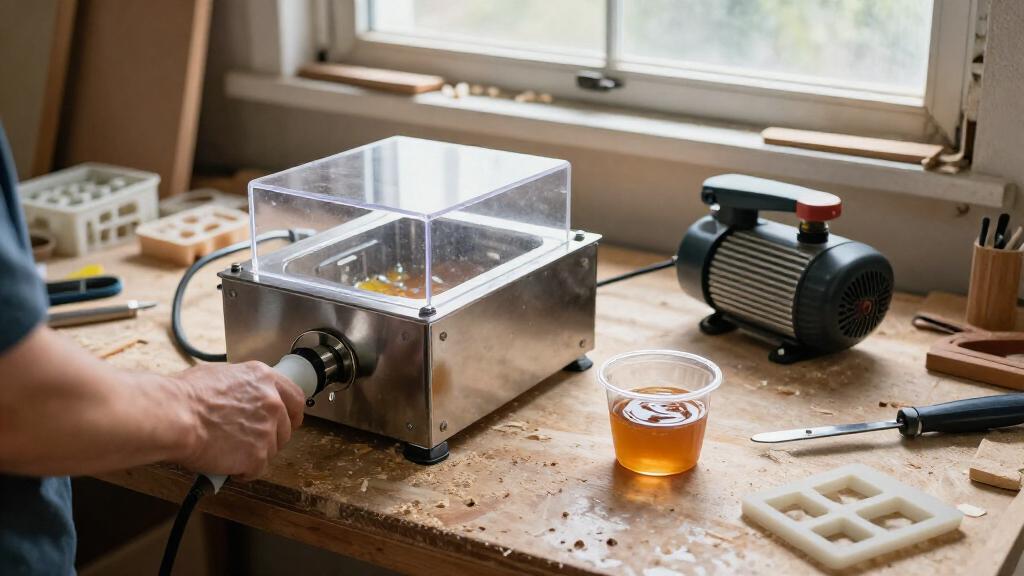
How We Picked
I evaluated these kits based on three primary pillars: degassing efficiency, build quality, and user accessibility. Efficiency was judged by the pump’s CFM rating relative to the chamber volume, ensuring that the vacuum level drops quickly enough to remove microbubbles before resin begins to cure. Build quality focused on the seal integrity of the lid and the material resistance to common epoxy chemicals, as a leaking vacuum is useless regardless of pump power. User accessibility considered how easy it is to monitor the process, particularly the clarity of the gauge and the visibility of the resin inside the chamber.
Ranking logic prioritized value for money for the majority of hobbyists, placing mid-sized acrylic kits higher than niche industrial options. However, durability played a tie-breaking role; stainless steel models were ranked higher than comparable acrylic ones when prices were similar, acknowledging the long-term cost of replacement parts. I also filtered out kits with reported issues regarding pump overheating or poor customer support for replacement seals, as these friction points significantly degrade the ownership experience.
| vacuum chamber kit for resin degassing | Lid material |
|---|---|
| VIVOHOME 1.5-Gallon Vacuum Cha | — |
| BACOENG 1.2 Quart Stainless St | Acrylic |
| VEVOR 3-Gallon Vacuum Chamber | Acrylic |
| VIVOHOME 3 Gallon Acrylic Vacu | — |
| VEVOR 5-Gallon Vacuum Chamber | Acrylic |
| VEVOR 3-Gallon Vacuum Chamber | Tempered glass |
| VEVOR 1.5-Gallon Vacuum Chambe | Acrylic |
| BACOENG 1 Gallon Acrylic Vacuu | — |
| VIVOHOME 5-Gallon Vacuum Chamb | — |
| BACOENG 3-Gallon Stainless Ste | Tempered glass |
| OMT 3 Gallon Vacuum Chamber & | Tempered glass |
| BACOENG Acrylic Vacuum Chamber | — |
Factors to Consider When Choosing Vacuum Chamber Kit For Resin Degassing
Selecting a vacuum chamber involves more than just picking the largest size available. Here are the critical factors that influence long-term satisfaction and project success.Chamber Capacity vs. Project Scale
Matching chamber size to your typical mold dimensions is the first step in avoiding wasted space or physical limitations. A 1.5-gallon chamber is generally sufficient for small jewelry, coasters, or keychains, where the resin volume is low and the surface area is limited. If you frequently cast tabletops, river tables, or large art pieces, you will need at least a 3-gallon or 5-gallon chamber to fit the mold without touching the sides. Over-sizing your chamber does not speed up degassing; in fact, larger volumes take longer to pull a vacuum, potentially wasting resin if it cures before bubbles are released. Conversely, under-sizing leads to messy spills and inadequate vacuum coverage for taller objects.
Material Durability: Acrylic vs. Stainless Steel
The choice between acrylic and stainless steel affects both visibility and longevity. Acrylic chambers allow you to visually monitor the rising bubbles and ensure the resin is not boiling over, which is helpful for beginners learning the degassing curve. However, acrylic is brittle and can crack if subjected to rapid temperature changes or impact. Stainless steel chambers are virtually indestructible and resistant to chemical corrosion from aggressive epoxies or UV resins. While steel obscures the view of the process, requiring you to rely solely on the vacuum gauge, it is the better investment for professional environments where durability outweighs the convenience of visual checks.
Pump Power and Vacuum Depth
Most consumer-grade kits come with 3.5 CFM single-stage pumps, which are adequate for removing large air pockets but may struggle with microbubbles in highly viscous resins. A higher CFM rating means the pump moves air faster, reducing the total time your resin sits in the chamber. It is important to understand that a single-stage pump typically reaches a vacuum level of around 500 microns, which is sufficient for most epoxy applications. If you work with ultra-clear resins where even microscopic bubbles are visible defects, you might need to look for a dual-stage pump, though these are rare in bundled kits and often require separate purchases.
Seal Integrity and Maintenance Costs
The effectiveness of any vacuum chamber relies entirely on the seal integrity between the lid and the base. Over time, the O-ring seals degrade, leading to slow vacuum pulls or complete failure to hold pressure. Check if the manufacturer sells replacement O-rings and if the lid design allows for easy cleaning of resin residue. Some kits use complex locking mechanisms that are prone to breaking, whereas simple clamping systems are easier to repair. Regular maintenance, such as wiping the seal with alcohol after every use, extends the life of the kit, but choosing a kit with easily sourced parts prevents downtime when replacements are inevitably needed.
Gauge Readability and Control Precision
A reliable vacuum gauge is your primary feedback tool during the degassing process. Digital gauges offer precise readings and are easier to read quickly, while analog gauges are more durable and do not require batteries. The control valve is equally important; a fine-tuning valve allows you to adjust the vacuum level slowly to prevent the resin from boiling over. Cheap valves often have a wide adjustment range that makes fine control difficult, leading to messy spills. Look for kits that specify a ‘needle valve’ or ‘precision valve’ to ensure you have granular control over the vacuum release.
Frequently Asked Questions
Can I use a vacuum chamber for any type of resin?
Most vacuum chambers work with standard epoxy, polyurethane, and polyester resins, but compatibility depends on the resin’s viscosity and curing time. Highly viscous resins require longer degassing times, which increases the risk of the resin curing inside the chamber if left unattended. Always check your resin manufacturer’s guidelines for recommended vacuum levels and durations. Some specialized UV resins may not benefit from vacuum degassing because they cure too quickly under light exposure, making the process impractical.
Why does my resin boil over in the vacuum chamber?
Boiling over occurs when the vacuum pressure drops below the vapor pressure of the solvents or gases within the resin, causing them to expand rapidly. This is common with low-viscosity resins or those containing volatile additives. To prevent this, you should use the vacuum valve to control the rate at which the vacuum is applied, allowing large bubbles to escape slowly before increasing the suction. Keeping the resin volume below the halfway mark of the chamber also provides necessary headspace for expansion without spilling into the pump.
Do I need a dual-stage pump for hobbyist resin casting?
For the vast majority of hobbyist projects, a single-stage pump with a 3.5 CFM rating is sufficient. Dual-stage pumps achieve deeper vacuums (lower microns), which is primarily beneficial for industrial applications involving composite materials or high-end optical resins. The cost difference is significant, and the marginal gain in bubble removal for standard epoxy casting is rarely noticeable to the naked eye. Unless you are producing high-precision optical components or aerospace composites, a single-stage kit offers the best return on investment.
How often should I replace the vacuum pump oil?
Most bundled vacuum pumps require oil changes every 50 to 100 hours of operation, or whenever the oil appears milky or dark. Milky oil indicates moisture contamination, which degrades the pump’s ability to pull a vacuum and can damage internal components. Some newer ‘oil-less’ pumps exist but are louder and have a shorter lifespan. Regularly checking and changing the oil is the single most important maintenance task to ensure your kit continues to perform effectively over several years of use.
Is it safe to degas resin with pigments or glitter?
Yes, but you must exercise caution as pigments and glitter can create unexpected foaming or clogging issues. Metallic pigments can sometimes react with certain resin catalysts under vacuum, though this is rare. Glitter and heavy additives can settle differently, potentially clogging the vacuum valve if the resin is left in the chamber for too long. Always test a small batch first to observe how the additives behave under vacuum, and never leave the chamber unattended for extended periods when using complex mixtures.
Conclusion
Choosing the right vacuum chamber kit for resin degassing ultimately comes down to matching your production volume with the appropriate capacity and material durability. For the majority of home hobbyists, the VIVOHOME 1.5-Gallon Kit represents the best overall choice, offering a user-friendly interface and reliable performance for small to medium projects. If you are just starting out and want the best value, the VEVOR 1.5-Gallon Kit provides essential functionality at a lower entry price, though you may need to upgrade the seals sooner. For professionals needing premium durability, the BACOENG Stainless Steel Kits are the superior option, resisting chemical damage and physical wear better than their acrylic counterparts. Beginners should avoid oversized chambers, sticking to the 1.5-gallon range to learn the degassing curve without wasting resin, while large-scale artists should invest in the 5-gallon VEVOR or VIVOHOME models to accommodate bigger molds efficiently.