
If you’re choosing between a clamshell and swing-away heat press, consider your workspace, project complexity, and safety needs. Clamshell presses are compact, budget-friendly, and great for simple, flat projects. Swing-away presses offer full access, better handling of intricate or layered designs, and improved safety, especially for delicate materials. Think about what suits your projects best—continue exploring to find the layout that fits your setup perfectly.

Get business pricing on tools and workshop supplies
- Business-only prices and quantity discounts
- Tax-exempt purchasing
- Multiple users, one account, clear invoices
Key Takeaways
- Clamshell presses are more compact and budget-friendly, suitable for beginners and limited workspace.
- Swing-away presses offer full access to the pressing surface, ideal for complex or multi-layer projects.
- Swing-away models provide safer handling by reducing contact with hot surfaces during setup.
- Clamshell presses are best for flat, simple projects like t-shirts, while swing-away handles intricate or layered designs better.
- Choice depends on workspace size, project complexity, safety needs, and material handling requirements.
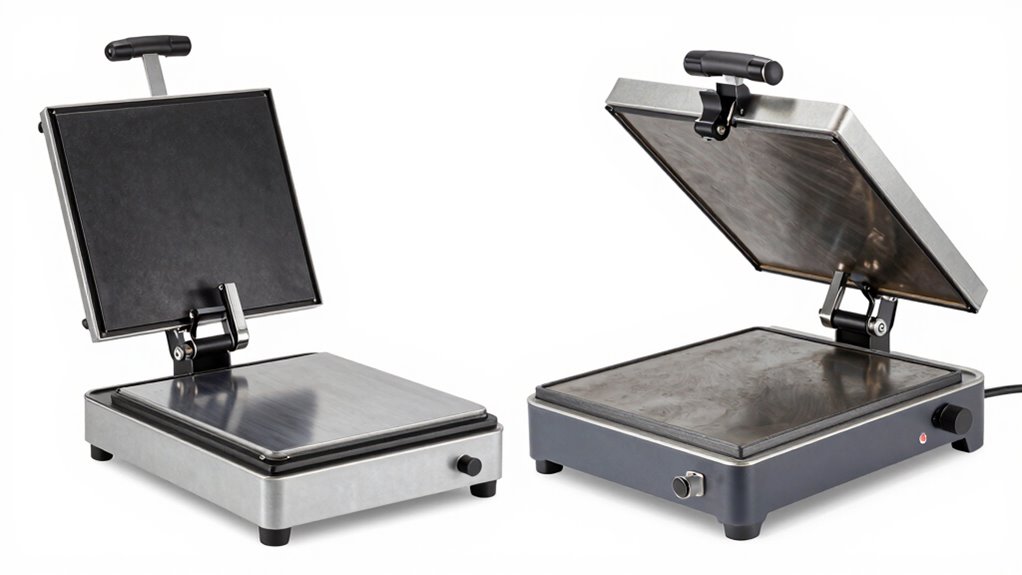
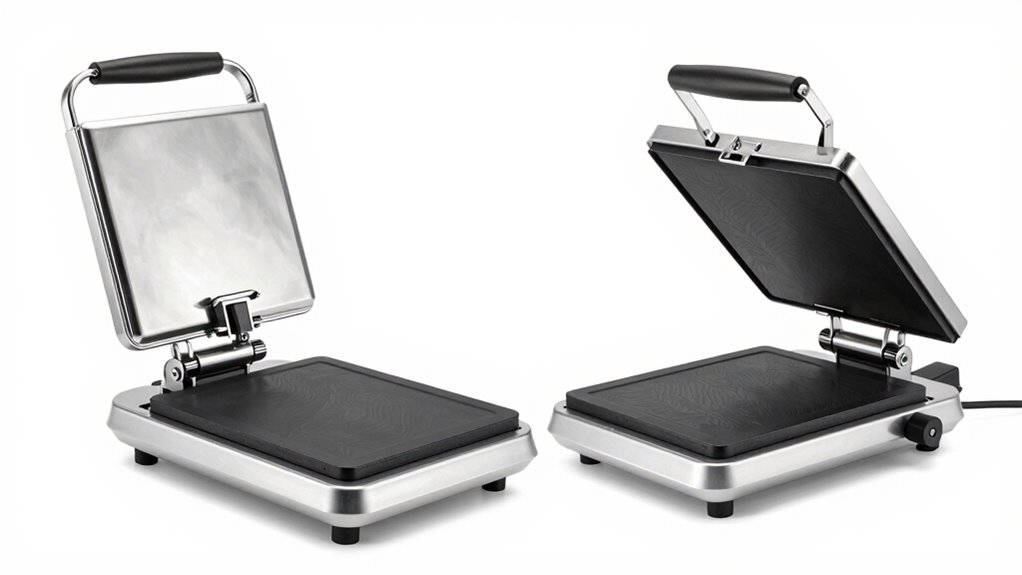
When choosing a heat press, understanding the differences between a clamshell and a swing-away model is essential for making the right decision. Both styles have unique features that influence how you handle heat transfer techniques and press material compatibility. Your choice depends on your specific needs, workspace constraints, and the types of projects you plan to undertake. Clamshell presses open like a book, with the top platen lifting upward, which makes them more compact and easier to store. They’re generally lighter and more affordable, making them appealing for beginners or those with limited space. However, because the heating element remains in place while you work, you need to be cautious about pressing delicate or uneven items, as this can lead to uneven heat distribution or accidental contact with the hot platen.
Choosing between clamshell and swing-away heat presses depends on your projects, workspace, and safety needs.
Swing-away presses, on the other hand, feature a top platen that swings away from the lower platen, providing full access to the entire pressing surface. This design offers better control over heat transfer techniques because you can position your material precisely without the risk of shifting during pressure. Swing-away models are often preferred for complex or multi-layer projects, as they accommodate thicker or more delicate press materials without disturbing the alignment. They’re also safer, reducing the chance of accidental contact with the hot platen during setup or removal. Additionally, swing-away presses tend to be larger and more expensive, which might not suit everyone’s workspace or budget. A thorough understanding of press material compatibility ensures more successful and durable results, especially when working with diverse fabrics and materials.
When considering heat transfer techniques, think about the types of materials you’ll work with most often. Clamshell presses are suitable for straightforward applications like t-shirts or flat items, but they might struggle with thicker or layered fabrics because of limited access and uneven pressure distribution. Swing-away presses excel in situations where precision and versatility are required, especially with complex designs, multi-layer transfers, or irregularly shaped items. Press material compatibility is another key factor; some materials need gentle handling or even heat distribution, making the swing-away design a better fit, while simpler, flat materials can be easily managed on a clamshell model. Moreover, understanding heat transfer techniques and how they interact with different heat press layouts ensures more reliable and high-quality results.
Ultimately, your decision hinges on how you prioritize workspace, safety, and project complexity. If you’re just starting out or working within tight space constraints, a clamshell heat press might be the best choice. If you need more control, flexibility, and superior safety features for intricate designs, then a swing-away model will serve you better. Both types have their advantages, but understanding how they align with your heat transfer techniques and press material compatibility will help you pick the layout that works best for your projects.
Popular right now

De'Longhi Linea Classic Espresso Machine with Adjustable Milk Frother

Vitamix Propel Series 750 Professional-Grade Blender, 4 Programs, Black

Breville Barista Pro Espresso Machine with Grinder, Brushed Stainless Steel
As an affiliate, we earn on qualifying purchases.
Frequently Asked Questions
Which Heat Press Layout Is More Suitable for Large-Scale Production?
You should choose a swing-away heat press for large-scale production because it offers better design flexibility and safety, making it easier to handle multiple or large items efficiently. Its independent upper platen movement allows precise positioning, reducing errors and waste. While it may be slightly more costly initially, the increased efficiency and consistent results make it more cost-effective in the long run, ideal for high-volume production.
How Does the Weight of Each Heat Press Type Affect Portability?
You might find that the weight of your heat press considerably impacts portability concerns. Swing-away models tend to be heavier due to their movable arm, making them less portable but easier to handle when applying even pressure. Clamshell presses are generally lighter, offering better weight distribution, which enhances portability. So, if moving your press around frequently is a priority, consider the weight and how it affects your ability to transport and position the device easily.
Are There Specific Materials Better Suited to One Layout Over the Other?
You’ll find that clamshell heat presses excel with thinner materials like paper or light fabrics, thanks to their design flexibility that allows easy access. Swing-away models are better suited for thicker or layered materials, as their design provides more even pressure and material compatibility. Choosing the right layout depends on your specific projects; consider material compatibility and design flexibility to optimize results with either heat press.
What Maintenance Differences Exist Between Clamshell and Swing-Away Presses?
You’ll find that maintenance differences between clamshell and swing-away presses mainly involve calibration procedures and safety features. Clamshell presses often require periodic calibration to guarantee even heat distribution, while swing-away models need checks on hinge alignment. Both types demand regular safety feature inspections, like locking mechanisms and safety shields, to prevent accidents. Overall, swing-away presses tend to need slightly more maintenance due to their moving parts, but proper upkeep keeps both safe and effective.
Can Both Layouts Accommodate All Heat Transfer Designs Equally Well?
Both layouts offer good design flexibility, but swing-away presses typically handle intricate designs better due to their fully raised upper platen, providing more workspace and even pressure. Clamshell presses are more cost-efficient and suitable for simpler designs. If you need versatility for complex projects, a swing-away press is a better choice, while clamshells are ideal if budget and efficiency are your priorities.
Conclusion
Ultimately, choosing between a clamshell and swing-away heat press is like selecting the right tool for a craft—you need the one that fits your needs perfectly. Clamshells are great for quick, space-saving jobs, while swing-aways offer better safety and even pressure. Think of it as a dance—each has its rhythm, but only one will lead you smoothly through your projects. Whichever you pick, make sure it aligns with your workflow to keep your heat pressing experience flawless.