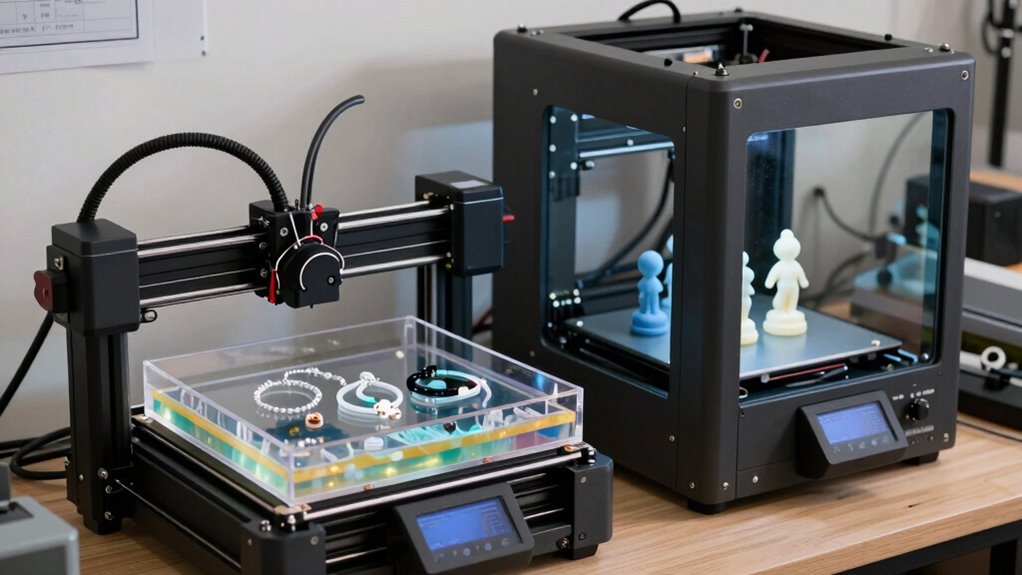

If your craft studio focuses on creating larger prototypes or functional parts quickly, an FDM 3D printer is your best choice due to its speed and material versatility. However, if you need highly detailed miniature models, jewelry, or intricate designs, a resin printer offers superior surface finish and precision. Consider your project size and quality needs—your ideal option depends on your priorities. Keep exploring to discover which printer suits your studio best.
Key Takeaways
- FDM printers are better for large, quick projects; resin printers excel in detailed, small-scale work.
- Resin printers produce higher surface quality, ideal for jewelry, miniatures, and intricate designs.
- FDM printers handle a wider range of materials and larger models, suitable for functional prototypes.
- Resin printing is slower but offers superior detail, making it perfect for high-precision craft items.
- Choose FDM for volume and speed; opt for resin when quality and detail are the priority.
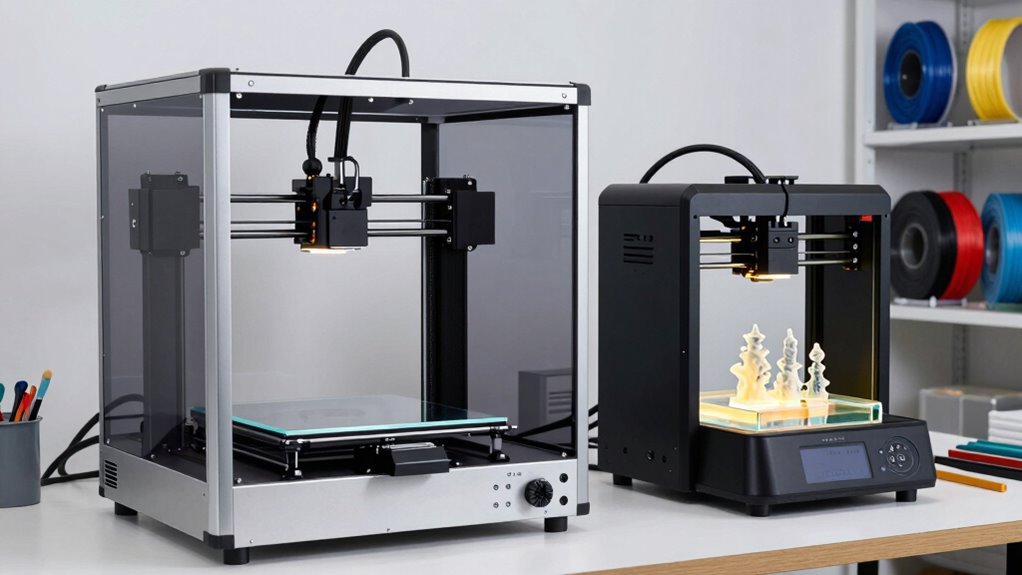
When choosing between a 3D printer and a resin printer, understanding their fundamental differences can help you make an informed decision. In a craft studio, your priorities might include speed, detail, and versatility. A 3D printer, especially FDM (Fused Deposition Modeling) models, is often favored for its ability to handle larger projects and a broader range of materials. It’s well-suited for industrial applications, where durability and volume matter, but it’s also popular among hobbyists for its straightforward operation. Printing speed is generally faster with standard FDM printers when working on bigger items, allowing you to produce larger prototypes or parts more quickly. However, you might find that the layer resolution isn’t as fine as with resin printers, which affects the detail and surface finish.
FDM 3D printers excel in speed and larger projects, but resin printers offer finer detail and surface quality.
Resin printers, on the other hand, excel in producing highly detailed, smooth models. They use UV light to cure liquid resin layer by layer, resulting in precision that’s hard to match. For a craft studio focused on small, intricate pieces—jewelry, miniatures, detailed prototypes—a resin printer can deliver exceptional quality. The trade-off is that resin printers tend to have slower printing speeds, especially for larger models, because the curing process is meticulous and involves multiple layers. If your projects require rapid production of complex, detailed items, a resin printer might slow you down, but the quality payoff can be worth it. Advancements in resin printing technology continue to improve printing speed and material options, making them more accessible for diverse projects, expanding their usefulness even further.
In terms of industrial applications, 3D printers are often chosen for their ability to produce functional parts, prototypes, and tools at a faster pace, especially when working with thermoplastics. Resin printers, meanwhile, are more niche, often used for creating highly detailed models or molds, rather than large-scale manufacturing. Speed differences are significant here: FDM printers can print larger objects in less time, making them more efficient for bulk production or time-sensitive projects. Resin printers, while slower, are invaluable for projects where detail and surface finish are paramount. Additionally, advancements in resin printing technology continue to improve printing speed and material options, expanding their usefulness even further.
Ultimately, your choice hinges on what’s most important for your craft studio. If you need quick turnaround times for larger or functional parts, a 3D printer will likely serve you better. But if your focus is on producing detailed miniatures or jewelry with high precision, investing in a resin printer makes sense, even if it takes a bit longer per piece. Both types have their strengths, and understanding these core differences will help you pick the right tool to elevate your craft.
FDM 3D printer for large prototypes
As an affiliate, we earn on qualifying purchases.
As an affiliate, we earn on qualifying purchases.
Frequently Asked Questions
Which Printer Type Is More Environmentally Friendly?
Resin printers tend to be more eco-friendly because they often use eco-conscious materials and generate less waste compared to filament-based 3D printers. However, they can have higher energy consumption during printing due to curing processes. If you prioritize sustainability, look for resin printers that use less power and eco-conscious resins. Overall, resin printers can be greener if you choose eco-friendly materials and manage energy use carefully.
How Long Does Maintenance Typically Take for Each Printer?
You’ll find maintenance times vary: for 3D printers, it often involves print bed leveling, which can take about 10-20 minutes, depending on your experience. Resin printers require regular resin curing and cleaning, typically taking around 15-30 minutes per session. Both need routine upkeep, but resin printers tend to need more frequent cleaning, while 3D printers focus on bed leveling and nozzle checks to keep everything running smoothly.
Can Both Printers Print With the Same Materials?
Think of your craft studio as a painter’s palette—you can’t use just one color for every project. Both printers, while versatile, don’t share the same materials. Resin printers excel in print precision with photopolymer resins, perfect for detailed miniatures. 3D printers offer greater material versatility with filaments like PLA and ABS, suitable for larger, functional objects. Choose based on whether you prioritize intricate details or broad material options.
What Is the Noise Level Difference Between Them?
The noise comparison shows that 3D printers typically produce more sound levels than resin printers. You’ll notice the 3D printer’s motors and fans generate a constant hum, which can be quite loud, especially during long prints. Resin printers operate more quietly, mainly because they rely on light curing rather than mechanical movement. If noise levels matter, a resin printer might be a better choice for a peaceful craft studio environment.
Which Printer Offers Better Scalability for Large Projects?
A 3D printer offers better scalability for large projects because of its greater material versatility and faster printing speeds. You can use various filaments like PLA, ABS, or PETG, which are ideal for bigger, more complex models. Its faster printing speed helps you complete large projects efficiently. Resin printers excel in detail, but their slower process and limited material options make them less suitable for large-scale production.
resin printer for miniature models
As an affiliate, we earn on qualifying purchases.
As an affiliate, we earn on qualifying purchases.
Conclusion
Ultimately, choosing between a 3D and resin printer is like deciding whether to sail with the wind or navigate by the stars. Both tools can elevate your craft studio, but your decision hinges on what you value most—speed and versatility or detail and precision. Remember, the right choice isn’t just about technology; it’s about forging your own path, reminiscent of Da Vinci’s pursuit of mastery. Trust your instincts, and let your creativity be your compass.
As an affiliate, we earn on qualifying purchases.
As an affiliate, we earn on qualifying purchases.