
TL;DR
Livingetc has published a design report on mitered countertop edges, a fabrication technique that makes a worktop appear thicker by joining its surface to a matching vertical strip. Kitchen designers say it can create a substantial-looking profile with less material and weight than a solid thick slab, but the result depends on precise cutting and careful matching.
Livingetc has reported on the mitered-edge technique, in which a countertop’s surface is joined to a matching vertical strip to make the worktop look thicker than its construction. Kitchen designers cited by the publication say the detail can give islands and counters a more substantial profile while using less material and avoiding the weight of a solid, oversized slab.

Get business pricing on tools and workshop supplies
- Business-only prices and quantity discounts
- Tax-exempt purchasing
- Multiple users, one account, clear invoices
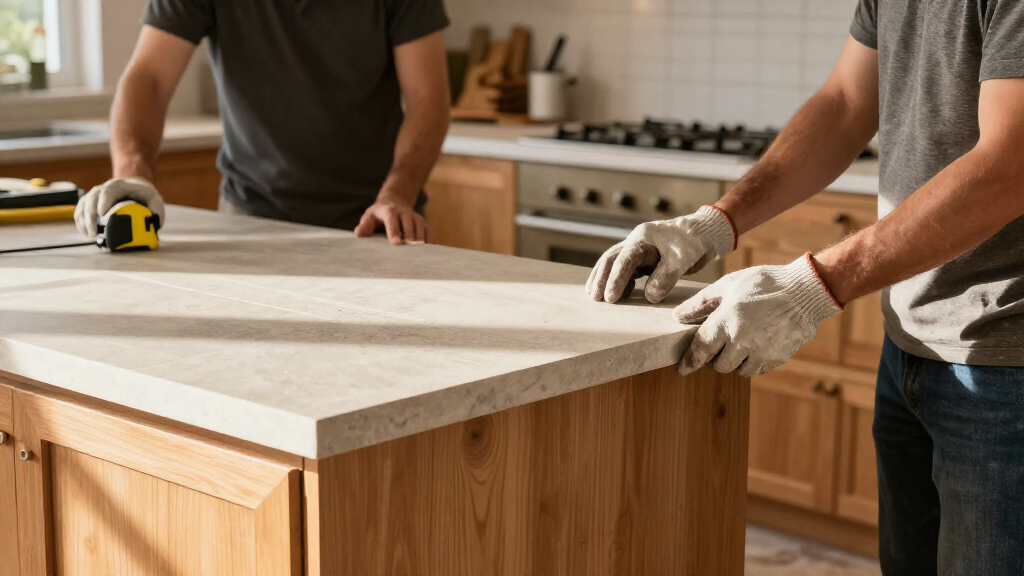
A mitered edge is made by cutting the horizontal worktop and the vertical edge piece at matching 45-degree angles, then joining them. Roundhouse head of sales and design Hayley Robson described the result as a deep, crisp profile that appears to be part of one substantial slab. The joint is intended to be difficult to see, though achieving that effect requires accurate fabrication.
Jayne Everrett, co-founder of Naked Kitchens, told Livingetc that the countertop must be carefully templated so the vertical and horizontal mitres meet cleanly. The level of difficulty varies with the material. Harvey Jones designer Lewis Buckley said that, with natural stone, material selection and precise cutting are needed to help the veining continue across the join.
The designers cited in the report describe the technique as useful for creating a dramatic edge without building the entire worktop from a thick block of material. Everrett said a solid slab could be expensive and very heavy; Robson said a mitered edge can deliver the visual effect with less weight and allow the profile depth to be adjusted to suit cabinetry or an island.
A Thick Look With Less Stone
The technique matters to homeowners planning a kitchen because countertop thickness affects both the room’s appearance and the practical demands of installation. A mitered edge can provide a chunkier visual profile without requiring a full-depth slab, which designers say can reduce material use and avoid some of the weight associated with a solid thick worktop.
That does not make the finish automatically inexpensive. The source describes it as potentially more cost-effective than a solid slab, but gives no prices or savings figures. The custom cutting, careful templating and material matching still require skilled work, so the final cost will depend on the countertop material, design and fabrication.
Popular right now

Ninja Combi 14-in-1 Multicooker, Air Fryer, Toaster Oven & Steamer (SFP701)

LG 55-Inch QNED73B Mini LED 4K Smart TV (2026)

Vitamix Touch & Go Advance 32-Ounce Bar Blender, White
As an affiliate, we earn on qualifying purchases.
How the Countertop Detail Works
Livingetc’s report presents mitered edges as a detail used particularly on kitchen islands, where a deeper profile can be more visually prominent. The technique joins a vertical strip to the worktop’s edge rather than relying on a single thick piece. If the surfaces align and the seam is concealed, the assembly can read as one solid counter.
The report draws on comments from designers at Roundhouse, Naked Kitchens and Harvey Jones. Their descriptions focus on fabrication and design considerations rather than a new product launch or industry-wide change. They say the profile can be tailored to cabinetry, while natural stone may need extra attention so that its veining appears to flow through the corner.
“A mitered edge is created by joining the worktop surface to a matching vertical strip, with both pieces cut at 45 degrees.”
— Hayley Robson, Roundhouse head of sales and design, quoted by Livingetc
Costs and Suitability Vary
The source does not provide project prices, cost comparisons or installation timelines, so the amount a homeowner might save is unknown. It also does not quantify how much lighter a mitered counter is than a solid slab. The reported benefits are designers’ general assessments, not a guarantee that every project will cost less.
Whether the finish suits a particular kitchen will depend on the chosen material, the design and the quality of fabrication. The report does not give specific guidance on durability, maintenance or performance for different countertop materials, nor does it establish that every seam will be invisible. Those details should be confirmed with the fabricator for an individual project.
Questions to Ask a Fabricator
For anyone considering the detail, the practical next step is to ask a kitchen designer or countertop fabricator for a material-specific estimate. Homeowners can ask how the edge will be templated and joined, how the seam will look from different angles, and—if using patterned stone—how the veining will be matched.
Because the report describes a bespoke fabrication detail rather than a scheduled industry development, it identifies no upcoming milestone. The finished appearance, cost and installation requirements remain matters to resolve during the design and quotation process.
Key Questions
What is a mitered countertop edge?
It is a countertop edge made by joining the worktop surface to a matching vertical strip, with the pieces cut at matching 45-degree angles. The join creates the appearance of a thicker slab.
Does a mitered edge use a solid thick slab?
No. The technique uses joined pieces to create the look of a thick edge, rather than making the entire countertop from one oversized, thick block.
Is a mitered edge cheaper?
Designers cited by Livingetc say it can be more cost-effective than a solid thick slab because it uses less material. The report provides no prices or guaranteed savings, and precise custom fabrication is still required.
Why is natural stone more demanding?
Natural stone may have distinctive veining that designers want to continue across the join. Buckley said careful material selection and precise cutting can help align the pattern.
Where is the technique commonly used?
The report says mitered edges are often used on kitchen islands, where the deeper profile can make a strong visual impression. A designer or fabricator can advise whether it fits a specific counter layout.
Source: livingetc.com