
TL;DR

Get business pricing on tools and workshop supplies
- Business-only prices and quantity discounts
- Tax-exempt purchasing
- Multiple users, one account, clear invoices
A Livingetc report outlines five storage practices drawn from Japanese kitchens: declutter before buying organizers, match containers to their contents, keep frequently used items accessible, choose cookware that can also serve food, and limit counter displays. The advice is practical design guidance, not a reported study or a new formal storage standard.
Livingetc has published five Japanese-inspired kitchen storage lessons focused on reducing clutter and making everyday cooking more efficient, including clearing shelves before buying organizers and giving frequently used items accessible, dedicated places. The report draws on comments from London-based designer Yoko Kloeden and Tasuku Ogino, executive vice president of Japanese home-goods company Nakagawa.
The first recommendation is to declutter before adding storage. Kloeden advises choosing one shelf and asking what each item is for before purchasing another container or organizer. The report presents this as a way to avoid spending money on storage that may simply accommodate objects a household does not need.
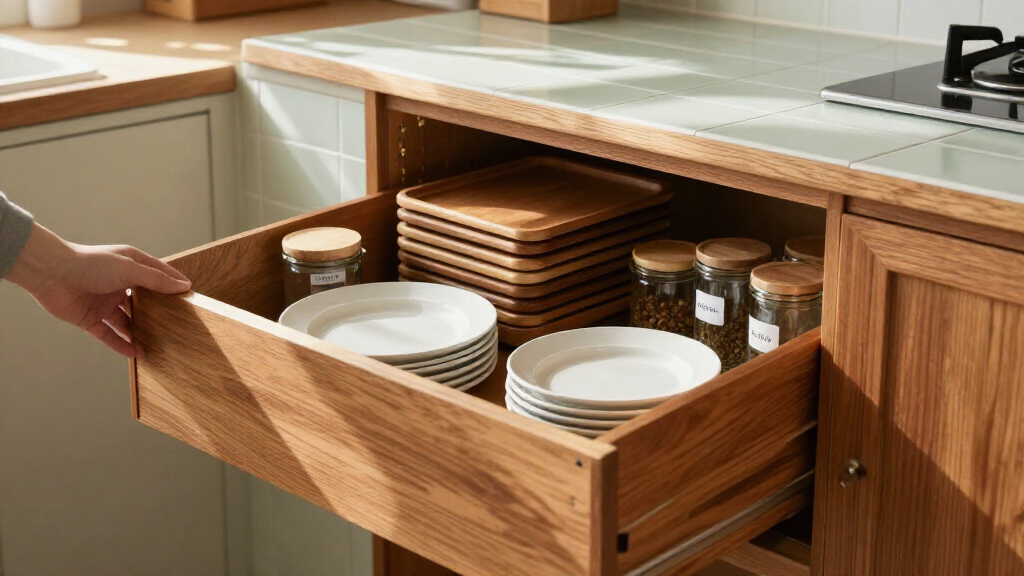
Two further lessons concern containers and cooking routines. The report says storage should suit what is being kept: Kloeden describes using paulownia wood boxes for dried goods and tea, while noting that transparent plastic containers make it easier to see their contents. For ingredients used repeatedly during cooking, she recommends choosing vessels with lids that are easy to handle, rather than decanting food solely to create a matching display.
The final lessons are to select cookware that can move from cooking to serving and to be selective about counter displays. Kloeden describes a vessel used for storing leftovers, reheating food and serving it, as well as a flameproof clay bowl that can go from burner to table. For countertop items, her proposed test is whether an object is used daily and has visual presence. Ogino describes the resulting look as “merihari,” or deliberate contrast.
Storage That Supports Daily Cooking
The advice matters because kitchen organization affects more than how cabinets look: it can shape how easily people find ingredients, prepare meals and clean up. Decluttering first offers a low-cost starting point, while assigning containers to specific contents can make everyday supplies easier to manage.
Using cookware for more than one stage of a meal may also reduce transfers between dishes and the amount of washing up, according to Kloeden. The report does not quantify those effects, so they are practical design arguments rather than measured results. Its broader point is that storage should serve a routine, not create extra work or crowd the counter.
Japanese wooden storage boxes for dried goods
As an affiliate, we earn on qualifying purchases.
As an affiliate, we earn on qualifying purchases.
The Five Practices in Brief
The Livingetc report frames these ideas as lessons to borrow from Japanese kitchens, rather than rules that every Japanese household follows. Its five practices are to edit possessions before buying organizers, select containers according to their job, keep frequently used cooking items easy to reach, choose cookware that can double as serveware, and leave out only a limited set of useful and visually considered objects.
Kloeden is identified in the source as the founder of a London architecture and interior design studio that incorporates Japanese aesthetics. Ogino is identified as an executive vice president of Nakagawa, a Japanese home-goods company founded in 1716. Their comments offer design perspectives; the source does not cite a survey or research comparing kitchens across countries.
“Before you add storage, take one shelf and ask what each thing on it is for.”
— Yoko Kloeden, London-based interior designer, as quoted by Livingetc
airtight plastic food storage containers
As an affiliate, we earn on qualifying purchases.
As an affiliate, we earn on qualifying purchases.
Limits of the Storage Advice
The source presents expert design advice, not independently tested guidance. It does not establish that the practices are common to all Japanese kitchens, nor does it compare their results with other approaches. The report also gives no measurements for potential savings in space, time or money.
Some material-related statements, including Kloeden’s explanation of paulownia wood and humidity, are attributed to her in the article; the supplied source does not provide supporting studies or care instructions. Readers would need to check that a container is suitable for its intended food and use. The advice to use cookware for cooking and serving likewise depends on the particular vessel’s manufacturer instructions and safe handling.
As an affiliate, we earn on qualifying purchases.
Applying the Ideas at Home
The report offers no announced follow-up study or product test. For readers applying its recommendations, the suggested first step is to clear and review one shelf, then decide which items genuinely need a container and what would make them easier to use. From there, households can organize frequently used ingredients and utensils around their cooking routines.
The next decisions are specific to each kitchen: whether existing cookware can safely serve more than one purpose, and which items merit a place on the counter. The source does not give a universal layout or prescribe a set of products; its approach is to judge storage by function, access and visual restraint.
small countertop organization jars
As an affiliate, we earn on qualifying purchases.
As an affiliate, we earn on qualifying purchases.
Key Questions
What are the five Japanese-inspired kitchen storage lessons?
Declutter before buying storage; match containers to their contents; keep frequently used items easy to reach; choose cookware that can also serve food; and leave only selected, useful items on the counter.
Why does the report recommend decluttering before buying organizers?
Designer Yoko Kloeden says to check what is on a shelf and what purpose each item serves before adding storage. The report argues this can prevent organizers from taking up space for items a household may not need.
Should all food be transferred to matching jars?
No. Kloeden’s advice is to choose containers for their practical function, such as visibility or ease of opening, rather than decanting everything for a matching appearance.
What items does the report suggest leaving on the counter?
Kloeden’s test is whether an item is used daily and has visual presence. The report gives condiment jars and a utensil holder as examples, while suggesting branded packaging be stored out of sight.
Source: rss
Halloween Picks
halloween
As an affiliate, we earn on qualifying purchases.