TL;DR

Get tools and workshop supplies delivered free — and shop member deals
- Fast, free delivery on millions of items
- Access to Prime Big Deal Days deals on October 6–7
- Prime Video, Amazon Music and more included
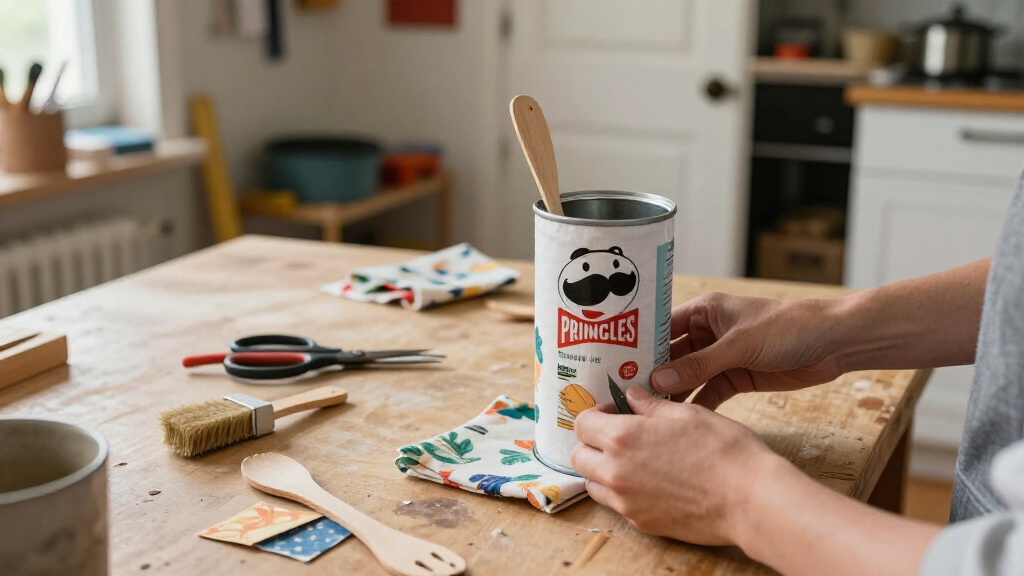
A DIY shown by Atix Home and reported by Hunker turns an empty Pringles can into a decorative container for small items such as hair ties and bobby pins. The project uses paint, a small knob, glue and an adhesive label; its cost savings depend on materials already on hand and local prices.
Atix Home’s DIY tutorial shows how to turn an empty Pringles can into a decorative storage canister, offering a reuse option for people who need a place for small household items. Hunker reported on the project, which uses paint, a knob and a label to adapt the packaging for countertop or bathroom storage.
The steps begin with cleaning the empty can to remove crumbs, then painting both the container and its lid in a color suited to the room. Hunker says the tutorial adds a second coat of texture by blotting paint around the can’s perimeter with a small sponge after the first coat dries.
Next, the tutorial uses a glue gun to attach a small knob to the lid and places a decorative adhesive label on the can’s side. The label can identify what is stored inside. Suggested uses include keeping bobby pins, rubber bands and other small items together, though the report does not describe testing the container for particular contents or conditions.
Atix Home’s finished example is styled as a bathroom canister with a wooden tray, towel and faux plant. Hunker suggests coordinating nearby decor, such as textiles, greenery, candles or small artwork, to make the repurposed container fit the surrounding space. The project requires a clean can, paint and a brush, a sponge, a small knob, a hot-glue gun and a decorative label; the report does not provide a measured total cost or project time.
A Reuse Option for Small-Item Storage
The idea gives an empty food container a second use instead of sending it directly to household waste, while addressing a familiar organizational problem: small objects can be difficult to find when scattered around a home. For readers who already have the basic supplies, the project may also avoid buying a dedicated canister. Hunker compares the DIY with retail storage options said to cost about $20 per canister or $50 to $60 for a set, but those figures are the article’s comparison, not a verified price survey.
The project’s savings are not guaranteed. Paint, a knob, labels and tools may need to be purchased, and the source does not calculate the total material cost. Its clearest appeal is customization: the can’s color, texture and label can be chosen to suit a room, while the original package is given a practical role.
small storage canisters for bathroom
As an affiliate, we earn on qualifying purchases.
As an affiliate, we earn on qualifying purchases.
How the Canister Tutorial Works
Hunker’s report identifies Atix Home on TikTok as the creator behind the example. The tutorial starts with an ordinary empty Pringles can and lid, then changes their appearance with paint and decorative details. The creator’s post caption, written in Spanish, describes making expensive-looking containers by recycling Pringles cans; translated, it presents the project as a way to make such storage at home.
The report mentions Rust-Oleum Painter’s Touch Latex Brush-On Paint as one possible paint, describing it as suitable for wood, plastic, metal and wicker and available in multiple shades. That product mention is an example, not a requirement of the tutorial. The source does not specify a particular paint formula for every can component, or provide guidance on whether a given paint will adhere to every container without preparation.
““You know those containers we all look for and that are very expensive? You can make them by recycling Pringles cans.””
— Atix Home, in the TikTok caption as translated by Hunker
DIY painted canisters for small items
As an affiliate, we earn on qualifying purchases.
As an affiliate, we earn on qualifying purchases.
Costs and Durability Are Unreported
The source does not state the tutorial’s publication date, the cost of its materials, how long the work takes, or how durable the finished canister is. It also does not report whether the painted container withstands regular handling, moisture or cleaning. Readers should treat the cited retail prices as Hunker’s comparison and check current local prices before assuming the DIY will cost less.
The report describes a decorative container but does not establish that it is suitable for food, liquids or other uses requiring a sealed or washable vessel. It also gives no specific safety instructions for using a hot-glue gun or paint. The exact product and label choices, as well as the final result, may vary with the materials used.
decorative storage containers for bobby pins
As an affiliate, we earn on qualifying purchases.
As an affiliate, we earn on qualifying purchases.
Choose Materials Before Starting
Anyone trying the project can begin by cleaning and drying an empty can, then choosing paint and decorative details for its intended location. The tutorial’s sequence is to paint the can and lid, let the first coat dry, add sponge-blotted texture if desired, attach a knob to the lid with a glue gun, and apply a label. Following the paint manufacturer’s instructions for application and drying is prudent, particularly when working indoors.
Atix Home’s example is a single DIY demonstration, and Hunker’s report does not announce a product launch or a broader rollout. The next practical step for readers is to compare the supplies they already own with the project list and decide whether the container suits the items they want to store. No additional tutorial update or performance testing is identified in the source.
As an affiliate, we earn on qualifying purchases.
Key Questions
What does the Pringles can DIY make?
It turns an empty Pringles can and its lid into a painted decorative container for small household items such as hair ties or bobby pins.
What materials does the project use?
The report lists a cleaning solution or damp cloth, paint and a brush, a small sponge, a glue gun, a small knob and a decorative adhesive label. The exact paint and decor can vary.
Will making the canister cost less than buying one?
It may if the maker already has supplies, but the project’s total cost is not reported. Hunker cites canisters around $20 each and sets priced at $50 to $60, without a current price survey or a full DIY cost calculation.
Is the finished canister waterproof or food-safe?
The source does not test or describe the canister as waterproof, washable or food-safe. The demonstrated use is decorative storage for small household items.
Source: rss
Halloween Picks
halloween
As an affiliate, we earn on qualifying purchases.