TL;DR

Get tools and workshop supplies delivered free — and shop member deals
- Fast, free delivery on millions of items
- Access to Prime Big Deal Days deals on October 6–7
- Prime Video, Amazon Music and more included
A Hunker report describes using breeze blocks as a decorative alternative to solid backyard fencing. Their openings can screen views while allowing air and light through, though the report does not provide construction guidance or compare costs.
Hunker has reported that homeowners can use concrete breeze blocks to screen parts of a yard without creating the solid barrier of a conventional fence. The blocks’ cutouts let air and light pass through, offering a design option for patios where airflow and some separation from neighbors are both priorities.
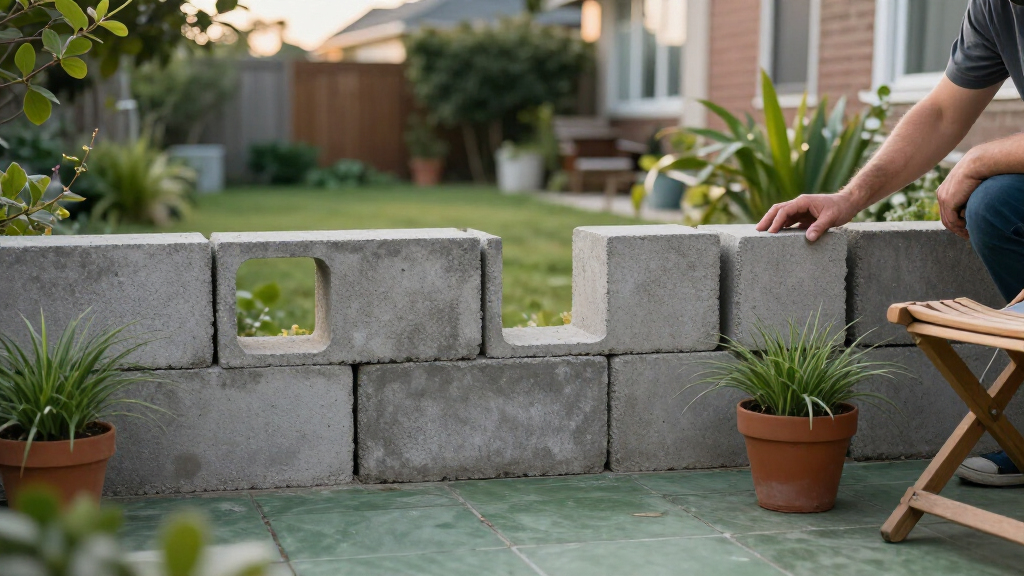
Breeze blocks are patterned concrete masonry units with openings through their faces. From a distance they can read as a wall, while the openings create partial visibility and permit air and light to pass. The degree of screening depends on the block design and how the units are arranged; the report does not quantify privacy or airflow.
For a patterned look, Hunker points readers toward masonry and landscape suppliers, which may carry blocks in different sizes and styles. It also describes standard 8-by-8-by-16-inch concrete blocks as a lower-cost alternative that can be arranged with deliberate gaps. The report advises checking that standard blocks have hollow cores before buying them for this use.
Design options include painting the blocks, combining them with planters or climbing vines, or placing them as an insert in a larger patio wall. They can also form a partial divider instead of enclosing the entire yard. These are examples in the report, not tested recommendations about a particular product, site or building method.
Privacy Without a Solid Barrier
Solid fences can reduce airflow across an outdoor space, while openings in breeze blocks offer a way to separate areas without fully closing them off. That may be useful on small patios or in warm locations where moving air is desirable, though the source offers no measured temperature or comfort comparisons.
The design also gives homeowners a choice between patterned masonry and less expensive standard blocks, with the appearance shaped by layout, paint and planting. Actual prices, availability and the amount of screening will vary, and the report does not provide a cost comparison or installation estimate.
concrete breeze blocks for yard privacy
As an affiliate, we earn on qualifying purchases.
As an affiliate, we earn on qualifying purchases.
A Mid-Century Masonry Feature
The report traces the broader idea of pierced outdoor screens to older practices in Asia, where pierced or woven screens were used to provide shade while allowing air through. It says concrete breeze blocks gained popularity in the United States in the 1930s alongside Art Deco design.
Hunker also notes that architect Frank Lloyd Wright experimented with patterned “textile blocks” in the 1920s. Breeze blocks became a prominent architectural feature in the 1950s and 1960s, particularly in hot regions, where their openings could support airflow. The report says they have also been used as windbreaks where outdoor spaces need more shelter.
““the cutouts in these concrete blocks allow both air and light to pass through””
— Hunker report
As an affiliate, we earn on qualifying purchases.
Site Details Still Matter
The report does not specify how high a breeze-block screen should be, how it should be anchored, or what foundations and mortar are appropriate. It also provides no guidance on local building codes, permits, structural loads or whether a particular wall design is suitable for a given site.
Privacy and airflow will depend on the block pattern, spacing, wall dimensions and viewing angles. The report does not present measured results, prices, product testing or a comparison of long-term maintenance needs. Readers would need to check product instructions and local requirements before building.
patterned concrete blocks for outdoor wall
As an affiliate, we earn on qualifying purchases.
As an affiliate, we earn on qualifying purchases.
Choosing Blocks and a Layout
The report’s suggested next step for homeowners is to compare patterned blocks from masonry or landscape suppliers with standard hollow-core blocks, then consider whether a full screen, partial divider or wall insert suits the yard. Paint and planting are presented as ways to change the visual effect.
Specific product availability and prices depend on the supplier. Before construction, homeowners should confirm that their intended design meets local rules and is suitable for the site; those details are not covered in the report.
hollow core concrete blocks for landscaping
As an affiliate, we earn on qualifying purchases.
As an affiliate, we earn on qualifying purchases.
Key Questions
What are breeze blocks?
Breeze blocks are concrete blocks with openings through their faces. The openings let air and light pass while the blocks create a partial visual screen.
Can standard concrete blocks be used?
Hunker describes using standard 8-by-8-by-16-inch blocks with intentional gaps as a lower-cost option. It advises checking that they have hollow cores before purchase.
Do breeze blocks provide the same privacy as a solid fence?
The report presents them as a privacy option, but their openings mean the degree of screening varies by pattern, spacing and viewpoint. It does not measure or guarantee privacy equivalent to a solid fence.
How can breeze blocks look less mid-century?
Hunker suggests painting them or pairing them with planters and climbing vines. It also describes using them as a partial divider or as an insert in a larger patio wall.
Source: rss
Halloween Picks
halloween
As an affiliate, we earn on qualifying purchases.